Nageshwar Jyotirlinga: The Shiv temple that is known as the Protector from Poison

RIYA SHARMA
HRDYAM - DISCOVER SACRED JOURNEYS, WISDOM & WELLNESS
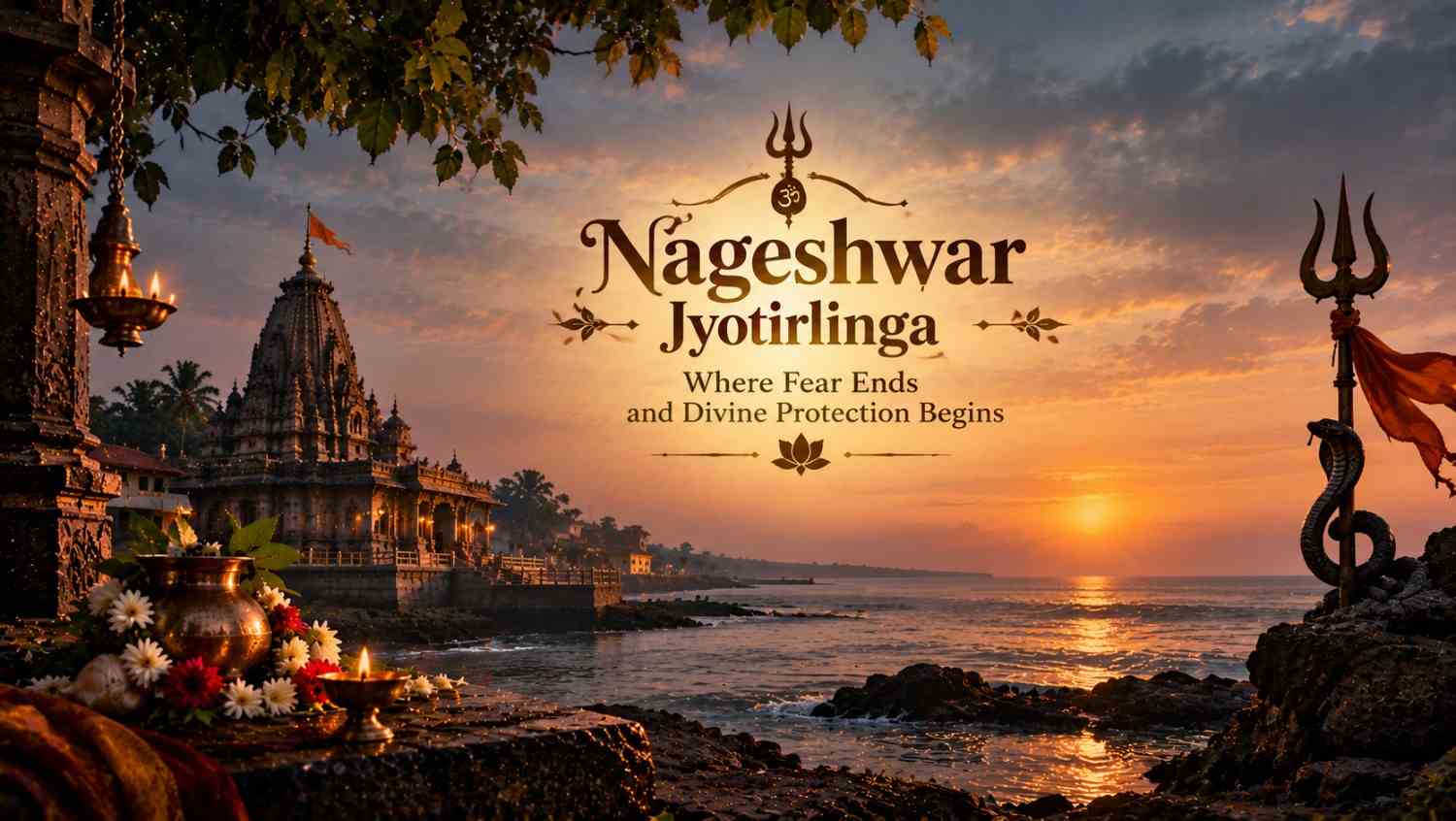
On the western coast of Gujarat, between Dwarka and Beyt Dwarka, there is an unusual Shiva temple. Unlike most other Jyotirlingas, the temple of Nageshwar is not surrounded by high mountains or hidden inside an ancient city. The temple of Nageshwar rises from the coast of Devbhumi Dwarka, and it is the presence of the Arabian Sea that adds a particular flavor to the pilgrimage.
In the center of the temple lies the Nageshwar Jyotirlinga that is considered to be the swayambhu form of Shiva. While the sanctum of the temple is below the ground level, there is a huge statue of Shiva seated on the ground outside the temple. Two contrasting forms of Shiva meet here: the Jyotirlinga in the quiet underground sanctum, and the towering seated statue in the open air outside.
However, there is something else that makes Nageshwar a very special place-the story of the devotee Supriya, the demon Daruka, and the intervention of Shiva.
| Nageshwar at a Glance | Details |
|---|---|
| Temple | Nageshwar Jyotirlinga |
| Location | Devbhumi Dwarka, Gujarat |
| Deity | Lord Shiva as Nageshwar |
| Jyotirlinga | One of the traditional 12 Jyotirlingas |
| Famous legend | Supriya and the demon Daruka |
| Distinctive feature | Underground sanctum |
| Shiva statue | Approx. 25 m / 80 ft |
| Nearby city | Dwarka |
| Distance from Dwarka railway station | About 16 to 18 km by road |
| Major festival | Maha Shivratri |
| Nearby pilgrimage sites | Dwarkadhish, Rukmini Devi, Beyt Dwarka, Gopi Talav |
| Best season | November-February |
Where is Nageshwar Jyotirlinga located?
Nageshwar Jyotirlinga is situated in Devbhumi, Dwarka district of Gujarat. The temple is 16 to 18 km from Dwarka railway station by road and is easy to visit on a pilgrimage to Dwarka.
Its location is important because the area is associated with Darukavana, which features in legends related to Nageshwar Jyotirlinga. Visitors will not find a forest today. Instead, they see an open coastal landscape with gardens, a pond, and the sea air of the Dwarka region.
And this is one of the most fascinating things about the pilgrimage site, since Nageshwar Jyotirlinga exists in the spiritual landscape of Dwarka along with the Vaishnava tradition.
Why is Nageshwar considered one of the twelve Jyotirlingas?
Jyotirlinga is a combination of two terms: jyoti, which means the light of the gods, and linga, which means the symbolic form of worship of Shiva. In this regard, Jyotirlinga is considered a sacred symbol of God Shiva and has twelve shrines located throughout India.
Thus, Nageshwar is considered a part of those twelve shrines, while Gujarat tourism defines it as one of the twelve swayambhu Jyotirlingas. However, there is the point that the sacredness of the temple is not associated with the current construction, but rather with the self-manifestation of Shiva in this place.
However, there is a specific point that should be noted. It is associated with the identification of the Darukavana, which is mentioned in the traditions. Thus, Nageshwar near Dwarka, Aundha Nagnath (in Maharashtra), and Jageshwar (in Uttarakhand) are identified as shrines related to Nageshwar. In addition, the tourism department of the state of Maharashtra itself acknowledges that the temple of Aundha Nagnath is a Jyotirlinga, while Gujarat identifies Nageshwar in Dwarka.
What is the story of Nageshwar Jyotirlinga?
The most popular story connected with Nageshwar is the story of Supriya and the demon Daruka. As described by Gujarat Tourism, it is a story of how the demon Daruka had kept a devotee of Shiva imprisoned, but she still continued to chant the name of Shiva despite being held captive.
The strength of the story lies in the fact that Supriya was not swayed by her physical surroundings. She was held captive, in danger, and seemingly with no way out. Nevertheless, she continued to chant Om Namah Shivaya. Shiva appeared and destroyed the enemies of his devotee, and appeared as the Jyotirlinga Nageshwar.
Thus, the significance of Nageshwar is more than just another temple devoted to the worship of serpents. It portrays Shiva as the divine protector who comes to his devotee's aid even in trying situations.
Why is Nageshwar associated with snakes and poison?
"Nageshwar" is considered a name that refers to the deity of the Nagas (or serpents).
In this context, the symbolism of the snake also has deep connections with Shiva, who is typically shown wearing the snake on his neck.
Symbolically, it also helps to explain the connection between the shrine and safety from poisoning or fear of snakes. According to India Tourism, the legend holds that the visit to the Nageshwar lingam protects a person from poisoning, snake bites, and other dangers.
The symbolism can also be interpreted more widely than this. In the Shaiva tradition, the poison does not mean just something physical; it can also refer to fear, destructiveness, and disturbance of harmony.
What is special about Nageshwar Temple architecture?
The uniqueness of the architecture starts even before a pilgrim approaches the shrine. Nageshwar Jyotirlinga is a sanctuary whose sanctum sanctorum is underground, and thus devotees need to move down to the shrine's sacred core. Government of Gujarat and Incredible India point out the temple's underground sanctum as its uniqueness.
The temple complex looks quite modern as far as its appearance is concerned, but it has quite an ancient religious background belonging to the Puranic period. Thus, Nageshwar differs from shrines that are interesting because of their present buildings.
Finally comes the most recognizable feature of the temple complex-a huge statue of sitting Shiva. Tour guides state that this statue is about 25 meters (or 80 feet) high.
Why does the giant Shiva statue matter to the Nageshwar experience?
This sculpture is not the actual Jyotirlinga. The Jyotirlinga continues to exist inside the sanctum sanctorum of the temple.
Rather, the sculpture of seated Shiva on the outside appears to serve as a kind of visual introduction to the shrine. From outside, where the environment is more open, people see Shiva sitting in meditation before entering the temple itself.
Thus, the pilgrimage takes place in an interesting way, that is, from the huge and visible statue of Shiva to the inner Jyotirlinga.
What is the significance of the Nageshwar Shiva Linga?
The Nageshwar Jyotirlinga is an incarnation of Shiva in his manifestation as a self-existent deity. As per India's official tourism website, the lingam is made of Dwarka Shila and has a unique shape associated with three-faced Rudraksha.

This makes the symbolism of the Naga particularly relevant to this shrine. In Indian religions, snakes are objects of both fear and admiration, representing danger, strength, transformation, and protection.
What makes this connection particularly fascinating in the case of Nageshwar is that, unlike many other symbols of danger, Shiva does not merely exist separately from this symbol but actually wears it around his neck.
How is Nageshwar connected with Dwarka?
The Nageshwar Temple is often included in the Dwarka pilgrim itinerary as well. The pilgrim will have the opportunity to visit the Shiva Temple, Dwarkadhish Temple, Rukmini Devi Temple, Beyt Dwarka, and other sacred sites in Gujarat.
Indeed, Gujarat Tourism includes Nageshwar in the Dwarka and Beyt Dwarka tour itinerary, which demonstrates the close connection of this temple with the geography of pilgrim destinations in the region.
This way, Nageshwar is very different from other Jyotirlingas, as one can have the experience of visiting not only one manifestation of Hindu sacred tradition, but others as well.
Which places can be visited near Nageshwar?
The nearby Gopi Talav Tirth is connected with the legends of Krishna and the Gopis. The other name of the place is due to the characteristic yellow-colored soil of Gopi Chandan.
One more place that should be visited along with Dwarka is Beyt Dwarka, and one more religious site is the Rukmini Devi Temple situated near Dwarka.
Visits to Gomti Ghat and Dwarkadhish Temple may help make Nageshwar one more stop on the way to Dwarka rather than an independent trip to the temple.
| Nearby Places | Approximate significance |
|---|---|
| Dwarkadhish Temple | Major Krishna/Vaishnava pilgrimage centre |
| Rukmini Devi Temple | Important temple dedicated to Rukmini |
| Beyt Dwarka | Island pilgrimage destination |
| Gopi Talav Tirth | Sacred site associated with Krishna and the Gopis |
| Gomti Ghat | Important sacred waterfront in Dwarka |
| Bhadkeshwar Mahadev | Shiva temple near the coast |
When is the best time to visit Nageshwar Jyotirlinga?
Nageshwar, according to Gujarat Tourism, is best visited from November to February due to the comparatively pleasant climate. Maha Shivratri is yet another significant time period, as the temple emerges as a key site for Shiva worship.
The seaside location further makes climate one of the crucial factors to consider. The western coastline of Gujarat gets quite warm during summer seasons, whereas the monsoon weather might influence Pilgrimage trips.
A calm visit to Nageshwar along with the exploration of Dwarka can be accomplished during the cooler season. During the festivals, on the other hand, pilgrim visits get more devotional and crowded.
What are the darshan timings at Nageshwar Jyotirlinga?
Darshan is generally available from early morning until about 9:00 PM, with morning and evening aarti. Sources differ on whether there is a midday break, and timings change on festival days, so please confirm with the Nageshwar temple trust before you travel.
For the devotees who plan to conduct their own puja at the temple, there is a booking process available through the website of the temple trust. It must be noted that booking a puja through the website means that the devotee will not conduct the puja himself/herself.
Nageshwar Darshan and ritual timings
| Nageshwar Darshan & Ritual Timings | Time |
|---|---|
| Morning Aarti | 5:30-6:00 AM |
| Darshan | 6:00 AM-9:00 PM |
| Morning/day Puja window | 6:30 AM-5:30 PM |
| Evening Aarti | 7:30-8:00 PM |
| Evening Puja window | 8:00-9:00 PM |
| Festival days | Timings may change |
What makes Nageshwar different from other Jyotirlingas?
Nageshwar’s greatest uniqueness is its unique combination of coastal geography, an underground cave, a snake symbol, and the tale of Supriya-Daruka.
Whereas some Jyotirlingas have mountains, rivers, and ancient city sites as their defining features, Nageshwar makes for a completely different experience: an open pilgrimage landscape by the seaside, where the large statue of Shiva is placed outdoors, and the Jyotirlinga is found underground.
The fact that Nageshwar Jyotirlinga has a connection with Dwarka allows for another dimension to be added to this regional trip. Pilgrims may go between the two important traditions within one small region.
Perhaps the best-known association with Nageshwar is not the worship of Shiva himself, but rather Shiva as a protector of devotion amidst fear.
What is the significance of Nageshwar in 2026?
Nageshwar remains an important religious destination in the tourism circuit of Dwarka in 2026. The current Gujarat Tourism itinerary guidebook includes Nageshwar along with Dwarkadhish and Beyt Dwarka, and other key destinations of Saurashtra.
At the national level, tourism of a religious nature continues to have an infrastructural focus. In February 2026, according to the Ministry of Tourism, PRASHAD schemes have been formulated taking into account several issues including carrying capacity, crowd management, sanitation, accessibility, movement of pedestrians, CCTV surveillance and availability of drinking water among other pilgrim facilities. (Source: PIB)
It is pertinent to understand the significance of this broader perspective in the context of destinations like Nageshwar because the modern pilgrimage process is no longer limited to reaching the sanctum.
How can you reach Nageshwar Jyotirlinga?
Nageshwar is easy to incorporate into a journey to Dwarka. Devbhumi Dwarka district authorities place it at around 16 kilometers from Dwarka railway station.
For the airport, visitors can use airports like Jamnagar or Porbandar and then take the road from there. The temple is also accessible via road connection from Dwarka to Nageshwar.
The simplest practical method would be for pilgrims to stay in Dwarka and travel to Nageshwar on a temple tour around Dwarka. This will also help visitors to incorporate the Jyotirlinga in combination with Beyt Dwarka, Rukmini Devi Temple, and others.
Why should Nageshwar be part of a Dwarka pilgrimage?

Nageshwar provides something unique beyond the mere act of checking off yet another Jyotirlinga site.
The legend of Nageshwar revolves around the worshipper who still invoked Shiva even after being placed in peril.
The architectural experience of the temple also helps to emphasize this aspect. The gigantic statue of Shiva adds an element of scale to the temple, while the underground sanctum allows focus to be placed on the Jyotirlinga.
However, the geographical context of the temple further emphasizes the importance of Nageshwar by combining elements like the Arabian Sea and Krishna traditions with India's greatest Shaiva pilgrimage site.
Frequently asked questions
Does Nageshwar Jyotirlinga Exist in Dwarka?
Yes. The Nageshwar Jyotirlinga discussed in this article exists in the Devbhumi Dwarka district in Gujarat, en route from Dwarka to Beyt Dwarka.
Why is Nageshwar known as Nageshwar?
The name of the shrine has significance related to Nagas snakes and Shiva's association with the Nagas.
Who was Supriya in the Nageshwar tale?
The person named Supriya in the traditional legend was devoted to Shiva and was imprisoned by the demon Daruka. Her prayers helped Shiva appear.
Is Nageshwar Jyotirlinga in an underground location?
Yes, the Jyotirlinga is situated in an underground chamber, which is one of the unique characteristics of the temple.
What is the height of the Shiva idol at Nageshwar?
The famous idol of Shiva in a seated posture is around 25 meters, or 80 feet, high.
What is the present Nageshwar darshan timing?
As per the official temple trust, the present darshan timing is from 6:00 AM to 9:00 PM, including a morning aarti time from 5:30-6:00 AM and an evening aarti time of 7:30-8:00 PM. Festival days’ timing may vary.
Is Nageshwar Jyotirlinga the only temple having a connection with the Nageshwar Jyotirlinga lineage?
No, there is competition among traditional lineages of Jyotirlingas. The Jyotirlinga located near Dwarka is promoted officially as a Jyotirlinga of Gujarat, whereas the Aundha Nagnath temple of Maharashtra is an official Jyotirlinga of Maharashtra. Jageshwar of Uttarakhand has another tradition related to Darukavana.
What are the other places that can be included in a Nageshwar visit?
The other places that can be combined with Nageshwar are Dwarkadhish Temple, Rukmini Devi Temple, Beyt Dwarka, Gopi Talav Tirth, and Gomti Ghat.
How can HRDYAM help you explore Nageshwar?
A visit to Nageshwar gains more meaning if the temple is seen as an element of the larger sacred geography of Dwarka. HRDYAM combines all these into one, helping travelers make sense of the sites they visit instead of just visiting one site after another.
With regard to Nageshwar, it involves linking the Jyotirlinga to the tale of Supriya, the coastal geography of Dwarka, and the overall Shaiva/Vaishnava traditions of Gujarat.
The content on our temple tourism website can even aid you in planning your entire tour to Dwarka, starting from Dwarkadhish and Rukmini Devi Temple up to Beyt Dwarka and other sites in the area.
In essence, it seeks to add meaning to the journey even before reaching the temple.
Conclusion
The temple at Nageshwar combines many elements of the sacred traditions of India: worship of Lord Shiva, the symbol of the snake, the story of a disciple who had to face danger, Darukavana, and the pilgrimage tradition of Dwarka.
The subterranean Jyotirlinga of this temple has a very personal connection to the spiritual world, while the gigantic statue of Lord Shiva sitting outside has made the temple very famous among contemporary pilgrims.
What matters most is that the story of Nageshwar has provided an important message that has been easy for people to comprehend-when fear takes over everything, devotion can come to the rescue. This is what makes Nageshwar unique, as here Shiva is not only a god of worship but the god of protection too.
Spiritual travel researcher, Vedic cultural writer, and contributing editor at HRDYAM.
You Might Also Like
Tags
More Articles
View all
Ramanathaswamy Jyotirlinga: where Rama worshipped Shiva
Rameswaram lies in the very south of India, where the land ends with an island surrounded by the sea. This place is the confluence of the stories of Lord Rama and Lord Shiva. It is one of the twelve h
Vaidyanath Jyotirlinga: Where Shiva became the Divine Healer
While there are several Shiva temples associated with mountains and rivers, others have a rich legend behind them. The legend of Vaidyanath Jyotirlinga, or Baba Baidyanath Dham, relates the temple to

Trimbakeshwar Jyotirlinga: Where Shiva and the Godavari meet
There are places where rivers start, and there are other places where the starting point of the river finds its significance in the holy memories of a civilisation. The Trimbakeshwar of Nashik in Maha