Mallikarjuna Jyotirlinga: Why is Srisailam so sacred to Shiva and Shakti

RIYA SHARMA
HRDYAM - DISCOVER SACRED JOURNEYS, WISDOM & WELLNESS
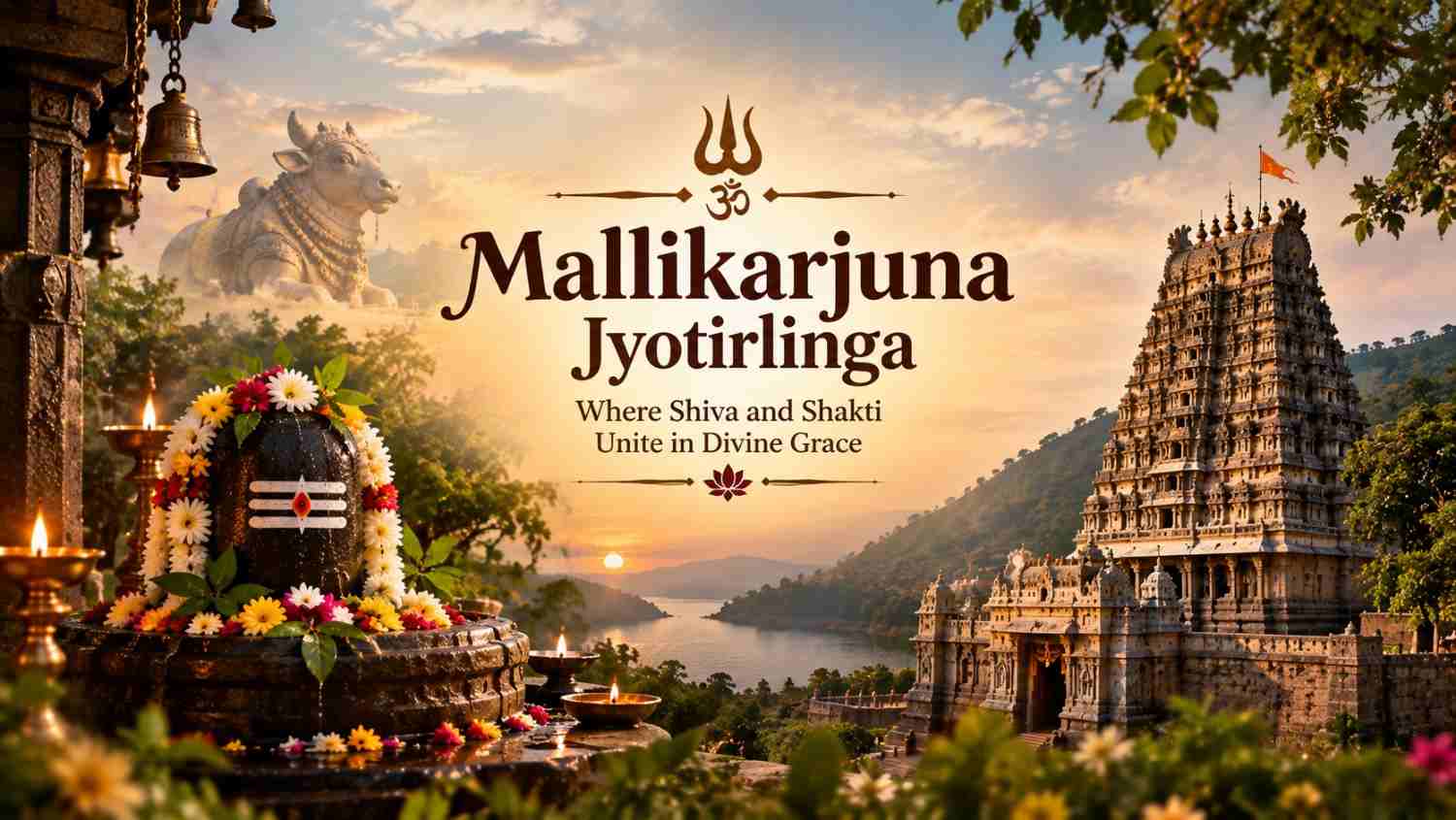
As you travel through the lush Nallamala Hills and through the twists and turns of the roads that lead you deeper and deeper into one of the most ancient sacred sites in southern India, Srisailam comes into sight.
Mallikarjuna Swamy, an incarnation of Lord Shiva, and Bhramaramba Devi, an incarnation of Goddess Parvati, are worshiped here. Thus, Srisailam is unique even among India's holy places because the same sacred site is believed to house a Jyotirlinga of Lord Shiva as well as a Shakti Peetha of the Goddess. Ministry of Tourism highlights this particular characteristic of Srisailam.
Since Mallikarjuna Jyotirlinga is located in the Nallamala Hills of Andhra Pradesh along the Krishna River, it cannot be simply regarded as just another of the 12 Jyotirlingas.
Where is Mallikarjuna Jyotirlinga located?
Mallikarjuna Jyotirlinga Temple is situated at Srisailam in the state of Andhra Pradesh, which is in the Nallamala hill range.
Landscape plays a significant role in the pilgrimage. The temple township is enclosed by hilly forest surroundings, while the river Krishna runs through the broader Srisailam region. Andhra Pradesh government says that Srisailam is a very ancient sacred site that is located in the northern portion of the Nallamala Hills.
As opposed to the urban temple city-based pilgrimage, Srisailam provides the traveler with a feeling of being in the broader sacred landscape.
Why is Mallikarjuna Jyotirlinga connected with lord Kartikeya?
One of the best-loved stories connected with Srisailam starts with a dispute in a family.
According to the legend, Shiva and Parvati wanted their sons Ganesha and Kartikeya to marry first. For this purpose, they suggested the following game: those who could circumnavigate the whole world and get back first were going to marry first.
Kartikeya got on his peacock and started his voyage. But Ganesha circumambulated only Shiva and Parvati and regarded them as representing the whole world. Thus, Ganesha did not have to make a long trip.
When Ganesha got married, Kartikeya got angry and left for Krauncha Mountain. Shiva and Parvati also followed him there. It is said that the presence of Shiva and Parvati there is related to the appearance of Mallikarjuna and Bhramaramba at Srisailam.
Thus, this story gives Srisailam a very personal character. Jyotirlinga in this legend is not represented only by cosmic images but also by the story of a family.
What does the name Mallikarjuna mean?
Mallikarjuna’s name is derived from a fusion of Mallika, representing Goddess Parvati, and Arjuna, representing Lord Shiva.
This implies that there is already an intrinsic symbolic relationship between the female and male gods embodied in the name itself.
At Srisailam, the same symbolism takes the form of architecture, where the main shrine is for Mallikarjuna Swamy and another shrine is for Bhramaramba Devi.
The Ministry of Tourism informs that Srisailam is one of the two Jyotirlingas and among the eighteen Maha Shakti Peethas, which makes Srisailam a doubly important pilgrimage center.
What makes Mallikarjuna Jyotirlinga different?
| Feature | What makes Mallikarjuna distinctive? |
|---|---|
| Jyotirlinga | Mallikarjuna Swamy |
| Location | Srisailam, Nallamala Hills, Andhra Pradesh |
| River | Krishna River |
| Shakti association | Bhramaramba Devi |
| Religious traditions | Shaivism and Shaktism |
| Jyotirlinga position | Traditionally listed as the second of the 12 Jyotirlingas |
| Shakti Peetha tradition | Traditionally counted among the 18 Maha Shakti Peethas |
| Sacred landscape | Nallamala forests, Krishna River and numerous associated shrines |
| Major festival | Maha Shivaratri Brahmotsavams |
Why is Bhramaramba Devi important at Srisailam?
In order to understand all of Srisailam, it is impossible to confine oneself to considering only Mallikarjuna.
As part of the very same sacred landscape, there is also the shrine of Bhramaramba Devi who, according to tradition, is considered to be a Maha Shakti Peetha. Thus, the temple brings together two different pilgrim traditions that people would have to travel to two different locations to visit.
The name of Bhramaramba can be connected with the incarnation of the Goddess in the guise of a divine bee (bhramara).
The presence of this female deity transforms the entire nature of the pilgrimage since Srisailam is not merely a Shiva temple with an additional shrine of the Goddess but is rather a combination of Mallikarjuna and Bhramaramba.
According to the documentation on the PRASHAD website, Srisailam is important to both Shaivism and Shaktism.
What can pilgrims discover beyond the main temple?

Srisailam's sacred landscape extends beyond the main temple complex.
Patala Ganga, the region of the Krishna River accessed by steps and ropeway, is one such pilgrimage site. Besides, Sikhareswaram, Sakshi Ganapati, Hatakeswaram and Paladhara Panchadara have always been part of the larger Srisailam pilgrimage circuit.
In addition, there are the caves of Akkamahadevi, which can be accessed by boat on the Krishna River, and the formation of the natural rocks, along with the involvement of the medieval mystic Akkamahadevi, make for an important religious site.
The Government of Andhra Pradesh recognizes these sites too as important pilgrim destinations near Srisailam.
Which places can you include in a Srisailam pilgrimage?
| Place | Why is it worth including? |
|---|---|
| Mallikarjuna Temple | Jyotirlinga shrine of Lord Shiva |
| Bhramaramba Devi Temple | Important Shakti shrine within the sacred complex |
| Patala Ganga | Sacred Krishna River pilgrimage site |
| Sikhareswaram | Hilltop shrine associated with Srisailam's sacred geography |
| Sakshi Ganapati | Traditional pilgrimage stop near Srisailam |
| Paladhara Panchadara | Sacred site associated with Adi Shankaracharya traditions |
| Hatakeswaram | Important shrine in the wider Srisailam landscape |
| Akkamahadevi Caves | Natural caves associated with the saint Akkamahadevi |
| Chenchu Lakshmi Tribal Museum | Introduces visitors to the region's tribal heritage |
What makes Srisailam's temple architecture worth seeing?
The structure of Mallikarjuna temple represents long-standing traditions of temple construction in South India.
The walls of the temple have intricate carvings of elephants, hunting scenes, and various incarnations of Shiva. The government of Andhra Pradesh suggests that the main construction of the temple took place in the 14th century, although the religious site is much older.
The complex is not monumental due to its size only. The architecture speaks volumes about religion, as pillars, sculptures, mandapas, and gateways make the act of walking around the temple a journey through religious art.
The landscape surrounding the complex changes the perception of the site. One does not view the temple as a separate building, but rather sees it as part of the Nallamala sacred landscape.
Why is Maha Shivaratri so important at Mallikarjuna?
There is no better example than the transformation that Srisailam undergoes during Maha Shivaratri.
This festival takes place in a unique way of Brahmotsavam, including worship and other related rituals such as the marriage of Mallikarjuna Swamy and Bhramaramba Devi.
During the month of February 2026, the festival was witnessed by a large gathering of pilgrims. According to media reports based on temple administration numbers, around 15 lakhs of pilgrims visited the temple during Brahmotsavams, while another three lakhs were expected to stay back in Srisailam for the night of Shivaratri.
Pagalankarana is one of the rituals that takes place. During this ritual, a white cloth is put on the sacred structure of the temple in a unique manner in darkness.
Which festivals are important at Mallikarjuna?
| Festival / Occasion | What happens |
|---|---|
| Maha Shivaratri Brahmotsavams | Major multi-day celebration with special worship and processions |
| Kalyanotsavam | Ceremonial marriage of Mallikarjuna Swamy and Bhramaramba Devi |
| Rathotsavam | Chariot procession associated with the festival |
| Ugadi | Telugu New Year celebrations at the temple |
| Karthika Masam | Major devotional period with increased pilgrim activity |
| Dasara / Navaratri | Important period for worship of Goddess Bhramaramba |
What changes at Srisailam in 2026?

The recent history of Srisailam is becoming more concerned with pilgrimage management.
The number of visitors to the temple was said to be 29,26,812 in March, April and May 2026, 10% higher than in the same period in 2025, according to temple administration officials. They attributed the increase in part to better services, transportation, and efforts to make darshan easier.
Perhaps even more interestingly, it was also announced in June 2026 by the temple administration that an AI-driven darshan management system will be developed, as well as a new queue complex. It is expected that the cost of the latter would be around ₹145 crore.
This is quite an interesting event in the modern history of pilgrimage tourism because now technology is used to manage rather than replace the religious experience.
This initiative was preceded by the PRASHAD-funded Srisailam Temple project. As reported by the Government of India, the cost of it amounted to ₹43.08 crore.
When is the best time to visit Mallikarjuna Jyotirlinga?
All will depend on your choice of pilgrimage.
If you wish to witness the power and vigor of Maha Shivaratri, visiting between February and March will be highly significant, but it is also among the busiest times.
In case of wishing to enjoy an undisturbed temple experience, moving around the complex may be less problematic outside major festival seasons. The rainy season and winter seasons are also different ways of experiencing the Nallamala terrain, but travelers should always confirm the prevailing weather conditions.
An important update for 2026 about Karthika Masam is that, according to the official website of Srisailam Devasthanam, the Karthika Masam season in 2026 will occur between 26th October and 23rd November, when the Sparsha Darshan will not take place on certain days of high pilgrim footfall.
How can you reach Mallikarjuna Jyotirlinga?
Srisailam is a mountain pilgrim site; therefore, the last stage via road is equally significant.
The Ministry of Tourism mentions that Kurnool Airport can be considered the nearest airport, being located at a distance of about 180 km, while Markapur Railway Station can be taken into account as a railway station that is 85 km away from Srisailam. The temple town of Srisailam has a bus stand.
Road travel is a viable option for a lot of people since Srisailam has road connections with the major cities of both Andhra Pradesh and Telangana.
How should you plan a Mallikarjuna pilgrimage?
| Travel Aspect | What Pilgrims Should Know |
|---|---|
| Main destination | Sri Bhramaramba Mallikarjuna Swamy Temple, Srisailam |
| State | Andhra Pradesh |
| Setting | Nallamala Hills |
| Nearest airport listed by the Ministry of Tourism | Kurnool, approximately 180 km |
| Convenient railway access | Markapur, approximately 85 km |
| Local transport | Buses, taxis and local pilgrimage transport |
| Major festival crowd | Maha Shivaratri |
| Nearby sacred sites | Patala Ganga, Sikhareswaram, Sakshi Ganapati and others |
| Nature & heritage | Nallamala landscape, Krishna River and Akkamahadevi Caves |
| Booking | Check the official Srisailam Devasthanam portal for seva, accommodation, and latest notices |
| Festival planning | Book accommodation and transport early during major festivals |
The official Srisailam Devasthanam website gives details about Seva booking, accommodation, Annadanam, and other pilgrimage facilities.
How can HRDYAM help plan a Mallikarjuna pilgrimage?
It is not necessary that a Srisailam trip should be only about visiting temples.
For a devotee, the trip could involve Mallikarjuna darshan, Bhramaramba Devi, Patala Ganga, holy places around the area, and the entire landscape of Nallamala Hills. Planning would be especially useful in case of families and senior citizens who would require transport services and breaks between locations.
HRDYAM's platform for temples and pilgrimages could be used to plan the holy places as a part of an overall spiritual journey.
The benefit in this sort of planning does not lie in convenience alone. With transport, accommodation, and temple visits planned, time is spared in actually enjoying Srisailam upon reaching there.
Conclusion
The narrative of Srisailam cannot be limited to a single god or a single myth.
Here is Mallikarjuna, which is the Jyotirlinga of Lord Shiva. Here is Bhramaramba, which is the powerful presence of Lord Shakti. Here is the story of Kartikeya and his parents. Here is the greenery of the Nallamala Hills and the river Krishna. Here are the ancient shrines and caves that have developed in relation to the main temple.
And here is the modern Srisailam, which takes care of millions of pilgrims, infrastructural growth, crowd management, and even artificial intelligence.
This is the reason why Mallikarjuna Jyotirlinga is considered to be a fascinating pilgrimage center amongst the 12 Jyotirlingas of India. It is both an ancient sacred site and a contemporary pilgrimage center, which is coping with the realities of the 21st century.
Spiritual travel researcher, Vedic cultural writer, and contributing editor at HRDYAM.
You Might Also Like
Tags
More Articles
View all
Kedarnath Jyotirlinga: Why is this Himalayan Shiva Temple so sacred?
There is one particular place on the way to Kedarnath where it seems like the scenery itself changes the pace of pilgrimage. Indeed, at Gaurikund, the road ends and the trek starts; the Mandakini Rive
Omkareshwar Jyotirlinga: Why is the Shiva Temple shaped by the Narmada?
Narmada meanders past an island which, according to tradition, takes the form of Om, the mystical sound. In the midst of this island lies Omkareshwar Jyotirlinga, and on the opposite bank is located t
Mahakaleshwar Jyotirlinga: Why is Ujjain known as the city of Mahakal?
Early morning, before dawn, while Ujjain sleeps, something strange happens inside the Mahakaleshwar Temple. The sacred lingam is roused, ceremonies begin, and the celebrated Bhasma Aarti gives the tem