Omkareshwar Jyotirlinga: Why is the Shiva Temple shaped by the Narmada?

RIYA SHARMA
HRDYAM - DISCOVER SACRED JOURNEYS, WISDOM & WELLNESS
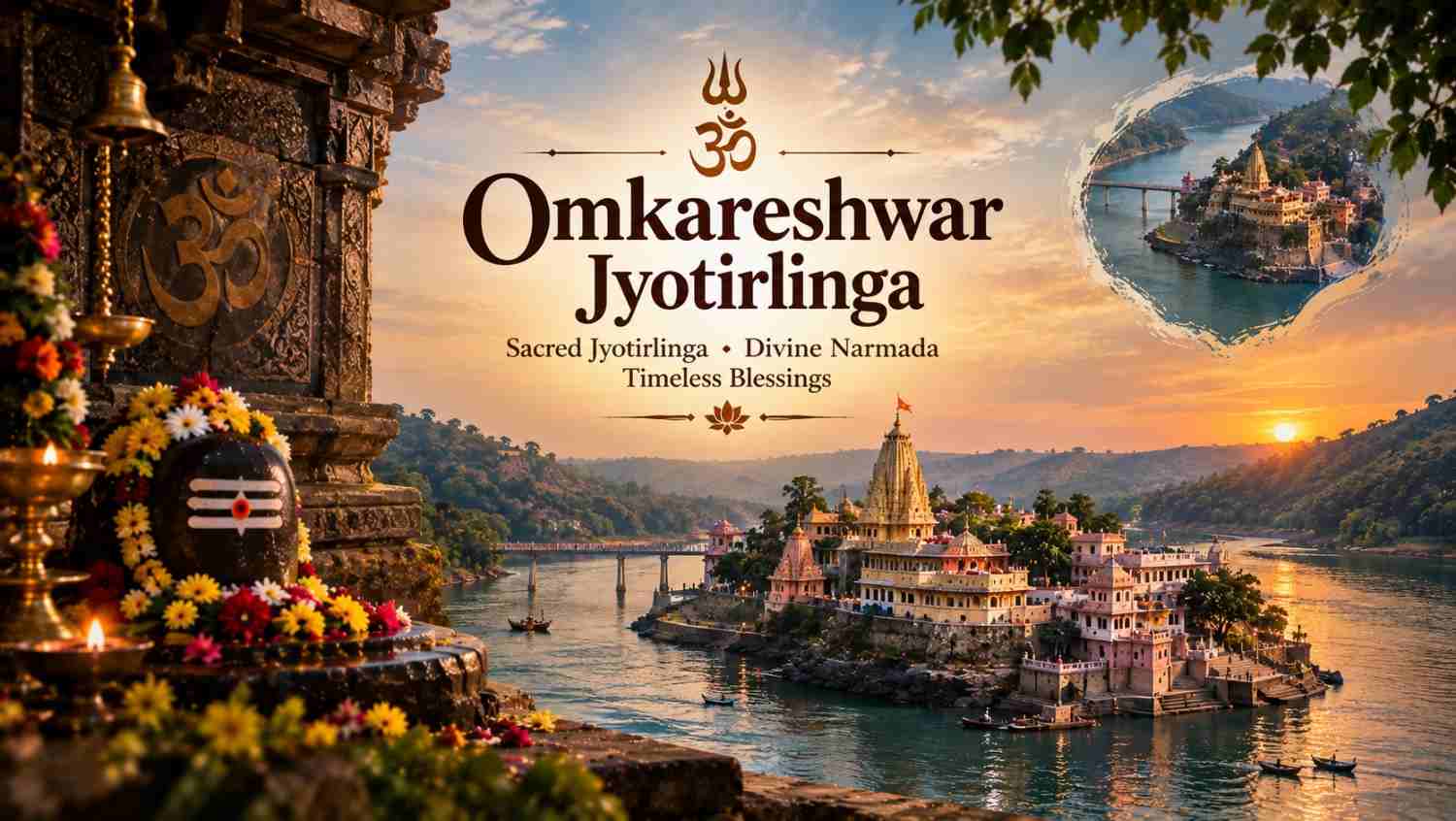
Narmada meanders past an island which, according to tradition, takes the form of Om, the mystical sound. In the midst of this island lies Omkareshwar Jyotirlinga, and on the opposite bank is located the age-old Mamleshwar Temple. These two temples, ghats, river, and the island form one of the most unique landscapes in Madhya Pradesh dedicated to the worship of Shiva.
The trip takes an even more fascinating turn once you realize that Omkareshwar is also intimately linked with Adi Shankara, Advaita Vedanta, and the newly conceptualized Ekatma Dham.
Where is the Omkareshwar Jyotirlinga located?
The Omkareshwar Jyotirlinga Temple is situated in the city of Mandhata, also referred to as Shivpuri, in the Khandwa district of Madhya Pradesh.
It is located on an island that results from the branching of the river Narmada into two streams. This island is commonly referred to as the Mandhata Island or Omkar Parvat and is associated with the form of the sacred Om symbol.
The geography plays a major part in understanding Omkareshwar. In Omkareshwar, the Narmada River is not just a river near the temple but forms the framework within which the sacred complex exists. The city is about 77-80 km away from Indore.
Why does the Narmada make Omkareshwar special?
This Jyotirlinga has an attribute that cannot be replicated elsewhere due to the Narmada.
It has been the custom for pilgrims to cross the river landscape to reach the temple, with its bridges, ghats, and narrow lanes on the island. The sounds of water, temple bells, and chanting become part of the pilgrimage experience.
In the Omkareshwar area, there are many other sacred places. Madhya Pradesh Tourism mentions 68 teerths and 108 Shiva lingas in the sacred geography.
What is the legend behind Omkareshwar Jyotirlinga?
There are some traditions related to Omkareshwar’s manifestation.
One such legend is about Vindhya Mountain, which did rigorous penance to Lord Shiva. This pleased Shiva, who appeared there at that time. Another tradition relates this holy place to Mandhata King, a forefather of the Ikshvaku dynasty, who did his penance here.
Even the official history of the temple holds a tradition, according to which the divine manifestation occurs in association with Omkareshwar as well as Mamleshwar. Both temples are thus very much related to each other.
This gives Omkareshwar more meanings: devotion, penance, the sacred sound Om, Shiva’s presence in the Narmada region.
Why are Omkareshwar and Mamleshwar both important?
The Omkareshwar Temple is located on the island itself, while the Mamleshwar Temple, which is also known historically as Amareshwar, is located on the south banks of the Narmada River. According to the district administration of Khandwa, these two temples enjoy equal importance, but according to the traditional Omkareshwar temple narrative, these are manifestations of the same divine form.
That is the reason pilgrims visit both temples together during the Omkareshwar pilgrimage instead of visiting Mamleshwar as a separate shrine.
In architectural terms, too, Mamleshwar enjoys great importance; there are inscriptions on its walls from 1063 AD.
How is Omkareshwar connected to Adi Shankaracharya?

Omkareshwar is linked to Adi Shankaracharya, the great philosopher who is supposed to have formulated the concepts of Advaita Vedanta. The Govinda Bhagavatpada Caves are believed to be the place where Shankara received his initiation from his guru, Govinda Bhagavatpada.
The cave now becomes an important link between the pilgrim town and philosophy, not just worship in the temple. This link has gained importance in recent times because of Ekatma Dham.
There is a 108-foot Statue of Oneness that depicts Adi Shankaracharya in his younger days as a 12-year-old at the Mandhata Hills.
The development of this project sees Omkareshwar as an important place where the doctrine of Advaita Vedanta can be studied and experienced. This is according to the project's official website, which is run by Madhya Pradesh, which sees this statue as a sign of universality and part of the Ekatma Dham project.
In March 2026, the government of Madhya Pradesh sent its message about the project and emphasized the connection between Omkareshwar and Shankaracharya and the importance of this place for the presentation of Advaita Vedanta philosophy.
Thus, Omkareshwar gets its second identity besides that of a Jyotirlinga.
What can you see beyond Omkareshwar Temple?
An effective itinerary of Omkareshwar will have provisions for sightseeing of the locations surrounding the primary temple. For tourists who have a penchant for architecture and history, Omkareshwar is especially worthwhile since the site isn’t dependent only on the primary Jyotirlinga.
Which places should you include in an Omkareshwar pilgrimage?
| Place | Why is it significant? |
|---|---|
| Omkareshwar Temple | Main Jyotirlinga shrine on Mandhata Island |
| Mamleshwar Temple | Ancient Shiva temple on the southern bank of the Narmada |
| Govinda Bhagavatpada Caves | Traditionally connected with Adi Shankaracharya and his guru |
| Statue of Oneness | 108-foot monument dedicated to Adi Shankaracharya |
| Siddhanath Temple | Medieval temple known for detailed stone carvings |
| Gauri Somnath Temple | Historic Shiva temple with a large stone lingam |
| Kedareshwar Temple | Historic Shiva shrine near Omkareshwar |
| Narmada Ghats | Important spaces for river worship and pilgrimage |
| Omkar Parikrama | Traditional sacred route around the island |
What is special about Omkareshwar Temple's architecture?
The temple's architecture is unique because the older temple and newer elements do not form a completely unified building. The official temple website states that the assembly hall has 60 pillars, and the temple complex is multi-tiered, with each tier representing a different aspect of Shiva.
An additional feature of the architecture of the temple is its setting. From different vantage points on the island, the temple, along with the Narmada River, ghats, and surrounding hills can be viewed at one go.
The nearby Siddhanath and Mamleshwar temples add more architecture to the pilgrimage site.
When are the major festivals celebrated at Omkareshwar?
However, there is a complete transformation in the atmosphere during the Shravan month owing to increased worship of Shiva in the whole country.
One such important festival is the Dola or Palki ceremony on Mondays at Omkareshwar. According to the official website of the temple, this festival involves the carrying of a golden palanquin of the three-headed image of Omkareshwar with prayers and music in the background.
Mahashivratri is another important festival, while Narmada Jayanti has special importance due to the association of the town with the river.
There is also a Shayan Aarti conducted daily in the temple since it is a tradition here that Lord Shiva stays at Omkareshwar after roaming through the three worlds.
Aarti timings at Omkareshwar are:
| Aarti / Ritual | Timing |
|---|---|
| Mangal Aarti & Naivedya Bhog | 4:30 AM-5:00 AM |
| Madhyanha Bhog | 12:20 PM-1:15 PM |
| Sayamkalin Shringar | 4:00 PM-4:15 PM |
| Shayan Shringar & Aarti | 9:30 PM-10:00 PM |
What changed at Omkareshwar in 2026?

Today's narrative of Omkareshwar, however, has become increasingly linked with the development of Ekatma Dham and the significance of spiritual tourism.
The 108-foot-high statue of Oneness is now a prominent feature of the Mandhata landscape, whereas the whole project aims at making a spiritual and philosophical destination based on the teachings of Adi Shankaracharya.
Then, there is also a significant story about tourism infrastructure development. The Ministry of Tourism's PRASHAD, the Development of Omkareshwar project of 2017-18 sanctioned for ₹43.93 crore, has been fully utilized. Works done under the project included improvements to the temple, construction of a darshan hall, waiting room, riverside footbridge, medical room, prasad counters, and development of Gau Ghat.
Another interesting infrastructure development in the area of Omkareshwar is the 600 MW Omkareshwar Floating Solar Park, which came into prominence in 2025 through the Ministry of New and Renewable Energy. It is a completely different perspective of the region, where renewable energy infrastructure coexists with one of India's most significant pilgrimage landscapes.
When is the best time to visit Omkareshwar Jyotirlinga?
Weather conditions are usually better from October to March, but Shravan and Mahashivratri offer more religious ambience, although there would be many more people around. October to March is considered a good time for visiting according to Madhya Pradesh Tourism.
When the objective of your visit is darshan, then it is necessary to find out the timing of the temple as per its official schedule. The temple schedule as of now includes activities starting from 4:30 in the morning, followed by darshan at various times of the day, and Shayan Aarti at 9:30 in the evening.
How can you reach Omkareshwar?
Both Jyotirlingas of Madhya Pradesh, Ujjain and Omkareshwar, can easily form part of the same pilgrimage journey for travelers.
How should you plan an Omkareshwar pilgrimage?
| Travel Aspect | Information |
|---|---|
| Main destination | Omkareshwar Jyotirlinga Temple |
| District | Khandwa, Madhya Pradesh |
| Nearest major airport | Indore, approximately 80-87 km |
| Rail access | Khandwa or Indore |
| Road access | Well connected with Indore and Khandwa |
| Main river | Narmada |
| Related temple | Mamleshwar Temple |
| Major pilgrimage periods | Shravan and Mahashivratri |
| Important nearby attraction | Statue of Oneness / Ekatma Dham |
| Temple schedule | Check the official Omkareshwar Temple portal before travel |
| Suggested combination | Ujjain-Omkareshwar Jyotirlinga Yatra |
| Planning tip | Allow time for both temples, river ghats, and Ekatma Dham |
What should first-time pilgrims know about Omkareshwar?
A first-time visit is made easier by keeping in mind that Omkareshwar is more than one temple.
Make sure to have ample time for Omkareshwar and Mamleshwar temples, visit Narmada ghats, and have enough time for the island's holy places. If you want to see Ekatma Dham and the Oneness statue, consider them as another leg in your itinerary rather than trying to see them while on darshan of the temple.
Another tip is not to make the whole journey coincide with festival days if that is not what you are looking for.
Frequently Asked Questions
Is Omkareshwar among the 12 Jyotirlingas?
Yes. Traditionally, Omkareshwar is considered the fourth Jyotirlinga among the 12 Jyotirlingas that follow. This is indicated on the official temple website.
Why does Omkareshwar take the shape of Om?
Mandhata Island is formed due to the river Narmada breaking into two branches. Its general shape resembles the holy word Om, which gives Omkareshwar its identity.
Are Omkareshwar and Mamleshwar the same Jyotirlingas?
Both the temples are regarded as highly related to each other in their local tradition. While the Khandwa district administration considers both temples as equal in importance, the traditional view of the Omkareshwar temple holds both in relation to the same manifestation of Shiva.
What significance does Omkareshwar hold in Adi Shankara’s life?
The caves in Omkareshwar known as Govinda Bhagavatpada Caves are said to be the place where the young Adi Shankaracharya met his guru Govinda Bhagavatpada. The recent initiative called Ekatma Dham makes use of this philosophical association.
What is the Statue of Oneness?
It is the 108-foot-high statue of Adi Shankaracharya on Mandhata Hills, showing Adi Shankaracharya as a 12-year-old. This is part of the Ekatma Dham project that aims at Adi Shankaracharya’s philosophy of Advaita Vedanta.
When is the best time to visit Omkareshwar?
October to March is usually a comfortable period for tourism. Shravan and Mahashivratri are the two significant periods from a devotional point of view but are also times when there will be crowds. Always confirm your visit timing from the temple calendar.
How far is Omkareshwar from Indore?
It is roughly 77-87 kilometers from Indore, depending on the source used. Indore is the nearest big airport city.
How can HRDYAM help plan an Omkareshwar Pilgrimage?
This would make Omkareshwar an excellent option in a tour of Madhya Pradesh Jyotirlingas, especially since it can be clubbed with Mahakaleshwar of Ujjain.
HRDYAM currently includes Omkareshwar Jyotirlinga and Mahakaleshwar Jyotirlinga from Madhya Pradesh, as well as the Ujjain & Omkareshwar Jyotirlinga Tour Package.
For pilgrims visiting along with their families or senior members, a structured plan could also help with coordinating accommodation arrangements and visits to Mamleshwar, Ekatma Dham, and other nearby places.
The concept is quite simple-instead of visiting a quick trip to the temple, giving time to the river, island, philosophy, and nearby temples.
Conclusion
The identity of Omkareshwar lies in its uniqueness.
Shiva in his incarnation of Omkareshwar, the Narmada surrounding Mandhata Island, the auspicious Om form, the Mamleshwar temple closely associated with it, stories of Vindhya and Mandhata, and even Adi Shankaracharya's philosophical legacy contribute to Omkareshwar's identity.
On top of it, the modern Omkareshwar features the Statue of Oneness, enhanced pilgrimage facilities, and an evolving spiritual-tourism network.
As a consequence, you end up having a Jyotirlinga where geography, devotion, and philosophy intersect in one and the same travel experience. It is not just about visiting the temple of Omkareshwar; you will visit the island formed by the river, explore the pilgrimage landscape, and gradually understand the reasons why this part of the Narmada has been sacred for centuries.
Spiritual travel researcher, Vedic cultural writer, and contributing editor at HRDYAM.
You Might Also Like
Tags
More Articles
View all
Kedarnath Jyotirlinga: Why is this Himalayan Shiva Temple so sacred?
There is one particular place on the way to Kedarnath where it seems like the scenery itself changes the pace of pilgrimage. Indeed, at Gaurikund, the road ends and the trek starts; the Mandakini Rive

Mahakaleshwar Jyotirlinga: Why is Ujjain known as the city of Mahakal?
Early morning, before dawn, while Ujjain sleeps, something strange happens inside the Mahakaleshwar Temple. The sacred lingam is roused, ceremonies begin, and the celebrated Bhasma Aarti gives the tem

Mallikarjuna Jyotirlinga: Why is Srisailam so sacred to Shiva and Shakti
As you travel through the lush Nallamala Hills and through the twists and turns of the roads that lead you deeper and deeper into one of the most ancient sacred sites in southern India, Srisailam come