Kamakhya Temple: Why is this Shakti Peetha so powerful?

RIYA SHARMA
HRDYAM - DISCOVER SACRED JOURNEYS, WISDOM & WELLNESS
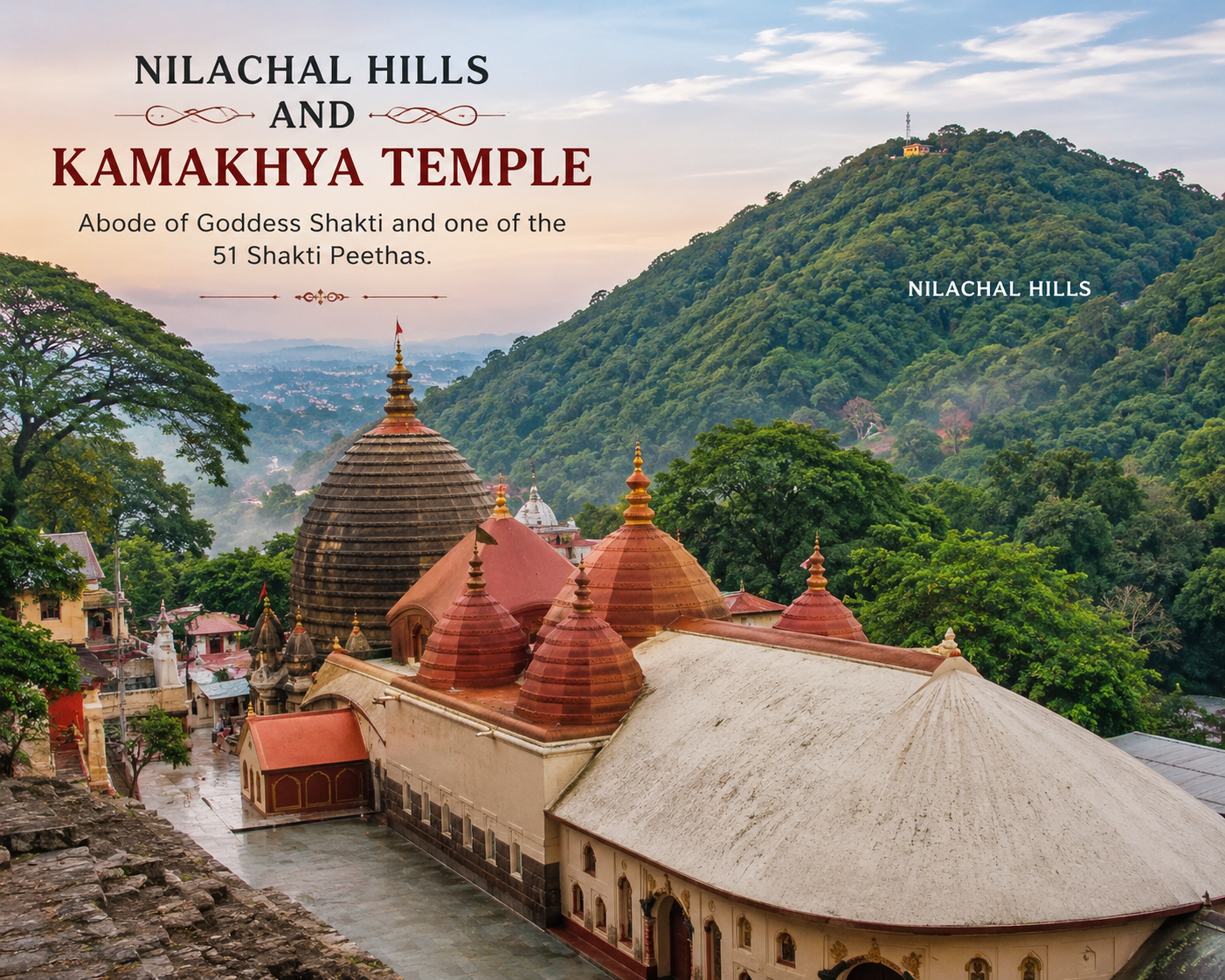
Kamakhya Temple is located on the Nilachal Hills overlooking Guwahati in Assam. There is no idol of the deity at this shrine, which is unique among the majority of major Hindu temples in India. Rather, the sacred space is defined by the presence of a naturally existing rock formation, which represents the yoni, and is placed in an underground chamber and continuously supplied with water from a natural spring.
Kamakhya is not only a temple dedicated to the goddess. This is a sacred landscape, where the cult of Shakti, fertility, creation, Tantrism, mythology, and Assamese cultural tradition have grown together for centuries.
Kamakhya is traditionally one of the 51 Shakti Peethas, and according to Assam Tourism, it is one of the most important Shakti shrines in India and a Tantric center.
Nilachal complex hosts a number of smaller temples dedicated to different gods and Mahavidyas.
It is particularly remarkable about Kamakhya that spirituality is not separated from nature. The most important religious festival celebrated there annually is Ambubachi Mela, which associates menstruation of the goddess with fertility of the earth.
Where is Kamakhya Temple, and what is it known for?
Kamakhya Temple is situated on Nilachal Hill in Guwahati, Assam, overlooking the Brahmaputra Valley. This is one of the most renowned Shakti temples of India and is a famous pilgrim spot in Northeast India.
There are four special features for which Kamakhya Temple is well known: it is a Shakti Peetha; the goddess is worshipped through a yoni-shaped stone instead of an idol; association with Shakta Tantra; and the annual Ambubachi Mela.
Kamakhya Temple is also a part of a much wider religious site. Several shrines devoted to the Dasa Mahavidyas and Shiva and Ganesha, as well as some sacred tanks, are spread all over Nilachal Hill. Thus, the Kamakhya Temples’ Complex provides a more spiritual experience than that gained by visiting only the main shrine.
| Aspect | Key Information |
|---|---|
| Location | Nilachal Hill, Guwahati, Assam |
| Religious Significance | One of the most important Shakti Peethas |
| Presiding Deity | Goddess Kamakhya |
| Form of Worship | Yoni-shaped stone rather than a conventional idol |
| Major Tradition | Shakta and Tantric worship |
| Major Festival | Ambubachi Mela |
| Temple Architecture | Nilachal-style architecture with a distinctive beehive-shaped dome |
| Best Time to Visit | June-July for Ambubachi; October-April for generally more comfortable travel |
The official “Incredible India” website also describes Kamakhya as one of the important Shakti temples of India with unique traditions, myths, and location at Nilachal Hill.
How did the story of Sati make Kamakhya a Shakti Peetha?
The spirituality of Kamakhya is inextricably linked to the mythological narrative of Sati and Shiva.
According to the legend, Sati, who was the daughter of King Daksha and wife of Shiva, went to her father's yajna although she had not been invited. She committed self-sacrifice in the fire when her father insulted Shiva. The heartbroken Shiva carried her dead body and started the terrible cosmic dance.
It is believed that to re-establish cosmic balance, the Sudarshana Chakra of Lord Vishnu was used to split the body into several pieces. It is also believed that these pieces fell in various places, forming what is called the Shakti Peethas.
It is the yoni of Sati which is considered to be the part fallen down at Kamakhya. The temple thus has special significance in terms of femininity, creativity, fertility, and the reproductive element of Shakti. This is how Assam Tourism describes the myth behind the sanctity of the site.
The myth thus does not just tell us about the geography of the place but also explains its special significance as far as the power of creation is concerned.
Why is the yoni worship at Kamakhya so significant?
Most prominent among all the characteristics of the Kamakhya temple is the worship of the Goddess Kamakhya herself without a proper anthropomorphic image of her inside the main shrine.
Rather, she is depicted as a stone yoni and is housed in the garbhagriha of the temple. There is also a perennial spring that keeps the sacred stone wet continuously. Such worship emphasizes the central place of fertility and creation as well as of feminine power.
It is also noteworthy that Shakti, here, is not merely seen as a female version of God but as a symbol of the creative energy that sustains life.
That is also why Kamakhya has traditionally had a special significance in rituals celebrating feminine power and fertility. It is most prominent during the Ambubachi Mela.
| Feature | What makes Kamakhya different? |
|---|---|
| Main sacred representation | Yoni-shaped stone |
| Location of sanctum | Underground, dark cave-like garbhagriha |
| Natural element | Perpetual spring water |
| Main theological association | Shakti, creation and fertility |
| Major annual celebration | Ambubachi Mela |
| Ritual tradition | Shakta and Tantric worship |
What makes Kamakhya one of India's major Tantra centres?
The reputation of Kamakhya temple is associated with the traditions of Tantra. Many streams of Shakta Tantra, as well as sadhus, ascetics, and spiritual seekers, have been visiting the temple complex throughout history.
Moreover, the Kamakhya Temples' Complex claims that a Kulacara Tantra Marga emerged at the temple complex, but it is not discussed publicly due to the nature of some of its aspects.
It is significant because many discussions about the religion simplify Tantra to strange rituals or practices. From the perspective of its broader religious context, Tantric traditions include certain approaches to the use of mantra, deity worship, ritual, meditation, and Shakti.
The Tantric identity of Kamakhya was formed during a long process of interaction between different traditions. In its historical representation, the complex is referred to as a pilgrimage destination for the followers of Hinduism, Buddhism, and Tantra, and for its syncretic religious culture.
One should, therefore, approach this topic with respect rather than considering Tantra a spectacle. Many aspects of its ritual practice are reserved for practitioners only.
How old is Kamakhya Temple, and who rebuilt it?

The history of Kamakhya is complicated, and it is essential to separate the antiquity of the sacred place from that of the current building.
The Kamakhya Temples' Complex has been mentioned in several medieval Tantric and religious texts, such as Kalikapurana and Yogini Tantra. The history of the Kamakhya Temples' Complex itself contains various opinions concerning the age of the earliest temple and describes some archaeological and radiocarbon data indicating considerable antiquity of the place.
The current temple has been connected with the reconstruction period of the Koch dynasty. King Bishwasingha has been linked with the previous reconstruction of the temple, and King Nara Narayana has started to rebuild it in the 16th century; the reconstruction of the temple was finished around 1565 AD, as can be traced from the history of Kamakhya.
The temple thrived in Ahom times, and the larger Nilachal complex became the complex of temples we know now.
| Period | Major Development |
|---|---|
| Ancient period | Development of the sacred site and goddess worship |
| Medieval period | Kamakhya emerges in major Tantric and religious texts |
| 16th century | Koch-period reconstruction |
| 17th–19th centuries | Expansion of the wider temple complex under Ahom patronage |
| Present day | Major Shakti pilgrimage and cultural destination |
What is special about Kamakhya's Nilachal architecture?
The architecture of the temple is easily recognizable. The temple's main spire takes on a beehive shape typical of Nilachal architecture, making it look like a symbol specifically associated with Assam.
The building itself represents an architectural fusion of the temple design and regional styles, and the entire complex includes shrines dedicated to various deities. Thus, the architecture of the temple can be said to represent more than one period in history as well as the development over time of the sacred place.
The temple's architectural style is particularly fascinating as it does not copy either Nagara or Dravida models that are commonly used in the classification of Indian temples.
For visitors who are passionate about architecture, the temple can be seen not only as a place of worship but also as an architectural legacy of Assam.
Which Mahavidyas can you discover around Kamakhya?
A pilgrimage to Kamakhya may expand beyond the core temple into the larger framework of Dasa Mahavidya traditions found on Nilachal Hill.
The ten Mahavidyas are conventionally seen as ten forms or emanations of the Divine Mother Goddess- Kali, Tara, Tripura Sundari, Bhuvaneshwari, Bhairavi, Chhinnamasta, Dhumavati, Bagalamukhi, Matangi, and Kamala.
The Kamakhya temple complex includes several subsidiary shrines, resulting in an interesting clustering of Shakta traditions in a single sacred site. The Assam Tourism Department itself emphasizes the temples connected with the Mahavidyas.
As such, the pilgrimage to Nilachal is different from going to just one temple since pilgrims have the chance to explore a broader spectrum of traditions related to goddesses in the same sacred hill.
Kamakhya temple complex itself states that there are various peethas and temples of Mahavidyas, Lord Shiva, Ganesha, Vishnu, and other gods situated on the hill.
What happens during Ambubachi Mela at Kamakhya?
Ambubachi Mela is the festival that has brought about the fame of Kamakhya in India as well as other parts of the world.
This festival celebrates the annual menstrual periods of Goddess Kamakhya and represents fertility, regeneration, and the generative powers of nature. In this festival, the temple undergoes a period of closure and seclusion before opening again for worshippers.
This festival is especially important since, in a culture in which menstruation has traditionally been restricted and associated with taboos, this cycle of nature for the divine feminine gets recognized as sacred.
According to Assam Tourism, Ambubachi is a four-day festival held in honor of the yearly menstrual cycles of the goddess.
Ambubachi Mela at a glance
| Aspect | What Happens |
|---|---|
| Central theme | Menstruation of Goddess Kamakhya |
| Symbolism | Fertility and regenerative power |
| Duration | Four-day ritual period |
| Temple | Enters ritual seclusion/closure |
| Pilgrimage | Large numbers of devotees and ascetics arrive |
| Reopening | Darshan resumes after the ritual period |
| Prasad traditions | Angodak and Angabastra |
What made Ambubachi Mela 2026 important for pilgrims?
The Ambubachi Mela 2026 yet again put Kamakhya into the heart of spiritual tourism in India. According to the traveller's guide issued by HRDYAM for 2026, the mela is a four-day festival that attracts mystics, ascetics, householders and spiritual aspirants to Guwahati during the monsoon period.
The 2026 description is significant even from the perspective of tourism in terms of the fact that such a huge festival necessitates not only religious planning but also accommodation, transport, sanitization, crowd flow planning, and information services provision.
It is significant in light of India's current strategy related to the development of its pilgrim-tourism sector. In recent years, the Ministry of Tourism of India has increasingly focused on sustainability and responsible management of pilgrimage destinations, including crowd flow, sanitization, walking infrastructure, waste management, drinking water, etc., under the PRASHAD framework.
In the case of Kamakhya, this issue is especially relevant due to the sacredness of Nilachal Hill.
When is the best time to visit Kamakhya Temple?
It all depends upon the type of experience you seek.
For instance, if it is the experience of Ambubachi Mela that you seek, then June becomes the most crucial month; however, this mela sees massive footfalls from people. If spirituality is what you seek, away from the chaos of crowds, then traveling outside the period of Ambubachi Mela could be more convenient.
As per Assam Tourism, June-July becomes an important period to visit Kamakhya Temple owing to Ambubachi Mela.
| Travel Goal | Suggested Period |
|---|---|
| Experience Ambubachi Mela | June |
| Explore the temple more comfortably | Outside major festival days |
| Explore Guwahati and nearby attractions | October-April can be more comfortable |
| Combine pilgrimage with Assam travel | Choose dates based on weather and festival calendar |
It is important for pilgrims to check the temple's arrangements before their visit, especially during festivities.
What should pilgrims know before visiting Kamakhya?
Kamakhya is not just a heritage site but an operational worship place. This difference is significant.
Visitors have to dress properly, observe temple rules, and not treat rituals as entertainment. It is also important to note that there may be restrictions concerning photography and entry. So official directions have to be followed.
The number of visitors becomes larger during Ambubachi Mela and other big celebrations. So it is necessary to make some arrangements in advance concerning accommodation and transport.
Finally, it is important to know that not all rituals in Tantra can be attended by everyone. Only the right knowledge will help one to participate in these activities successfully.
How does Kamakhya fit into Assam's wider spiritual landscape?

Kamakhya may prove to be the starting point instead of the end of your Assam pilgrimage journey.
There are also a few other temples of importance located within and around Guwahati. This includes such famous shrines as the Umananda Temple, located at Peacock Island, Ugratara Temple, Basistha Temple, and Navagraha Temple, etc.
It would allow you to take part in both forms of spiritual worship and to make a complete spiritual itinerary out of your trip.
Which 7 more temples can you explore on Nilachal Hill?
A visit to the Kamakhya Temple need not be restricted to the principal place of worship only. The Nilachal Hill itself is a vast landscape of sanctity, and there are temples for various aspects of Shakti and even Shiva on this hill. As per information available from the Assam Tourism website, there are various Mahavidya temples and also five temples of Shiva on this hill.
This gives special significance to the Nilachal Hill as far as pilgrimage is concerned. Rather than making Kamakhya Temple an individual destination, one can explore a series of shrines for various aspects of the Divine Feminine as well as Shaiva worship.
From among all the places of worship associated with Nilachal Hill, these seven temples deserve special mention:
| Temple | Associated Deity / Tradition | Why Is It Significant? |
|---|---|---|
| Bhubaneswari Temple | Goddess Bhuvaneshwari | Represents the Divine Mother as the ruler of the universe and offers panoramic views of the surrounding landscape |
| Tara Temple | Goddess Tara | Associated with a powerful form of Shakti and the Tantric tradition |
| Kali Temple | Goddess Kali | Represents fierce and transformative Shakti |
| Chinnamasta Temple | Goddess Chinnamasta | Associated with self-sacrifice, transformation, and powerful Tantric symbolism |
| Bagala Temple | Goddess Bagalamukhi | Traditionally associated with the power to restrain or overcome opposing forces |
| Bhairavi Temple | Goddess Bhairavi | Represents a fierce form of the Divine Feminine |
| Dhumavati Temple | Goddess Dhumavati | Associated with the Mahavidya tradition, renunciation, and deeper spiritual wisdom |
How does each shrine add to the Nilachal Pilgrimage?
Bhubaneswari Temple also has significant meaning in the Shakta tradition on Nilachal Hill. Goddess Bhuvaneshwari is known for being the sovereign deity of the universe; thus, this temple can be considered one of the elements of the theological concept that Shakti is the cosmic power that rules everything in existence.
Tara Temple also establishes the link between Nilachal Hill and one more important Mahavidya tradition, since Tara represents one of the very powerful forms of the Divine Mother and thus emphasizes the Tantric nature of the Kamakhya complex.
The Kali Temple adds another aspect of the Shakti cult to the hill. The images of goddess Kali represent time, change, and the destruction of ignorance, and thus her temple represents another manifestation of feminine energy compared to the symbolism of fertility that is predominant in the Kamakhya Temple.
Chinnamasta Temple is especially unique in the sense that this deity is represented by the most unusual and complex image in the Mahavidya tradition. The symbols that are related to Chinnamasta usually relate to sacrifice, vitality, and transformation. Thus, this temple can be better understood not through the sensationalism of Tantra but through its religious symbols.
The Bagala Temple is related to the Bagalamukhi, which symbolizes yet another aspect of Shakti. According to the traditional rituals, Bagalamukhi is the goddess who controls the hostile forces. Thus, she is highly significant for certain Shakta and Tantric practices.
In addition, the Bhairavi Temple worships Bhairavi-a ferocious aspect of the Divine Feminine. The presence of Bhairavi, Kamakhya, and other Mahavidyas proves that Nilachal Hill is a concentrated sacred space rather than just a pilgrimage site where there is a temple of only one deity.
Finally, there is the temple of the last Mahavidya in this list-Dhumavati. She is related to renunciation, detachment, and wisdom, which lies beyond the common notions of prosperity and beauty. She helps pilgrims to realize that the Shakti traditions include not only fertility and abundance but also impermanence, loneliness, and spirituality.
According to Assam Tourism information, on Nilachal Hill there are temples to Bhubaneswari, Kali, Tara, Chinnamasta, Bagala, Bhairavi, Dhoomavati, Matangi, and Kamala, thus forming the Dasamahavidya tradition centered around Kamakhya.
How to plan a Kamakhya Pilgrimage?
Kamakhya is fairly easy to reach, as it lies in Guwahati, one of Northeast India's prominent urban centers.
The two nearest air and rail stations are Lokpriya Gopinath Bordoloi International Airport and Guwahati Railway Station. From the city, travelers can then reach Nilachal Hill by road.
According to the official website of Incredible India, the two stations are the prominent means of accessing the site.
However, pilgrim tourism should include all factors such as traffic, festivals, and the duration of darshan.
| Planning Aspect | What Pilgrims Should Know |
|---|---|
| Nearest City | Guwahati |
| Location | Nilachal Hill |
| Airport | Lokpriya Gopinath Bordoloi International Airport, Guwahati |
| Railway | Guwahati Railway Station |
| Local Transport | Taxis, app-based cabs, and local transport are available in Guwahati |
| Accommodation | Guwahati offers budget hotels, mid-range stays, luxury hotels, and homestays |
| Best Time | October-April for generally pleasant travel; June-July for Ambubachi Mela |
| Temple Visit | Allow sufficient time for darshan and movement around the sacred complex |
| Nearby Sacred Sites | Bhubaneswari, Tara, Kali, Chinnamasta, Bagala and other Nilachal shrines |
| Special Puja | Pilgrims seeking specific puja arrangements should make enquiries in advance |
| Festival Planning | During Ambubachi Mela, expect significantly higher pilgrim movement and plan accommodation and local transport early |
How can HRDYAM help plan a Kamakhya pilgrimage?

More than just locating a hotel and traveling to Guwahati, planning the Kamakhya pilgrimage includes timing of the temple, arranging for darshan, local transportation and accommodation, and even visiting other shrines in the surrounding area.
The Kamakhya pilgrimages offered by HRDYAM include all the components in a well-curated package, which includes choices like temple darshan, accommodation, transport help, puja service, and family-friendly plans.
HRDYAM also offers a guide on Kamakhya Temple that covers the history, architecture, significance, and details about pilgrimages to this temple. It can be used as an internal source for readers wanting to understand the destination before planning a pilgrimage journey.
Readers wanting to explore the wider Shakti tradition can find information in the guide to 51 Shakti Peethas, also provided by HRDYAM.
Conclusion
What makes Kamakhya unique is the presence of many Indian spiritual traditions combined in one place.
Kamakhya is a Shakti Peetha, the centre of Shakta worship, a place of great importance for Tantrics as a pilgrim site, the representation of female creative energy, the historical temple of Assam and the site of an unusual religious festival of India.
Probably the most unique thing about Kamakhya is the manner in which a natural phenomenon is treated here as the element of the sacred world, not the object which needs to be hidden. This is illustrated through Ambubachi Mela.
The trip to Kamakhya gives the visitor more than darshan; it provides him/her with an opportunity to see how mythology, geography, architecture, Tantra, feminine spirituality, and tradition can remain connected throughout centuries.
This is why the trip to Nilachal Hill becomes more than a trip to another famous temple of India.
Spiritual travel researcher, Vedic cultural writer, and contributing editor at HRDYAM.
You Might Also Like
Tags
More Articles
View all
Kedarnath Jyotirlinga: Why is this Himalayan Shiva Temple so sacred?
There is one particular place on the way to Kedarnath where it seems like the scenery itself changes the pace of pilgrimage. Indeed, at Gaurikund, the road ends and the trek starts; the Mandakini Rive

Omkareshwar Jyotirlinga: Why is the Shiva Temple shaped by the Narmada?
Narmada meanders past an island which, according to tradition, takes the form of Om, the mystical sound. In the midst of this island lies Omkareshwar Jyotirlinga, and on the opposite bank is located t
Mahakaleshwar Jyotirlinga: Why is Ujjain known as the city of Mahakal?
Early morning, before dawn, while Ujjain sleeps, something strange happens inside the Mahakaleshwar Temple. The sacred lingam is roused, ceremonies begin, and the celebrated Bhasma Aarti gives the tem