Pashupatinath Temple, Nepal: history, significance, Shiva legend & travel guide

RIYA SHARMA
HRDYAM - DISCOVER SACRED JOURNEYS, WISDOM & WELLNESS
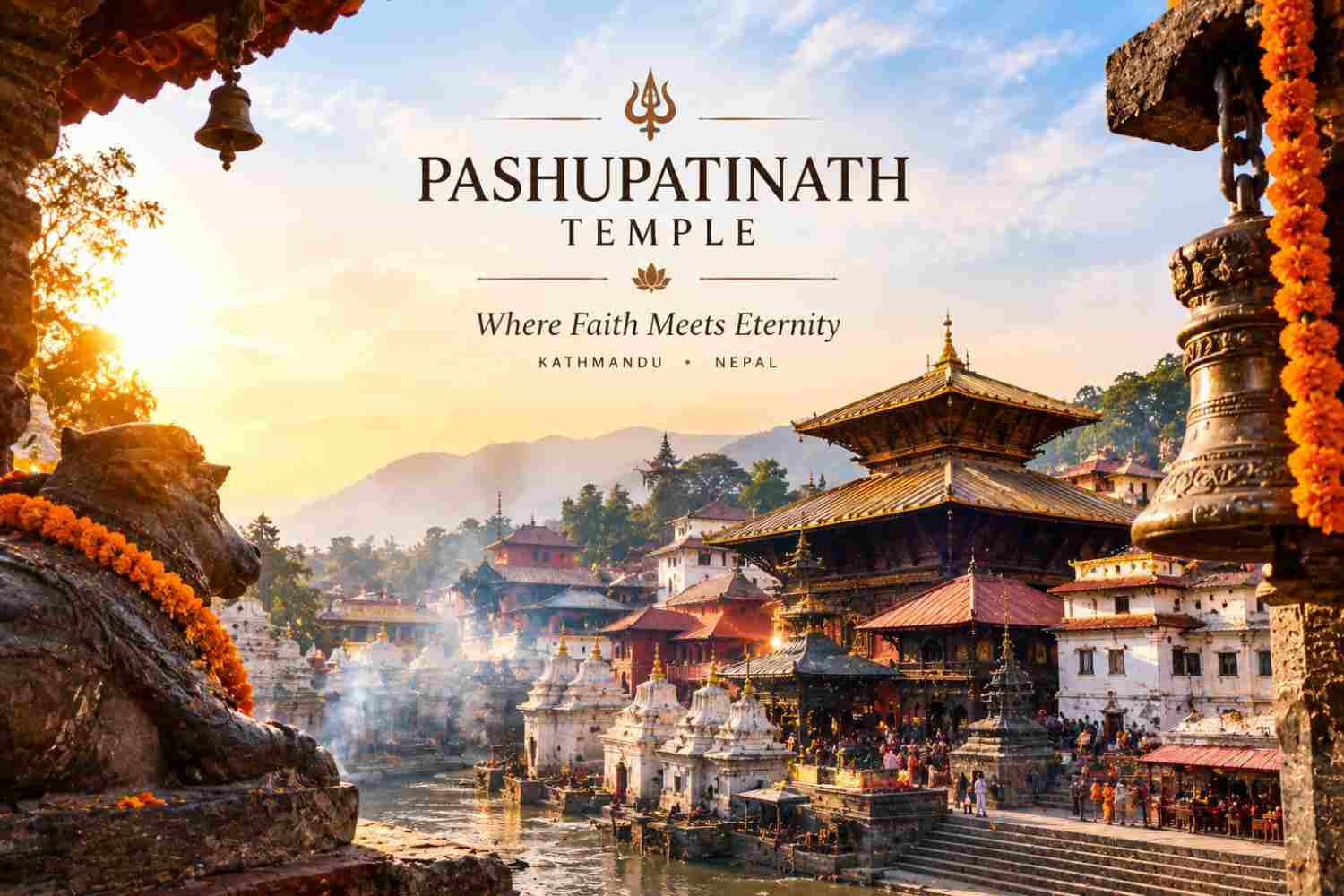
Even before the ringing of the bells and the gathering of pilgrims at the banks of Bagmati, Kathmandu wakes up to its new day.
Mist covers the river. Smoke wafts from the ghats. Priests in the temple complex get ready for their morning rituals, as the city beyond the golden roofs begins its journey into another day.
Pashupatinath is at the center of this ancient landscape-one of the most respected Shiva temples in Nepal. Located on the banks of the Bagmati River, the temple lies in the Kathmandu Valley World Heritage Site declared in 1979. The larger Pashupati area covers an extensive sacred landscape of temples, shrines, ashrams, ghats, forests, and monuments.
Pashupatinath is a sacred world where Shiva manifests as Pashupati-the Lord of beings-where the river holds prayers and ashes; where myths form part of the landscape; and where life, death, and liberation co-exist very closely.
What was sacred here before the temple rose?
Two stories form the history of Pashupatinath.
On the one hand, there is the history of kings, temples, and reconstructions. On the other hand, there is the religious story of the belief in the sanctity of the land long before someone erected any building in this spot.
According to oral and written traditions collected in the country's heritage documents, the land was discovered as a holy site due to the discovery of a Shiva linga in this place, with a legend about how the divine cow Kamadhenu poured her milk above the spot where it was placed. Pashupati was linked archaeologically and historically to the Licchhavi period, while the subsequent rulers reconstructed and enlarged it.
The modern main temple is traditionally linked to the Malla period, with the statement by the Pashupati Area Development Trust that the temple was constructed in 1697 CE during the reign of King Bhupalendra Malla.
Therefore, Pashupatinath is not a snapshot of history but the site of multiple reconstructions, while keeping the belief in its sanctity long before the modern architecture.
What stories is the history of Pashupatinath?
The immediate impression one gets as one approaches the main temple is unmistakably Nepalese.
The main shrine conforms to the pagoda style of architecture with two roofed stories atop a square base. The roofs are gold-plated, the doors are silver-coated, and there are detailed carvings on the wood and metal parts of the shrine. A gold finial tops the shrine, with the western entrance facing the great Nandi.
Thus, the architecture here goes beyond mere aesthetics. It provides an organized sacred place, with the square base of the shrine providing stability to the temple, the roofed stories pointing upward, and the four entrances directing the shrine toward the cardinal points.
However, the most striking aspect of the whole place could be the contents inside. What one sees when the silver doors open is the holy mukhalinga of Pashupatinath, which is the Shiva that is different from the aniconic linga found in most Hindu temples. This is where architecture stops, and theology begins.
What does Shiva see from every direction?
Standing before the concept of Pashupatinath’s linga, one comes across an interesting picture.
The primary linga of Shiva consists of four faces facing in four directions, and above them is a fifth face that faces upwards and cannot be seen, according to tradition.
This creates the five-faced Pashupati. According to the Pashupati Area Development Trust, the five-faced Pashupati consists of Tatpurusha, Aghora, Sadyojata, Vamadeva, and Ishana, wherein Ishana is the invisible face of Shiva that looks upwards.
These five faces represent different manifestations of the same divine being as follows:
| Face | Direction | Broad spiritual association |
|---|---|---|
| Sadyojata | West | Creation and emergence |
| Vamadeva | North | Preservation and beauty |
| Tatpurusha | East | Spiritual discipline and inner awareness |
| Aghora | South | Transformation and dissolution |
| Ishana | Above | Transcendence and divine grace |
Face number five is probably the most profound because it cannot be seen. It serves to remind the worshipper that any representation is only a portion of the Divine.
How can one Shiva hold five faces?
The five faces of Shiva are not five separate gods; they are five ways of looking at one reality.
Sadyojata is associated with creation-the birth of existence.
Vamadeva: brings out preservation, beauty, and the nurturing aspect of Shiva.
Tatpurusha: focuses on the self and spiritual consciousness.
Aghora: despite its threatening name, refers to transformation and destruction of that which must be dissolved. Destruction does not mean extinction according to Shaivism; it opens up possibilities of new beginnings.
Ishana: Shiva’s facing up, hidden face representing transcendence from all four directions and beyond the scope of normal sight.
Together, the five faces make a very fascinating concept-that of Shiva not being bound by any single direction, function, or form. Shiva is both inside and outside the world.
Why did Shiva once choose the form of a deer?
Why does this temple house such an oddly shaped four-faced linga?
The reason is contained in what is perhaps the most beautiful of all legends of the Kathmandu Valley.
As per this legend, Shiva and Parvati visited this valley and were delighted with the forests that lined the Bagmati. Shiva turned himself into a deer and disappeared into the forest at Mrigasthali.
The Gods finally found him and tried to drag him back. Shiva refused. During the ensuing struggle, one of the horns of the deer was broken into four pieces. According to this legend, these four pieces formed the four faces of the Pashupatinath linga.
This legend not only provides an explanation for the shape of the linga. This legend also explains the origin of the name Pashupati-God of the deer, God of all animals, God of all living beings.
Even today, Mrigasthali, the deer sanctuary on the other side of the Bagmati, makes sure that this legend remains a physical reality of the temple complex.
What does the Shivalinga hold beyond its form?

For the devotees, the Pashupatinath lingam is not just another ancient object of veneration. For the devotees, the Pashupatinath lingam is an embodiment of Shiva himself.
As one may notice, the lingam tradition points to Shiva’s nature that transcends form; but the faces help to materialize this transcendence and turn it into something approachable for the devotees. This is the reason why the Pashupatinath lingam is unique-here the abstract symbolism of the lingam meets the faces of Shiva.
Here we have a beautiful paradox: the lingam is referring beyond form; the faces give form to the Beyond Form.
The devotee thus is approaching that which he or she can see, being aware at the same time that which is being venerated is beyond this very visibility. This may be the reason why darshan is so important here.
What makes every corner of Pashupatinath sacred?
It is even more interesting when the temple itself ceases to be the only place people visit.
Pashupatinath Temple is surrounded by the sacred landscape, which covers both banks of Bagmati. While on the western bank there are the main temple and a significant number of other shrines, on the eastern bank one can find such holy places as Guhyeshwari, Gorakhnath and Mrigasthali. Ghats and sacred sites are located between them along the river.
According to the Nepal Tourism Board, the whole area of Pashupati occupies about 246 hectares and has temples, monuments, and ashrams.
Now it makes everything very different. One cannot say that a pilgrim is going to one temple anymore. He/she is going through the whole sacred landscape of Shiva.
| Essential Information | Details |
|---|---|
| Temple Name | Pashupatinath Temple |
| Location | Kathmandu, Nepal |
| Deity | Lord Shiva, worshipped as Pashupati-“Lord of Animals” |
| River | Sacred Bagmati River |
| Religious Tradition | Shaivism / Hinduism |
| Main Deity Form | Sacred Shiva Linga with four visible faces and a fifth, Ishana, associated with the upward direction |
| Architecture | Two-tiered pagoda-style temple with gilded roofs and silver-plated doors |
| Historical Period | The sacred site has ancient origins; the temple complex developed significantly during the Licchhavi period and was expanded by later rulers |
| Present Temple | Traditionally attributed to King Bhupalendra Malla, with the present structure dating to 1697 CE |
| UNESCO Status | Part of the Kathmandu Valley UNESCO World Heritage Site, inscribed in 1979 |
| Temple Complex | Includes numerous shrines, temples, monuments, ghats, and sacred spaces |
| Major Festivals | Maha Shivaratri, Teej, Bala Chaturdashi, and other Shaiva festivals |
| Sacred Ghats | Aryaghat and Bhasmeshwar Ghat along the Bagmati River |
| Nearby Sacred Site | Guhyeshwari Temple, an important Shakti tradition site |
| Priests | Bhatta priests traditionally serve as the principal ritual priests, supported by temple Bhandaris |
| Non-Hindu Access | The main temple is traditionally open only to Hindus; non-Hindu visitors can view the temple from designated areas across the Bagmati |
| Best Known For | Shiva worship, five-faced Pashupatinath linga, Shaiva traditions, Bagmati rituals, cremation ghats and its vast sacred landscape |
| Official Authority | Pashupati Area Development Trust (PADT) |
What does the Bagmati carry beyond its waters?
It runs alongside Pashupatinath, almost as a link connecting all the elements-the temple, the ghats, the rituals, the city, and the stories.
To the Hindus, Bagmati is a sacred river. This river represents cleansing, ritual bathing, and departure into the next life. In the case of Pashupatinath, the river gains even greater importance, as the same riverbank sees not only worship but also the burning of the dead bodies.
Every day at sunset, the Aarati of the Pashupati Bagmati is performed. In the process, priests perform the ritual using candles while reciting some chants from the other side of the river.
What makes this scene unique is the fact that the river is not just a part of the scenery. It is part of the ritual. Where life and death meet at ghats
Where do life and death meet at the ghats?
Continue to walk along the Bagmati River, and there is yet another aspect of the spirituality at Pashupatinath.
At Aryaghat and Bhasmeshwar Ghat, the cremation rituals happen along the holy river. According to the Pashupati Area Development Trust, Aryaghat is one of the most significant places for performing cremation rituals at the site, while Bhasmeshwar is yet another place for cremation rituals.
Here the concept of impermanence finds a physical manifestation. The temple stands for eternity. The fire of the cremation stands for the temporary nature of life. And the river flows between them.
There are not many pilgrimage sites where Hindu spirituality about the concepts of life, death, and moksha can be seen physically as clearly as at Pashupatinath.
why priests hold an important place in Pashupatinath?
One more distinctive aspect of Pashupatinath lies in its priesthood. The key Bhatta priests belong to South Indian Dravida Brahmins. In an official Pashupatinath Area Development Trust advertisement seeking recruitment of Bhatta priests, there are requirements of being a Shaiva Trilinga Dravida Brahmin and having profound knowledge of Sanskrit, Vedas-Vedanta, Dharmashastra, and Tantra.
There are also Bhandaris whose role consists of the performance of rituals and administrative activities at the temple. This setup implies one more intriguing thing related to the temple-even though Pashupatinath is thoroughly Nepali, the ritual world of the temple has also had connections with wider Hindu traditions of the whole subcontinent in the past.
Thus, the priests themselves become another piece of Pashupatinath's history of religious continuity beyond its borders.
What sacred stories on the river's edge?
On the other side of the river lies Guhyeshwari, an important Shakti center in Nepal and a divine complement of Pashupatinath. Mythology connecting the two sites revolves around the tale of Sati.
Gorakhnath Temple, a site connected with the yoga tradition known as Nath, and Mrigasthali, a place of Shiva’s deer tale, lie nearby. Other sites such as Vatsaleshwari and several Shiva temples complete the list.
Aryaghat, Bhasmeshwar, Ram Ghat and Surya Ghat-all important ghats along the river-make the Bagmati area an important part of the pilgrimage, not just the border surrounding the temple. Thus, the places listed above form a circuit of pilgrimage within a larger circuit.
Can an entire sacred landscape become a living museum?
It is not difficult to envision Pashupatinath as an amazing Shiva temple. However, take a tour through its premises, and you will come away with a completely different impression.
Stone sculptures, wooden sculptures, other temples, monasteries, ashrams, lingams, ghats, and layers of architecture from centuries make the site worthy of being called an open-air museum of religion, art, and culture, with various architectural styles and sanctuaries located throughout the site.
Therefore, the temple complex is of great importance not only to pilgrims but also to historians, architects, artists, and students of Indian civilization.
Each sculpture serves as one piece of memory. Each temple provides a new layer. The whole site is an open library.
What awakens when Shivratri reaches Pashupatinath?
The normally vast proportions of Pashupatinath seem almost incomprehensible in scope. Sadhus come, devotees form lines to have darshan, lamps light up the temple complex, and the temple itself becomes one of the major centers of Shaiva devotion.
In February 2026, the Associated Press noted that tens of thousands of devotees came to Pashupatinath for Shivaratri, including pilgrims from India and other places.
However, Shivaratri is only one manifestation of Pashupatinath's living tradition. Teej, Ekadashi, and weekly Bagmati Aarati also draw devotees to the holy site. Thus, the temple does not exist in the past. The past continues to unfold right here.
How does an ancient sanctuary speak to the present?
And it is also developing as an evolving institution.
The Pashupati Area Development Trust, in September 2026, held a unique ritual of Maharudri and Kshama Puja in Pashupatinath along with the recital and worship of Navchandi at Guhyeshwari, seeking peace, prosperity, and general well-being.
The temple's official information for the year 2026 includes details of other rituals that are going on, such as the morning prayers, Abhisheka, and evening Aarati.
All of this seems quite trivial compared to the ancient history of the temple. But this very fact holds the importance of its existence.
What journey begins after the pilgrimage ends?

What is perhaps the most amazing aspect of Pashupatinath is that every visitor experiences a different temple.
The architect might see the gilded roofs and sculpted struts.
The historian might trace Licchhavi and Malla influences.
The Shaiva devotee might kneel before the panchmukhi linga.
The pilgrim might meditate beside the Bagmati River at Aarati.
The visitor facing personal loss might find solace at the ghats.
And the traveller seeking solitude might find peace in the forest of Mrigasthali.
The physical place is the same. The pilgrimage experience is different. This is what distinguishes Pashupatinath from being just a place.
When the sacred landscape becomes the destination-HRDYAM
In the case of HRDYAM, the Pashupatinath pilgrimage destination provides precisely such an experience that cannot be deciphered through a mere list of sights to be seen.
An authentic pilgrimage experience at Pashupatinath can begin with Shiva’s five faces and end at the Bagmati Aarati, covering many more elements in between, such as the divine deer story, the Guhyeshwari temple, Mrigasthali, etc.
HRDYAM can provide a pilgrimage experience at Pashupatinath, which not only allows access to the destination but also helps visitors understand the significance of the experience in such a spiritual trip.
The objective is not merely to claim, “I was at Pashupatinath.”
The objective is to return understanding the reason behind Pashupatinath being a holy destination for centuries.
Conclusion
The bells gradually come to a halt.
There will be fewer throngs of people, fewer lights on the Bagmati. There will be the conclusion of the rituals of the priests and the river flowing toward the next valley.
However, nothing is ever really concluded at Pashupatinath. The five faces either observe or do not observe. The story of the deer persists in Mrigasthali. The ghats maintain their old rituals. The Bagmati carries the prayers, ashes, and reflections forward. And pilgrims continue coming to the same holy place with new questions in mind.
This could perhaps be the greatest teaching of Pashupatinath. Shiva as Pashupati is not only the deity of the temple; he is the deity of the whole cycle: creation and destruction, departure and return, life and death, form and the formless.
And all of these worlds are met together by the Bagmati.
Spiritual travel researcher, Vedic cultural writer, and contributing editor at HRDYAM.
You Might Also Like
Tags
More Articles
View all
Kedarnath Jyotirlinga: Why is this Himalayan Shiva Temple so sacred?
There is one particular place on the way to Kedarnath where it seems like the scenery itself changes the pace of pilgrimage. Indeed, at Gaurikund, the road ends and the trek starts; the Mandakini Rive

Omkareshwar Jyotirlinga: Why is the Shiva Temple shaped by the Narmada?
Narmada meanders past an island which, according to tradition, takes the form of Om, the mystical sound. In the midst of this island lies Omkareshwar Jyotirlinga, and on the opposite bank is located t

Mahakaleshwar Jyotirlinga: Why is Ujjain known as the city of Mahakal?
Early morning, before dawn, while Ujjain sleeps, something strange happens inside the Mahakaleshwar Temple. The sacred lingam is roused, ceremonies begin, and the celebrated Bhasma Aarti gives the tem