Dash Mahavidyas of Maa Shakti at Kamakhya

RIYA SHARMA
HRDYAM - DISCOVER SACRED JOURNEYS, WISDOM & WELLNESS
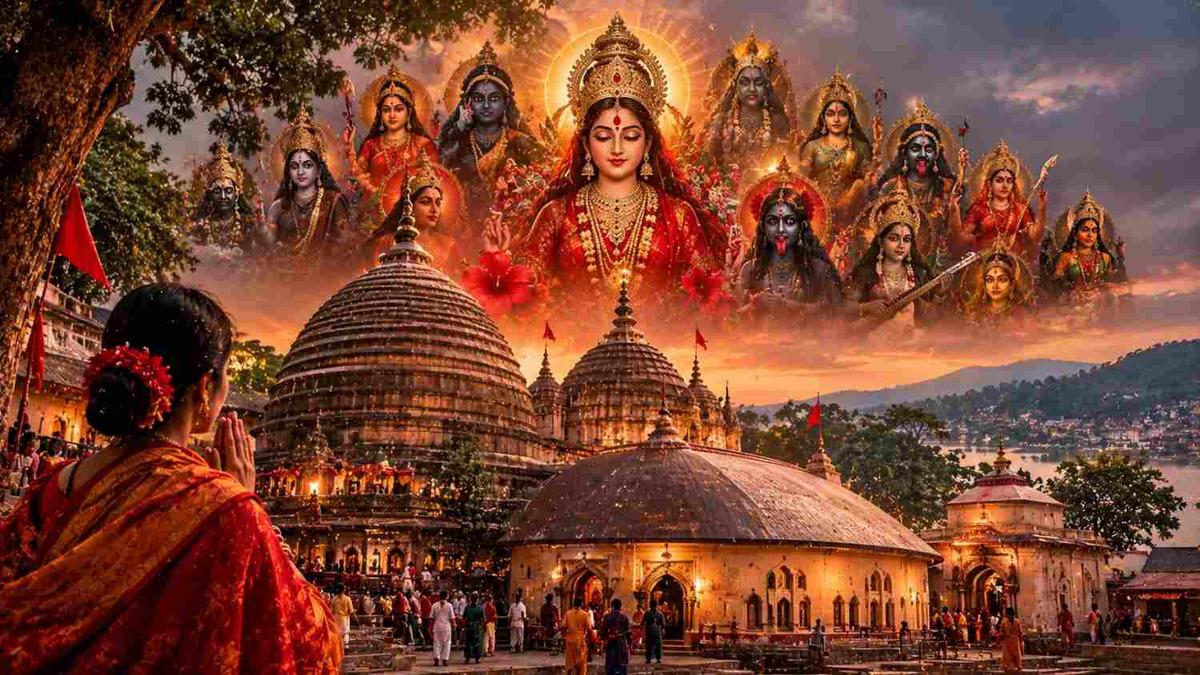
The Divine Mother has ten different forms of manifestation on the holy Nilachal Hill in Guwahati. These are known as the Dasha Mahavidya, and each represents a different aspect of Shakti. Some aspects include creation, knowledge, success, change, protection, and salvation.
Kamakhya Temple is housed on this sacred hill. In contrast to many other forms of worship of the Divine Mother in idol form, the Inner Sanctum of the Temple contains a natural fissure in the rock, representing the yoni. It is a symbol of creation and life. Surrounding the main temple on Nilachal Hill, there are many temples dedicated to the Mahavidyas. Therefore, this location is very important for Shakta and Tantric worship within India.
During your visit to Kamakhya, you may be interested in visiting other locations in Guwahati. There are many old shrines dedicated to Shiva, Vishnu, and various forms of the Divine Mother. Below is a brief guide to gain an overview of what each of the Dash Mahavidya represents, where they can be found, and some important temples within Guwahati.
What is the significance of Dasha Mahavidya at Kamakhyahya?
Dasha Mahavidya (ten great knowledge) are ten forms of the Divine Mother in the Shakta tradition. Each of these ten goddesses represents various elements of the universe and the spiritual path. These include: time, compassion, beauty, prosperity, speech, control, change, and transcendence.
There are many versions of the origin of these ten Mahavidyas. One popular story links them to the relationship between Sati and Lord Shiva. In this story, when Shiva tried to stop Sati from going to the yajna of her father Daksha, she emanated ten powerful forms from the ten directions. Therefore illustrating that the power of the Divine Mother could never be restricted. These ten divine forms became known as the Dasha Mahavidyas.
All ten Mahavidyas are worshipped at Nilachal Hill. The Kamakhya Devalaya states that the main deity is that of Kamakhya and that all of the Mahavidyas are distributed around the hill. Important to note is that although Kamakhya is the major deity at this site, she is worshipped in the form of Tripura Sundari/ Shodashi. However, the Matangi and Kamala peethas can also be found within the main temple. The remaining 7 Mahavidyas can be found in separate shrines within Nilachal Hill.
Kamakhya provides a vast holy landscape, where all different aspects of Shakti can be worshipped in a connected pilgrimage site.
| No. | Mahavidya | Commonly associated significance |
|---|---|---|
| 1 | Maa Kali | Time, transformation and liberation |
| 2 | Maa Tara | Protection, compassion and guidance |
| 3 | Maa Tripura Sundari / Shodashi | Divine beauty, harmony and consciousness |
| 4 | Maa Bhuvaneshwari | The universe and cosmic space |
| 5 | Maa Bhairavi | Discipline, courage and spiritual power |
| 6 | Maa Chhinnamasta | Sacrifice, life energy and self-transcendence |
| 7 | Maa Dhumavati | Impermanence, detachment and wisdom |
| 8 | Maa Bagalamukhi | Restraint, protection and control of harmful forces |
| 9 | Maa Matangi | Knowledge, speech, music and expression |
| 10 | Maa Kamala | Prosperity, abundance and auspiciousness |
What are the ten Mahavidyas, and what do they represent?

There are ten Mahavidyas. They are symbolic representations of various aspects of reality and cosmic power. The different meanings attributed to each Mahavidya vary according to different texts within Tantra, and also differ in different regions.
Maa Kali- the power of time and transformation
Maa Kali is known as the first of the Mahavidyas. She is a dark, fierce goddess associated with time to represent how everything that is created is in constant change. She destroys ignorance, egotism, and attachment to allow spiritual development.
In Kamakhya, there is a shrine dedicated to Mahakali, located on Nilachal Hill. Pilgrims visit this shrine to gain bravery, protection, and release from restrictive fears.
Maa Tara- The Goddess who guides across difficulties
Tara is known as a protective goddess. It is also believed that she has great mercy and can steer her followers out of difficult situations. Her name is said to mean ‘one who helps living beings to cross the ocean of worldly life’.
In Tantric traditions, Tara is very important and represents enlightening knowledge. Within the Mahavidya temple circuit, visiting the shrine dedicated to Tara on Nilachal Hill is an important part of the pilgrimage.
Maa Tripura Sundari or Shodashi- The beauty of the three worlds
Tripura Sundari (Shodashi) represents perfection, balance, and completeness. The name itself means that she embodies beauty in all three worlds. She is a symbol of the unification of spiritual knowledge and worldly existence.
The main deity at Kamakhya is Tripura Sundari (Shodashi), and therefore this Mahavidya holds a very important position within the holy sites on Nilachal Hill.
Maa Bhuvaneshwari- The Queen of the universe
This is a representation of the infinite universe. It is also considered as the universal mother.
The temple lies at the highest point on Nilachal Hill. Apart from being a religious destination, the view from here is amazing and allows you to get a broad view of Guwahati and the river Brahmaputra. Hence, visiting this place is an unforgettable experience during any visit to Kamakhya.
Maa Bhairavi- The power of discipline and spiritual courage
This deity symbolizes strong devotion, self-restraint, and the power to get rid of ignorance. This idol shows the need for determination, self-restraint, and courage to overcome inner difficulties.
This temple of Bhairavi is one of the Mahavidya temples located at Nilachal Hill. This represents the violent aspect of the Divine Mother.
Maa Chhinnamasta- The power of sacrifice and self-transcendence
This Mahavidya has a very dramatic appearance. She carries her decapitated head in her hands. Blood drips from her neck and nourishes her attendants. This image is symbolic of many things. It represents sacrifice, the cycles of life, life and death, and non-attachment.
The image of this deity goes against traditional notions of creation and destruction. The shrine for this form of Chhinnamasta, located on Nilachal Hill, is known as Guptakamakhya according to local temple traditions.
Maa Dhumavati- the wisdom of the unmanifest
Dhumavati symbolises an old hag and signifies smoke, nothingness, and hardship. As a result, she prompts us to reflect on the nature of impermanence, and also the wisdom we may gain through uncertainty.
Instead of representing the positive and beautiful aspects of life, Dhumavati represents the spiritual importance of negative, incomplete things. She encourages followers of the Mahavidya tradition to realise that divine wisdom can be gained from difficult experiences.
Maa Bagalamukhi- the power of restraint and protection
Maa Bagalamukhi has the power of stambhana. She is worshipped to protect from negative forces, increase clarity, and to stop negative actions and speech.
In the typical depictions of this deity, she is seen holding back her opponent. There is a large following of this deity at the shrine located on Nilachal Hill. This is a significant site for followers of the Tantric beliefs of Kamakhya.
Maa Matangi- the goddess of knowledge, speech, and art
Maa Matangi represents wisdom, music, learning, and eloquence. Sometimes she can be considered a Tantric aspect of Saraswati. She is a source of transcendental knowledge.
The peetha of Maa Matangi is inside the main temple at Kamakhya. It signifies the importance of knowledge, eloquence, and sophistication in Mahavidya.
Maa Kamala- the goddess of prosperity and abundance
She is also associated with fortune, fecundity, beauty, and auspiciousness. Within Tantrism, she is seen as a form of Lakshmi.
As with Matangi, Kamala’s representation of fortune encourages devotees to view it as a pious duty. Kamala’s peetha is also located within the main temple at Kamakhya.
Where are the ten Mahavidya shrines located at Kamakhya?

There are several Mahavidya shrines to be found in the temple complex. However, it is important to note that, although 10 Mahavidyas are worshipped at this location, they are not all in individual shrines inside the same courtyard.
Tripura Sundari/Shodashi is worshipped in the main temple. Matangi and Kamala are also associated with this temple. The remaining 7 Mahavidyas each have their own shrines in the hills surrounding the main temple.
Shrines can be visited by following paths/ staircases across the Hill. Depending on the path you take and what access and directions are available, it may change the order in which you visit them. It is best to check with the authorities and local guides to find out the best and most up-to-date way to navigate through the shrines.
Which other sacred places should you visit around Guwahati?
Other places of religious significance to visit in Guwahati include:
Umananda Temple (Shiva)
The temple of Lord Shiva can be found on Peacock Island in the Brahmaputra River. To reach the island, you will need to take a boat from the shoreline in Guwahati.
This temple has a connection with the story of Shiva and Kamadeva. As the island lies in the middle of the Brahmaputra, it is an unusual place for pilgrimage within Guwahati.
Ugratara Temple (Goddess)
Also located in Uzan Bazar, Ugratara Temple is a significant place of worship for a Goddess in Guwahati. It is associated with the Goddess Tara, and is very significant for Shakta traditions in Assam.
As a place of worship for a Goddess, visiting Ugratara as part of a larger trip to all significant Goddess temples in Guwahati could be beneficial. Due to its location, it can also easily be combined with other main sights in Guwahati.
Navagraha Temple (Nine Planets)
Found on Chitrachal Hill, the Navagraha Temple is dedicated to the nine planets in Hindu astrology. These are Surya, Chandra, Mangala, Budha, Brihaspati, Shukra, Shani, Rahu and Ketu.
The temple is a key place to visit for those wishing to pay respects to the planets. As it is located on a hill, visitors can enjoy beautiful views of the city.
Basistha Temple (Holy Hermitage of Sage Vashishtha)
This temple is found in the south-eastern part of Guwahati. It is traditionally associated with Sage Vashishtha. This temple sits near where 3 rivers meet, including Sandhya, Lalita, and Kanta.
With beautiful nature surrounding the temple, and hills and flowing water nearby, the temple provides a tranquil place to visit. It would be a nice place to visit if a visitor is looking for a more tranquil place of worship than the busier temples in the city.
Sukreswar Temple (Shiva)
Sitting on the banks of the Brahmaputra River, this temple is dedicated to Lord Shiva. As it is close to the riverbank, it is a meaningful place to visit in order to combine temple visiting with appreciation of the holy river.
This temple is also associated with Sukreswar Hill and the historical religious identity of Guwahati.
Dirgheswari Temple (Goddess)
Found in the North of Guwahati, this temple is dedicated to the Goddess Durga. It is well known for its connections with the Ahom period. Found in a hilly region with rocky landscapes, the area has traditional links to ancient places of worship.
This temple is a good chance to visit another significant place of worship for the Shaktas, outside of Nilachal Hill.
Hayagriva Madhava Temple
If time permits to leave Guwahati, then Hayagriva Madhava Temple in Hajo is a great place to add to your itinerary. The temple is dedicated to Lord Vishnu in his Hayagriva incarnation and is a significant place of worship for both Hindus and Buddhists.
Found on the Monikut Hill, this temple is found around 28km from Guwahati to the West.
How can you plan a Kamakhya and Guwahati temple circuit?
Mahavidya Temples can be visited at a leisurely pace. While visiting the main Kamakhya temple complex, plenty of time should be allocated for visiting the Mahavidya temples, which are located across Nilachal Hill.
On day two, visit the main temples of Ugratara, Navagraha and Umananda. Depending on how much time you have, you could also include Basistha and Dirgheswari. Hajo is best done as a separate trip.
Alternatively, if you want to take your time, you may wish to spend 2 or 3 days in Guwahati. This will allow you to visit the temples, take the ferries, explore the area, and perhaps allow some flexibility with the schedule based on temple opening times and crowd levels.
Suggested two-to-three-day Guwahati spiritual itinerary
| Day | Suggested places | Travel focus |
|---|---|---|
| Day 1 | Kamakhya Temple and the Mahavidya shrines on Nilachal Hill | Main darshan and exploration of the Dasha Mahavidya tradition |
| Day 2 | Ugratara Temple, Navagraha Temple, Umananda Temple and Sukreswar Temple | Shakti, planetary and Shaivite traditions within Guwahati |
| Day 3 | Basistha Temple, Dirgheswari Temple and Hayagriva Madhava Temple at Hajo | Explore sacred sites beyond the central city; Hajo can be planned as a separate excursion |
When is the best time to visit Kamakhya and Guwahati?
It is a good time to visit the temples and attractions in Guwahati between October and March.
June is an important month as there is a festival called Ambubachi Mela in Kamakhya. It represents the annual menstrual cycle of the Goddess, celebrating fertility and the reproductive power of women. During this time, the temple complex itself will be closed; however, it reopens after this festival. It attracts a large number of pilgrims, monks, and tourists.
Durga Pooja/Navaratri are also important festivals to worship the goddess. However, during these times, there may be large crowds. It is therefore important to consider where you stay, transport, and how long your darshan may take.
What should devotees know before visiting Kamakhya?
There are a number of considerations to make when visiting Kamakhya. Different rituals and access may happen at different temples in this complex.
- Time: Visiting Kamakhya and associated Mahavidya temples can take several hours.
- Appropriate Footwear: As you will be walking around Nilachal Hill, you will need to wear appropriate footwear. However, when entering temple areas, you will need to leave your footwear at designated areas.
- Follow Instructions: Different rules may apply regarding taking photographs, offering items, and visiting different temples. Follow instructions given by temple staff.
- Large Crowds: During major festivals such as Ambubachi Mela and Navaratri, there will be many people attending.
- Be Sensitive: Kamakhya is an important centre for Shakta and Tantric worship. Be respectful and sensitive to rituals and customs.
- Check Times: Please check the times of the temple and darshan in advance, as they can change. For up-to-date information, visit the official site of Maa Kamakhya Devalaya.
Frequently Asked Questions
What are the Dasha Mahavidyas of Kamakhya?
There are 10 Mahavidyas in total: Kali, Tara, Tripura Sundari (or Shodashi), Bhuvaneshwari, Bhairavi, Chhinnamasta, Dhumavati, Bagalamukhi, Matangi and Kamala. Each represents a different aspect of wisdom and Shakti.
Are there temples for all 10 Mahavidyas within the Nilachal Hill?
Yes; however, they are not all in separate temples. Tripura Sundari is the main deity of the Kamakhya Temple. There are only two other peethas for the Mahavidyas in the main temple: Matangi and Kamala.
Is Kamakhya one of the 51 Shakti Peethas?
Yes. It is considered one of the 51 Shakti Peethas. As per the Shakta tradition, it is said that the yoni of the Goddess Sati fell here, meaning it is highly representative of fertility, creation, and the Divine Feminine.
What is the connection to Tantra?
Kamakhya is one of the most important Tantric sites of Shaktism in India. Many aspects of the rituals performed, the location of the temple, and worship in this temple are connected to both Shakta and Tantric traditions. These traditions can vary and shouldn’t be stereotyped as often assumed.
How long do you need to spend visiting these temples?
It would be good to spend 2-3 days. One day for the Kamakhya Temple and Mahavidyas, one day for the major temples in Guwahati, and if you have time for other places outside of the city, perhaps Hajo.
When is the best time to visit?
A good time to visit is from October to March. However, if you visit in June, you will be able to attend the Ambubachi Mela. However, you will find very busy crowds and temporary alterations in the accessibility of the temple.
What other temples are worth visiting?
In Guwahati, Umananda, Ugratara, Navagraha, Basistha and Sukreswar are all important temples. For a longer trip, you may wish to also visit the Dirgheswari temple (North Guwahati) and the Hayagriva Madhava Temple in Hajo.
Discover a deeper spiritual journey with HRDYAM
A trip to Kamakhya lets you explore the concept of Shakti more deeply and appreciate Assam's spiritual culture. Visiting the Mahavidyas and other sacred sites within the Guwahati region will create a highly meaningful pilgrimage.
With HRDYAM, you can find meaningful spiritual journeys to sacred sites. Whether you're visiting a site or planning a pilgrimage, you can create a deeply meaningful journey tailored to you.
Take a look at our guided pilgrimage options and spiritual services to create a meaningful pilgrimage.
Conclusion
The Dasha Mahavidyas depict various aspects of the Divine Mother. As a result, Kamakhya has become a very special site of Shakta worship. Several important temples can also be found in Guwahati.
Visiting the shrine of Maa Kamakhya, visiting the shrines of the Mahavidyas, or exploring the ancient temples located along the River Brahmaputra means that visitors to Guwahati can learn more about traditional culture in this region of North Eastern India. The devotion, philosophy, myth, and beautiful scenery in Guwahati, in the presence of Maa Shakti, are very inspiring.
Spiritual travel researcher, Vedic cultural writer, and contributing editor at HRDYAM.
You Might Also Like
Tags
More Articles
View all
Char Sham Yatra for senior citizens: 2027 dates, registration, cost & safety guide
Many people wish to complete the ‘Char Dham’ pilgrimage in the Garhwal region of the Indian Himalayas. The pilgrimage includes visiting 4 holy sites: Yamunotri, Gangotri, Kedarnath, and Badrinath. How

Winter in Tawang: Best time to visit & experience snowfall
Winters are a treat in Tawang. With snow-capped mountains, frozen lakes, and serene, meditative monasteries, the whole place comes alive with the magic that is associated with the Eastern Himalayas. A
Simhastha Kumbh: The sacred Kumbh Tradition across four pilgrimage cities
Every few years, millions of devotees embark on a spiritual journey to some of India's most holy rivers. Sadhus visit with their Akhadas, and Temple towns prepare to welcome pilgrims. The incredible g