3 Shakti Peethas, 3 States, 1 Divine journey

RIYA SHARMA
HRDYAM - DISCOVER SACRED JOURNEYS, WISDOM & WELLNESS

The Northeast of India is full of sacred temples and rich traditions that will leave you with memories to last a lifetime. There are many places of worship in the region, including 3 of the Shakti Peethas. These include Kamakhya Temple (Assam), Nartiang Durga Temple (Meghalaya), and Tripura Sundari Temple (Tripura). All 3 temples have their own mythological stories, ritualistic practices, and cultural significance; however, they are all linked by their devotion to Goddess Shakti.
There are other reasons to visit these temples besides Darshan. The pilgrimage includes visiting the beautiful hill areas of Assam, rich heritage villages of Meghalaya, and the temple town of Udaipur (Tripura). This creates a unique spiritual circuit spanning 3 states in the Northeast.
Why are these three Shakti Peethas significant?
In Hindu mythology, the Shakti Pithas are holy sites linked to the body parts of Goddess Sati. When Lord Shiva was carrying Sati’s body, the areas where it is believed the body fell became key centres for worship of Shakti. Although there may be differences in traditions, these temples remain very important in Hindu faith.
| Temple | Traditional Shakti Peetha association | What makes it significant? |
|---|---|---|
| Kamakhya Temple | Yoni of Goddess Sati | Represents feminine creative energy and is associated with Tantric traditions |
| Nartiang Durga Temple | Left thigh of Goddess Sati | Connected with the heritage of the Jaintia Kingdom and worship of Goddess Jayanti |
| Tripura Sundari Temple | Right foot of Goddess Sati | Dedicated to Goddess Tripura Sundari and known for its distinctive temple architecture |
These 3 temples each represent a unique aspect of the Divine Mother. Kamakhya is linked to female creative energy, Nartiang is considered a sacred home of the Goddess Jayanti/Jainteshwari, whilst Tripura Sundari is worshipped in her powerful aspect. Due to the distance between them, this journey becomes interesting as we see how one spiritual tradition links 3 unique places and communities.
What makes Kamakhya Temple in Assam the starting point of this journey?

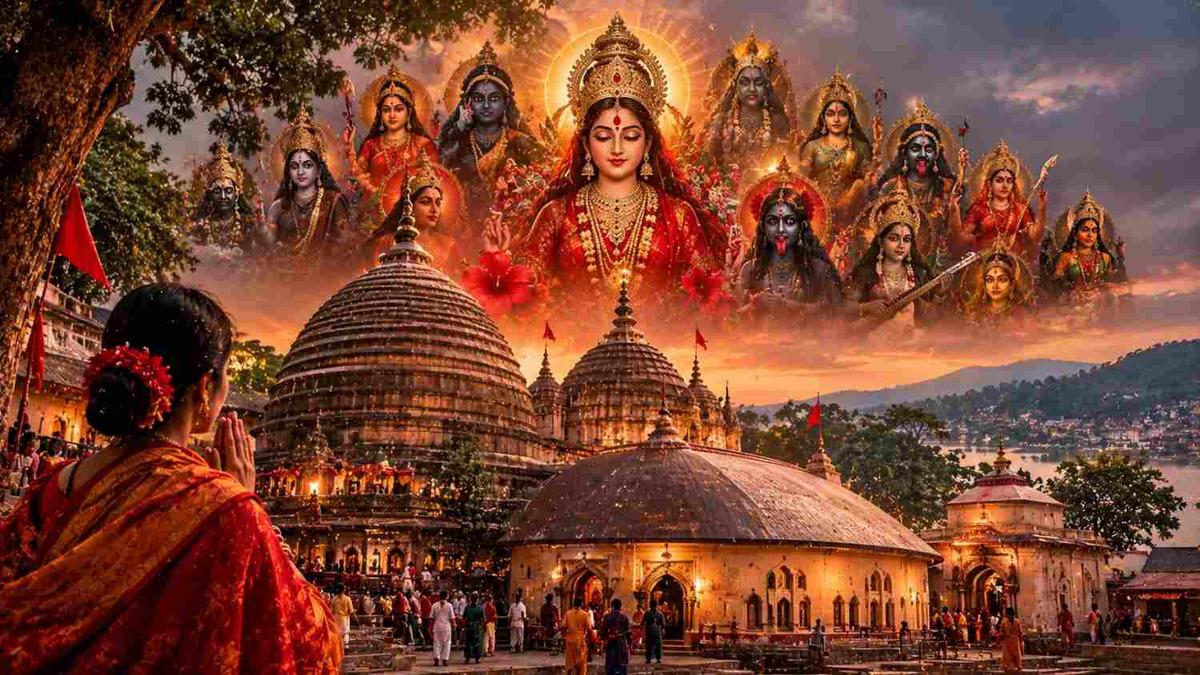
The Kamakhya Temple in Guwahati on Nilachal Hill is one of the most important Shakti sites in India. Rather than having an idol of the Goddess, the temple has a natural rock formation that represents a yoni. It is a place of great importance in Shaktism and Tantra.
One of the most important festivals at the temple is the Ambubachi Mela, which takes place once a year in June. It represents the annual menstruation of the Goddess Kamakhya and is a celebration of fertility and creation. Many devotees, sadhus, and spiritualists come to visit the temple.
In addition to the main temple, there are several other temples on the Nilachal Hill. Each temple houses a different manifestation of the Divine Mother. You can enjoy some spectacular views of Guwahati and the Brahmaputra from this location.
Tip: Guwahati is the obvious place to start your trip. There are plenty of transport links by air, train, and road. If you’re visiting during the Ambubachi Mela, it will be very busy, so be sure to find out the opening/closing times of the temple.
Why is Naritang Durga Temple in Meghalaya a Unique Shakti Peetha?

The journey continues from Assam to the Nartiang Durga Temple (also known as Jainteshwari), located in the West Jaintia Hills. It is traditionally believed that this is where the left thigh of the Goddess fell. The temple is dedicated to Goddess Sati, worshipped here as Jayanti, and is a key place of worship for Shakti followers.
This temple is fascinating to visit as it is linked to the rich history of the Jaintia Kingdom. The temple is also close to the ancient Nartiang monoliths, which are significant ancient stones linked to the history of the Royal family and ancestors. This means it is quite unique as it combines both religion and culture.
It is a much quieter place to visit than the big pilgrimage sites. As it is located in Meghalaya, you can also explore the surrounding areas, including Jowai.
This temple is about 24km from Jowai and around 65km from Shillong. You can use Jowai as a base to visit this temple. Be sure to organise local transport in advance, especially if visiting later in the day.
What makes Tripura Sundari Temple in Tripura an important Pilgrimage destination?

Tripura Sundari Temple (Also known as Matabari) is another popular tourist spot in Tripura, located in Udaipur. It was built in 1501 by Maharaja Dhanya Manikya and is one of the important Shakti Peethas of India. It is believed that the right foot of the Goddess Sati fell here.
This temple is dedicated to Goddess Tripura Sundari, who is the avatar of Parvati. The structure has a unique architecture with a square-shaped sanctum. The roof was designed keeping in mind the traditional architecture of rural Bengal. It is also known as Kurma Peetha, as it resembles the shape of a tortoise.
Kalyan Sagar is one of the most beautiful parts of the temple, as it is a sacred lake surrounding the temple. This lake is home to many fish and tortoises, which are worshipped by the devotees. The temple is an important pilgrimage spot during Diwali.
Tips: Udaipur is about 55 km away from Agartala. You can easily reach there by road or rail. The nearest airport is Maharaja Bir Bikram Airport located in Agartala. The best period to visit here would be during Diwali Mela; however, there can be more crowds.
How can you plan one journey across Assam, Meghalaya, and Tripura?
As the temples are in different states, it is best to plan your visit around them. Plan your trip in stages. Think about the transport links, how long each stage of the trip will take, and temple times.
| Journey stage | Destination | Suggested travel approach |
|---|---|---|
| First stop | Kamakhya Temple, Guwahati, Assam | Reach Guwahati by air, rail, or road |
| Second stop | Nartiang Durga Temple, Meghalaya | Travel towards Shillong and Jowai, then continue to Nartiang |
| Third stop | Tripura Sundari Temple, Udaipur, Tripura | Travel onward to Tripura, using Agartala as the main transport gateway |
There is no specific timetable for travelling between the temples. The condition of roads, transport links, and the season can impact your travel time. If you are travelling with elderly people or children, it is a good idea to look up interstate transport links to see what the best order would be.
Tips
- Leave extra time for travel between states.
- Check opening times, festivals, and any special arrangements for the temple.
- Book your accommodation and transport between cities in advance during Ambubachi Mela and Diwali.
- Wear comfy shoes for exploring the temples. Each temple will have specific footwear requirements for darshan.
- Leave some flexibility in your itinerary to allow for delays due to the weather, especially during the monsoon.
When is the best time to visit these three Shakti Peethas?
This really depends on what you want to prioritise.
| Temple | Major festival | Significance |
|---|---|---|
| Kamakhya Temple | Ambubachi Mela | Celebrates the symbolic menstruation and fertility of Goddess Kamakhya |
| Nartiang Durga Temple | Durga Puja | Celebrates the worship of Goddess Durga and local religious traditions |
| Tripura Sundari Temple | Diwali Mela | Attracts large numbers of devotees for worship and celebrations |
Generally speaking, October to March is a great time to visit the Northeast to see everything in comfort. It is a good time to visit all three of these places.
However, if you are a devotee, you may want to visit during one of the festivals. The main festival of the year is Ambubachi Mela, which happens in June at Kamakhya. Diwali also sees big crowds at Tripura Sundari Temple. This is a great time to get a real feel for religion, but there will be more crowds and more demand for accommodation.
Nartiang can be visited all year round; however, due to the weather in Meghalaya during the monsoon season, it may not be the best time to drive. Be sure to check the weather and transport conditions in your area.
What can travellers experience beyond temple darshan?
Trips to these three States will also give you an insight into the rich culture of this part of North East India. Guwahati has a beautiful riverside along the Brahmaputra and plenty of temples. You can learn about the local history around Nartiang as you see the ancient monoliths and learn about the rich history of the Jaintia Hills. Udaipur has some beautiful lakes and temples.
You can get a more meaningful experience by eating local foods, visiting traditional markets, learning about local crafts, and interacting with locals. Be respectful of local traditions and follow any rules in the temples. Ask for permission to take photographs of people or religious activities.
Sometimes the most memorable parts of a pilgrimage aren’t just when you get to see the deity. The peaceful travel between sites, the stories behind each shrine, and how each community shows its devotion to the Divine Mother can be equally memorable.
Frequently asked questions
Are Kamakhya, Nartiang Durga and Tripura Sundari all Shakti Peethas?
Yes. They are all traditional Shakti Peethas of Goddess Sati. They are important places of worship for the Goddess.
Can the temples be visited in one trip?
Yes. Travelers can visit all three temples on a long interstate trip. They can visit Guwahati (Assam), Nartiang (Meghalaya), and Udaipur (Tripura). You need to take into account transport links and times.
Which one is connected to the Ambubachi Mela?
The Kamakhya Temple (Guwahati, Assam) holds the yearly Ambubachi Mela, celebrating the symbolic menstrual cycle and female reproductive power of the Goddess.
What is the best time to visit the Tripura Sundari Temple?
Generally, you will find it comfortable between October and March. Many devotees also visit during the Diwali celebrations taking place at the temple.
How does HRDYAM make a spiritual journey more meaningful?
Your pilgrimage will mean much more to you if you are able to learn about the history, traditions, and spirituality behind the places you visit. With HRDYAM, you’ll be able to take your spiritual journey to new heights whilst also planning your travels.
HRDYAM helps you understand the significance of pilgrimage sites and learn about their traditions. Our travel services will allow you to explore the different pilgrimage opportunities available whilst considering your own travelling requirements.
Every journey has a story. See what experiences others have had on their travels by viewing Travellers’ Experiences.
Whether you’re looking for blessings at Kamakhya, learning about the heritage of Nartiang or seeing the devotion at Matabari, travelling between these 3 states will allow you to get closer to your faith, culture and see the diverse nature of the Northeast of India.
Conclusion
A trip to the 3 Shakti Peethas will take you through 3 states united by their love for the Divine Mother. Each place has its own unique charm and will offer you a new perspective of worshipping Shakti. Be it the divine energy in Kamakhya, the culturally rich history of Nartiang, or the peaceful environment of Tripura Sundari.
This is a great opportunity for pilgrims or culture lovers to explore the spiritual culture of North East India.
Spiritual travel researcher, Vedic cultural writer, and contributing editor at HRDYAM.
You Might Also Like
Tags
More Articles
View all
Char Sham Yatra for senior citizens: 2027 dates, registration, cost & safety guide
Many people wish to complete the ‘Char Dham’ pilgrimage in the Garhwal region of the Indian Himalayas. The pilgrimage includes visiting 4 holy sites: Yamunotri, Gangotri, Kedarnath, and Badrinath. How
Dash Mahavidyas of Maa Shakti at Kamakhya
The Divine Mother has ten different forms of manifestation on the holy Nilachal Hill in Guwahati. These are known as the Dasha Mahavidya, and each represents a different aspect of Shakti. Some aspects

Winter in Tawang: Best time to visit & experience snowfall
Winters are a treat in Tawang. With snow-capped mountains, frozen lakes, and serene, meditative monasteries, the whole place comes alive with the magic that is associated with the Eastern Himalayas. A