Navratri: Nine nights, nine faces of Shakti

RIYA SHARMA
HRDYAM - DISCOVER SACRED JOURNEYS, WISDOM & WELLNESS
The first indication of Navratri usually comes not from any temple.
This could be a spontaneous display of a tiny kalash in the corner of your house, the planting of new barley seeds into the moist soil, or a diya being lit even before sunrise. Markets get colorful and decorated, with the preparations for the festival in the air. Someone somewhere prepares for fasting. Someone elsewhere starts practicing songs for garba in the evening.
But slowly and silently, life's usual tempo begins to change.
For nine days and ten nights, Navratri invites Indians to turn their eyes towards Shakti-the divine feminine principle of creation, protection, and transformation of everything in this world. However, there is no unified way to celebrate Navratri in India. One region welcomes the Goddess in the elaborately decorated and prepared household altar, whereas another celebrates thousands of people dancing around the garbha deep all night. In Kolkata, the city streets come alive through the festival of Durga. In the southern parts, houses get decorated with the Golu. In North India, the festivities end with Ramlila and Kanya Pujan. The names and traditions may vary.
What changes when Shakti comes home?
Navratri starts with an invitation.
Before the songs, the dances, the fun-filled evenings and everything else that Navratri symbolises, comes Ghatasthapana-the invocation of Goddess Durga into the house itself. This involves preparing a clean place where a kalash is kept, and barley seeds are planted in a pot of soil. In the following nine days, those little green sprouts would come to signify prosperity and divinity.
The kalash takes pride of place in the household rituals; flowers are offered, incense burnt, prayers done, and in households that keep up with the tradition, Akhand Jyoti burns for the nine nights. The routine of morning and evening worship soon becomes a part of the home's life.
It is an incredibly intimate ritual. Goddess isn't being called from far-off places. She has been invited into the home.
And as the first lamp is lit and the process of growth of the first little sprouts commences, Navratri starts with an act of faith, with the creation of a sacred space.
How many faces can Shakti reveal?
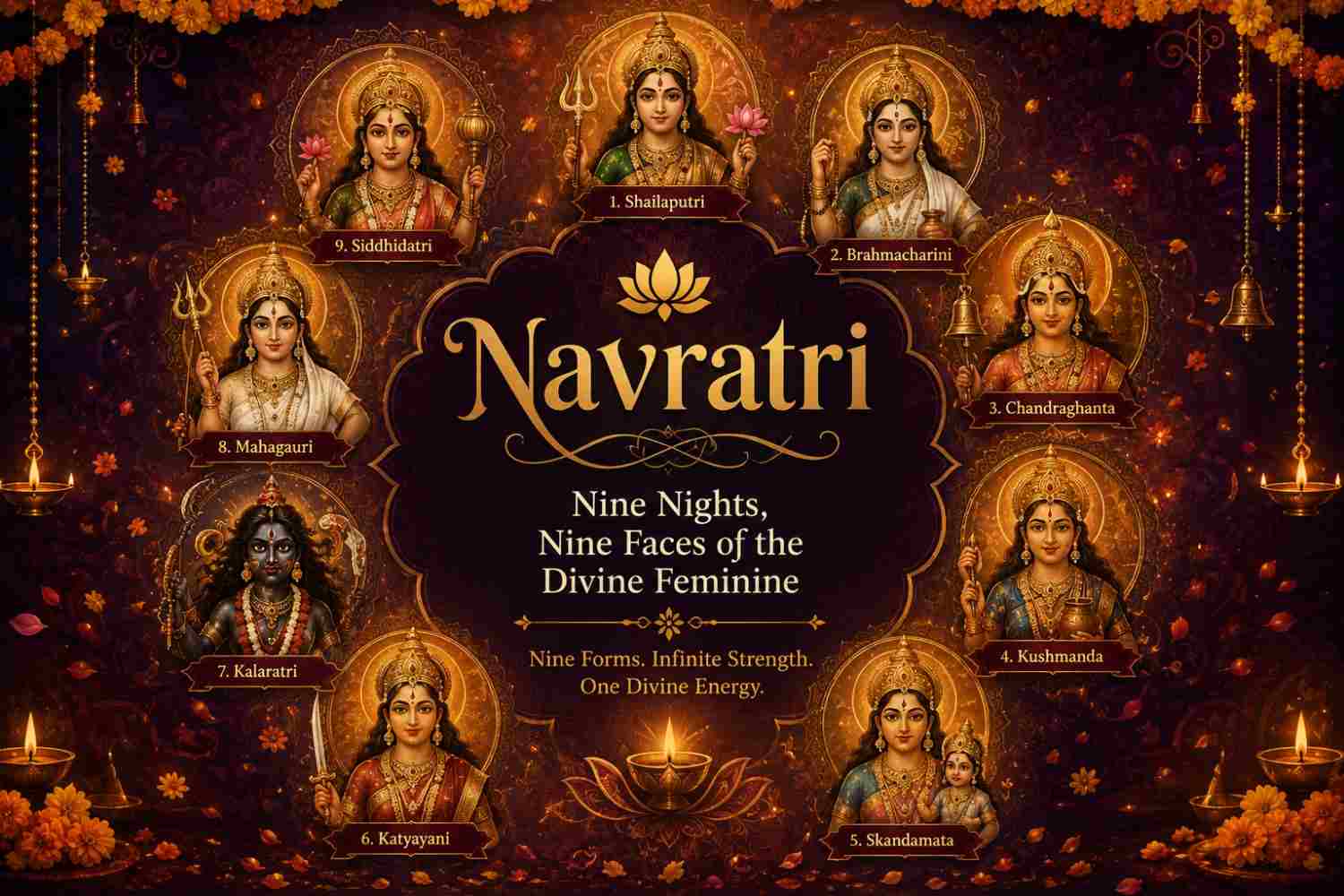
As soon as the kalash has been positioned and Navratri starts, the Devi manifests in nine unique manifestations, known as Navadurga. Every day, a different manifestation of the Goddess attracts the attention of the worshipper, thereby providing the entire nine-day process with its unique rhythm and symbolism.
| Day | Form of the Goddess | What the form evokes |
|---|---|---|
| Day 1 | Shailaputri | Strength and the steadfastness of the mountains |
| Day 2 | Brahmacharini | Austerity, devotion and spiritual discipline |
| Day 3 | Chandraghanta | Courage, protection and inner strength |
| Day 4 | Kushmanda | Creation, vitality and the energy of life |
| Day 5 | Skandamata | Motherhood, compassion and nurturing strength |
| Day 6 | Katyayani | Courage and the power to overcome adversity |
| Day 7 | Kalaratri | Fearlessness and the destruction of darkness |
| Day 8 | Mahagauri | Purity, peace and spiritual clarity |
| Day 9 | Siddhidatri | Fulfilment, wisdom and spiritual accomplishment |
Thus, nine days turn into a much bigger experience than a simple countdown.
They turn into nine occasions for the encounter with Shakti in her different forms, as well as a chance for self-realization through her.
What does devotion ask us to give up?
Even as Navratri gets established in the house, the celebration starts becoming an introspective affair. The days of Navratri for most devotees are days of vrat, which is not merely an alteration in the diet, but much more than that.
Some do it on all the nine days, some take certain days out, and some maintain a sattvic diet without fasting at all. There may be variations from family to family, but the essence is always the same: control your body so that your mind can concentrate.
The kitchen also transforms during these days. The grains used are kuttu, singhara, and rajgira; samak rice and sabudana are commonly used; fruits, milk products, makhana, and vrat-safe vegetables constitute the day's food. Instead of salt, sendha namak is used, and foods like wheat, beans, onion, and garlic are not used.
How does Navratri speak differently across India?
It is a fact that Navratri celebrations never appear identical throughout the country of India.
| Region | How Navratri Comes Alive | What Makes It Distinctive |
|---|---|---|
| Gujarat | Garba and dandiya fill neighbourhoods and large grounds, often continuing late into the night. | The garbha deep remains at the heart of the dancing, connecting celebration with devotion. |
| West Bengal | Kolkata transforms with Durga Puja pandals, artisan-crafted idols and dhunuchi naach. | The city itself becomes part of the celebration, with streets remaining alive throughout the festival. |
| North India | Families observe Navratri puja and fasting, while Ramlila performances lead towards Dussehra and Kanya Pujan. | The festival moves between household worship, public theatre and the eventual celebration of victory. |
| Tamil Nadu, Karnataka & Andhra Pradesh | Homes create Golu displays of dolls and figurines, alongside Saraswati Puja and Ayudha Puja. | Learning, creativity, tools and everyday work are brought into the sacred space. |
| Mysuru, Karnataka | The royal city celebrates with an illuminated palace and the grand Jamboo Savari. | Navratri takes on a distinctly royal and processional character. |
| Maharashtra | Ghatasthapana and fasting are accompanied by increasingly popular garba and dandiya evenings. | Traditional observances meet the festive energy of community dancing. |
Where does devotion go when it leaves the home?

Nine days have settled down into their own routine by now-prayers in the morning, fasting throughout the day, and celebrations beginning when the sun starts to set. Yet, Navratri has never been limited to the prayer room alone.
Step out, and you will see the festival transform itself in yet another form.
In Gujarat, the devotional purity of Garba deep turns into dance circles. In Bengal, the Goddess transforms herself into the grandeur of public venues. In the South, households welcome the celebration of Golu and the coming together. In North India, the stages of Ramlila prepare themselves for the concluding episodes of the play.
The festival travels from private celebration to community celebration-from the diya in one household to being celebrated by thousands of people together.
And maybe that is why Navratri is so full of life-because it doesn’t force us to choose between the two.
Can devotion find its rhythm in a dance?
The arrival of the evening brings a change in the atmosphere.
With the prayer in the morning being replaced by music, the open grounds get filled with colors, as the formation of a circle takes place around the garbha deep, hand clapping in tune, making everyone move as one.
Garba and Dandiya become one of the most prominent ways of celebrating Navratri in this manner. This is where, in Gujarat, communities gather from one night to another to make prayers turn into music and dancing.
Yet behind the colorful skirts and dancing lies something more than just dancing. The circle formed is without any start or end point, while the lamp inside makes people remember their divinity.
What if worship could look like learning and work?
Sometimes, Navratri is celebrated in places where worship is not expected to take place.
Books are carefully organized. Instruments, tools, and even means of transport may be cleansed, ornamented, and offered to the Goddess. In South India, Saraswati Puja is celebrated to mark knowledge and learning, but Ayudha Puja respects the instruments through which people express themselves and earn.
It is a delightful change in attitude. A book ceases being just a book. A tool ceases being just a tool. For a while, they act as a reminder of knowledge, skill, and labor that constitute our lives.
It could be another way of interpreting Shakti, not only as a deity who is revered in a temple, but as the very energy that makes us learn, produce, and progress.
What begins anew beneath Navratri's nine nights?
After nine days of prayer, discipline, and celebration comes Vijayadashami-Dussehra, which is the day of victory in the festival.
In North India, there is a spectacular end to Ramlila when the effigies of Ravana, Meghnad, and Kumbhakaran are burnt down. In other regions, the day of celebration comes in different ways, such as immersing the idol of Durga in Bengal and Ayudha Puja and Vidyarambham ceremonies in the South.
However, behind these different celebrations, there is one common theme-victory and renewal.
The festival has seen devotion, discipline, celebration, and contemplation. But now it is time to take this feeling of renewal out of the festival and into something else-a new venture, a new learning, or even a new perspective on life.
What does Navratri awaken within us?
One of the most aesthetically pleasing ways to experience Navratri is to stop seeing it as an event meant to be witnessed.
Participate in the garba dance in the evenings. Attend a puja ceremony. Eat the food offered during a vrat. Experience Golu, or participate in the festivities at a Durga Puja celebration. Learn the story behind your family's traditions. And if you get the chance, experience Kanya Pujan or a Ramlila show not as an event to be witnessed, but as a tradition that people carry around for generations. This is what these spiritual trips teach us: the rich tradition of festival celebrations.
Each one of these practices reveals a different dimension. Dance is devotion expressed through movement. Fasting is discipline demonstrated. Diya is tranquility created. Community celebration is belonging experienced.
Navratri is remembered for all these experiences, and you can take your observations further into the celebration, participating and getting lost in the celebration itself.
And this is where a journey with HRDYAM may begin-not just about places, but about tales, rituals, and experiences through which one can experience India's spirituality more directly.
Conclusion

Every Navratri festival eventually comes to its serene end.
The garba grounds are vacated, the festival attire goes back into the closet, the final aarti takes place, and the space made ready for the start of the festival is duly wound up. The jau seeds from Ghatasthapana can now be given away in blessings, while the kalash and its contents will be formally wound up in accordance with the traditions of the family.
However, Navratri was never supposed to remain limited to those nine days. It started with a small ceremony of invoking the divine power and then grew through worship, fasting, dancing, singing, eating, community spirit, and devotion. All over India, it took on many forms but ended with one theme-Shakti as the power that gives life, strength, knowledge, and rejuvenation.
The celebration has ended. The journey continues.
Spiritual travel researcher, Vedic cultural writer, and contributing editor at HRDYAM.
You Might Also Like
Tags
More Articles
View all
What is HRDYAM? The AI-Powered Spiritual Ecosystem
The spiritual essence of India has not merely consisted of temples alone. It is found in pilgrimage circuits, old rituals, Vedic astrology, Yoga, Ayurveda, sacred rivers, traditions of the region, art

How HRDYAM blends spirituality with sustainability
How would pilgrimage change if it were no longer viewed as a trip to a shrine but as an engagement with the entire sacred geography? The river next to the shrine, the communities that live by the shri
Deepavali oil bath & Narak Chaturdashi: the sacred morning before Diwali
Not all families start off the celebrations of Diwali with crackers and lighting of lamps during the night hours. For several families in South India, the celebration starts much earlier-even before t