Maa Brahmacharini: The strength to walk the hardest path

RIYA SHARMA
HRDYAM - DISCOVER SACRED JOURNEYS, WISDOM & WELLNESS

The first day of Navratri has something to teach us about establishing ourselves. Day two makes our life's journey more challenging.
Navratri Day 2 is dedicated to Maa Brahmacharini, the second manifestation of the Navdurga. While Maa Shailputri signifies the process of initiation into our life's journey, Maa Brahmacharini is about what follows the initiation-about perseverance in the face of hardship, especially when the euphoria of the beginning wears off.
This isn't the tale of Maa Brahmacharini's conquest on the battlefield; this is the story of tapasya-a story of setting goals and staying committed to them over several years. Being in her avatar of Parvati, she did rigorous penances for only one reason-to make Lord Shiva her consort. And such was her commitment to her aim that she could forsake everything in pursuit of it.
This is why Navratri Day 2 is different from Day 1. While the former tells us to initiate, the latter challenges us with our perseverance.
Maa Brahmacharini, in her usual portrayal, is seen to walk without footwear, carrying a japa mala in one hand and a kamandalu in the other. This picture has an unusual element to it. She does not carry any powerful weapon or a throne or even an impressive animal to ride.
Her strength lies in her concentration, self-restraint, and dedication. In this context, during Navratri 2026, she teaches us a lesson that feels quite significant at the moment. While we always rejoice in celebrating the beginning of the new class, the new job, the new routine, the new resolution that we make for ourselves, very few things actually get accomplished in the excitement of Day 1. It is only when we stick around on Day 10, Day 50, or even Day 100 that things actually get done.
The goddess who chose the Path of Tapasya
"Brahmacharini" is a term that means the process of tapasya – disciplined life and dedication. In the tradition of Navdurga, Brahmacharini is revered on the second day of Navratri as the ascetic form of Parvati in her penance for Lord Shiva when she was unmarried.
It is not hard to see why her form is unique due to its simplicity. The goddess Brahmacharini is depicted walking barefoot, with japa mala and kamandalu in her hands. Unlike other warrior forms of Durga, she does not have any weapon, and her power is symbolized through meditation, austerity, and self-restraint.
The mythology of Brahmacharini is related to Parvati's desire to attain Lord Shiva. The traditional story states that she did her penance by gradually renouncing worldly pleasures and bearing hardships while remaining dedicated to her goal. It is this dedication that gives uniqueness to the second day of Navratri.
There is also a sense of deep relatability in the depiction of Maa Brahmacharini. She is the depiction of the aspect in us that works to do something even if there is no one watching it. This can be seen as the student who studies without getting distracted, the artist who continues to practice, or the individual rebuilding themselves every day.
This means that if Maa Shailputri is about the beginning, then Maa Brahmacharini is about following up the beginning with commitment. In essence, Maa Brahmacharini is all about being patient, disciplined, and devoted, which means that her day in Navratri 2026 should mean this to everyone.
From Beginnings to Inner Discipline
While Day 1 is all about the beginning of the spiritual journey, Day 2 poses a far more difficult question: "Can you stick to your commitment even when the journey gets difficult?"
This is where Maa Brahmacharini comes into the tale of the Navdurga. The key attribute of the goddess is tapasya, which is the ability to tolerate difficulties for a noble cause. The worship of Maa Brahmacharini moves beyond the act of resolving to the practice of developing the required level of discipline.
Parvati's penance for Lord Shiva was not just a single day's activity. It was a process of withdrawal from material life and growing austerity. She had the strength of character to maintain her resolve amidst hardships and became an example of perseverance and self-control.
Thus, the progression of Navratri days gains special significance because following the search for stability in the form of Maa Shailputri, one needs to channel the gained stability towards a goal.
Take any important task you have attempted in your life. You know how the beginning stages go-full of enthusiasm. You find the process interesting, the goal attainable, and the promises made to yourself effortless to keep. The true challenge comes after a while, when it gets hard to make any significant progress.
The Goddess Maa Brahmacharini exemplifies this stage.
Through her incarnation on the second day of Navratri 2026, she reminds people that sometimes development cannot be measured with great steps forward. It is more about getting up every morning and doing what needs to be done. It is about exercising self-control when the opposite force pushes you in another direction. It is about maintaining determination even when the outcome is nowhere near.
It is for this reason that the second day of Navratri 2026 is not about reaching the destination. It is about acquiring patience in order to walk that distance. The Goddess shows that sincerity can be turned into an inner strength.
A journey written through years of Tapasya
Maa Brahmacharini is the story of how Parvati decided that she would attain Lord Shiva through tapasya, not through anything else like money, beauty, or power.
Parvati was aware of the challenges of tapasya, but she embraced it all the same. According to the traditional versions of her story, Parvati left behind the amenities of life and became wholly absorbed in her penance. She meditated for long hours, slowly depriving herself of food and other physical comforts. Tapasya was not about self-mortification because it was an expression of Parvati's commitment to her task.
The significance of her name, Brahmacharini, can be understood now. Brahmacharini was a person who was committed to a path of discipline and directed her mind and deeds to her higher objective.
Years of austerity finally put her through the test that would make everyone else give up their determination. But not Parvati. Eventually, her patience and dedication led to her marriage with Shiva.
And there lies an amazing distinction between desiring something and being able to work for it with patience. Parvati did not just desire her objective but worked her whole life around it.
Which is what makes her tale highly pertinent for Navratri Day 2. It is a reminder of how intention becomes important only when coupled with consistency. The story of Maa Brahmacharini is one of the quiet and determined will to walk towards something despite its distance.
And the question she puts forth for everyone to think about is very basic: what are we ready to dedicate ourselves to once the excitement fades away?
What her form teaches about perseverance

It is interesting to note how simple the iconography of Maa Brahmacharini appears to be. She is portrayed as being barefoot, with one hand holding a japa mala and another, a kamandalu. There are no weapons or any kind of jewelry competing for attention. In the form of her appearance alone lies the message of the second day of Navratri–that strength comes from discipline, not from showing off.
Japa Mala
The japa mala signifies prayers, meditation, and contemplation. It signifies repetition too-that something worthwhile needs constant effort to bring about change.
In the life of a believer, it signifies the effort of coming back to the same exercise every day, whether prayer, meditation, or introspection.
The Kamandalu
The kamandalu, which is usually held by the ascetics, stands for simplicity, moderation, and a life without being too dependent on worldly conveniences. When Maa Brahmacharini carries it, it shows her willingness to sacrifice her worldly pleasures in order to follow her own path.
Sometimes, making progress means knowing what should be removed, not added.
Her Bare Feet
Brahmacharini walks barefoot, and this is an expression of her austerity as well as her readiness to face difficulties in the process of her penance.
Her bare feet can be viewed as a symbol of humbleness. She doesn't need a luxurious background to showcase her strength since she already possesses it.
Her White Clothes
Usually, Maa Brahmacharini is shown in white clothes, which stand for simplicity, peace, purity, and clarity. They fit her well since she follows her path through concentration, not luxury.
No Weapon but Great Power
One of the most distinctive features about her body is what she doesn’t have.
In contrast to a number of the other bodies of Navdurga, the body of Maa Brahmacharini doesn’t have a weapon. She fights a different kind of battle, one within herself.
A ritual rooted in patience and devotion
The second day of Navratri is for Maa Brahmacharini. Puja should be done in a simple manner since her form is an embodiment of simplicity, devotion, and self-control. You may follow the custom of your family or simply keep your Puja simple.
Before starting, make the area of puja clean, have a bath, and wear fresh clothes. Keep the image or idol of Maa Brahmacharini next to the Kalash made on the first day.
Puja Vidhi Step By Step
Start with a peaceful mind and light a ghee diya and incense sticks.
Give flowers and akshat to Maa Brahmacharini while recalling her appearance and mythology.
Apply kumkum and sandal paste to the idol or picture, depending on your family's custom.
Give fruit offerings and bhog. The food should be basic and sattvic in nature.
Recite Maa Brahmacharini's mantra or pray from Durga Saptashati, which talks about her.
Meditate for a few minutes. It will be very significant on this day because meditation is an important aspect of Maa Brahmacharini's worship.
Perform aarti and pray according to your own wishes. You can also take a sankalp to develop one virtue in yourself that day, such as patience, self-control, discipline, or perseverance.
Serve bhog as prasad to all the family members after doing the puja.
As against festivals where beautiful decorations and a large number of offerings tend to overshadow the actual essence of the festival, Maa Brahmacharini worship becomes an apt place for doing things in a simple manner. What Day 2 stands for is not its elaborate puja rituals but the sincerity that goes into performing it.
If you have vowed to fast during Navratri, get your bhog and meals ready in accordance with the fasting rituals your family follows. There is absolutely no need to complicate things.
Everything you need for day 2
Contrary to the first day, where much of the preparations focus on Ghatasthapana, rituals on the second day can be kept quite basic. On the second day, the same Kalash is worshipped that was established on the first day, and the offerings are made to Goddess Maa Brahmacharini. The traditional list includes flowers, rice, sandalwood, milk, and sugar.
| Puja Samagri | Purpose |
|---|---|
| Maa Brahmacharini's image or idol | Main focus of the puja |
| Existing Kalash | Continues from Day 1 |
| White flowers/jasmine | Traditional floral offering |
| Akshat (unbroken rice) | Used during prayers |
| Chandan (sandalwood paste) | Traditional offering |
| Kumkum / roli | Tilak and puja |
| Gangajal | Purification |
| Ghee diya | For the puja and aarti |
| Incense/dhoop | Creates a traditional worship setting |
| Milk, curd and honey | Used in some traditions for abhishek |
| Sugar | Traditional bhog for Maa Brahmacharini |
| Fresh fruits | Sattvic offering |
| Panchamrit | Prasad or offering, according to family tradition |
| Japa mala | Useful for mantra chanting |
Not all items mentioned above need to be purchased. Different families have different practices, and a plain puja with whatever ingredients are available will suffice just fine. The nature of worshipping the goddess Maa Brahmacharini suggests the same too.
Simple offerings, deep devotion
The second day of Navratri requires offerings that are as simple as the life of Maa Brahmacharini. Among the many offerings traditionally offered in her name, the ones of sugar and mishri are significant. Fruits, milk preparations, and other simple sattvic dishes may also be offered.
The significance of sugar is that it adds sweetness to the austerity of a day dedicated to tapasya. Post tapasya, the message of Maa Brahmacharini's story is that austerity does not involve being tough; rather, it is all about doing what one believes in and sticking to it.
| Bhog | How it is traditionally used |
|---|---|
| Sugar | One of the principal offerings associated with Day 2 |
| Mishri | Offered as prasad and valued for its sweetness |
| Milk | Used as an offering or in simple milk-based preparations |
| Kheer | A simple milk-based sweet that can be offered according to family tradition |
| Fresh fruits | A natural and sattvic offering |
| Sugar-based sweets | Barfi and other simple preparations may be offered |
Words to steady the mind

Mantra Chanting is highly significant for Navratri Day 2 since the mythology of Goddess Brahmacharini revolves around Tapasya, concentration, and dedication. The mantras related to her can be recited as part of the morning ritual or even meditated silently.
Mool Mantra
ॐ देवी ब्रह्मचारिण्यै नमः॥
Om Devi Brahmacharinyai Namah
A basic mantra such as this one is appropriate even for people who have just started practicing mantra repetition. It can be repeated 11, 21, or 108 times.
Prayer of Maa Brahmacharini
दधाना करपद्माभ्यामक्षमाला कमण्डलू।
देवी प्रसीदतु मयि ब्रह्मचारिण्यनुत्तमा॥
Meaning: “Let Maa Brahmacharini, the auspicious goddess who carries rosary and kamandalu in her hands, be kind to me.”
This is such a wonderful hymn which perfectly reflects the form that she assumes-the rosary symbolizing constant remembrance and the kamandalu symbolizing simplicity and self-control.
How to include mantra in your puja
After lighting the diya and making the offering, get seated in front of the picture of Maa Brahmacharini and take a few deep breaths, and then begin chanting.
If you use the mala, chant with ease and not in haste to reach the target number of repetitions. This is because you are trying to bring your focus back if the mind wanders away from it.
Also, this mantra can be chanted throughout the day as a practice on Day 2 of Navratri 2026. Every time you find yourself getting distracted or feeling impatient, take a break and say, "Om Devi Brahmacharinyai Namah."
Thus, the mantra does not only become a chant recited during the puja. But, in fact, the message conveyed by Maa Brahmacharini in the form of this mantra is that one must focus on what they have chosen.
Green for growth and renewal
According to the traditional colour scheme, the second day of Navratri 2026 is related to the colour green, as the goddess on this day is Maa Brahmacharini. In comparison with the yellow colour that characterizes the first day, the green one creates a totally different atmosphere.
The reason why the green colour is suitable for Maa Brahmacharini is due to her story being one about gradual development. The years she spent on her penance did not give her an immediate reward but showed her devotedness and discipline instead.
How You Can Include Green on Day 2
Wear a green saree, kurta, dupatta, or just some green accessory.
Decorate your puja area with green leaves and fresh flowers.
Include some green items in your rangoli or house decorations.
Even a green bangle, scarf, or head ornament will be enough if you like traditional things but in a low-profile way.
This colour is not necessary for performing the puja ritual itself. It is just a way of being part of the cultural tradition on Navratri Day 2.
There is something symbolic in wearing green on this very day. After all, a plant doesn't turn into a tree overnight. It grows patiently, step by step. The tale of Maa Brahmacharini tells us the same thing-that some of the most significant changes in our lives come gradually, long before others could notice them.
Cultivating patience, focus and inner strength
Goddess Brahmacharini is known for tapasya, patience, self-restraint, and perseverance. Hence, the boons that one usually gets from worshipping her have more to do with the personal qualities that help in overcoming challenging periods of life than with having wealth or prosperity.
Devotees usually pray to her for:
Staying strong during tough times: This helps devotees be strong during difficult times.
Patience: Her penance is an example of patience because she patiently waits for the proper result and does not give up.
Ability to concentrate better: Being the goddess of meditation and japa, her worship will help people concentrate more.
Discipline and self-control: She motivates devotees to be conscious about everything they do.
Courage to be consistent: Some people find it easy to start something, but they cannot continue doing it. The worship on the second day motivates people to be persistent in their decisions.
Peace of mind: People spend time meditating and praying in silence while their schedule is usually very busy.
Spiritual strength: This day is especially important for those people who have started or just resumed their spiritual practice.
The real learning point might be even more valuable than any blessing. Maa Brahmacharini does not symbolize immediate success. She symbolizes who we become during this waiting period.
The tale teaches us that sometimes patience is not about doing nothing. It is rather about being there and doing what you need to do in silence.
Keep the second day mindful
The second day of Navratri emphasizes discipline and devotion, which doesn’t imply making it a day of stress. The idea of the rituals is to instill mindfulness, and not to feel stressed out about getting everything done perfectly.
- Making the Fast a Challenge
A Navratri fast is your personal religious observance, which should not be considered a challenge. You do not have to push yourself only because somebody else observes a more rigorous fast. Observe a traditional Navratri fast that is right for you.
- Doing Puja Hastily
Since Maa Brahmacharini symbolizes patience, performing puja in haste just to get it over with will undermine the essence of the day.
- Limiting Your Wishes To Material Ones
You will pray for success, happiness, good health, relationships, or any other wish of yours. But Day 2 gives you a chance to pray for discipline, patience, clarity, and commitment.
- Making Tapasya A Test Of Suffering
Maa Brahmacharini's penance does not imply anything but suffering intentionally and damaging your body. The real meaning of her penance is discipline and choice.
- Missing Out On What You Are Chanting
If you are reciting the mantra of Maa Brahmacharini, try to understand what you are chanting instead of blindly following the words. Just a few minutes of concentrated mantra can give you many benefits.
- Compounding With Someone Else's Penance
Some people fast the whole day, some people only take one meal, whereas others do a simple morning puja. In Navratri, every person celebrates in their own way.
The core idea of Day 2 is not about being perfect, but consistent. Maa Brahmacharini's tale is all about change through devotion, discipline, and patience.
Different traditions, one spirit of devotion
While the second day of Navratri in India could feature similar worship of the Goddess in different parts of the country, the nature of the observance can vary drastically from one place to another. Some places celebrate the occasion with peaceful worship at home, while in some others the festival has started taking the shape of a community festival.
| Region | How Day 2 is Celebrated |
|---|---|
| North India | Devotees continue their daily Navratri puja, fasting, mantra chanting, and recitation of devotional texts. Homes often maintain the Kalash and other arrangements established on Day 1. |
| Gujarat | The evenings begin to come alive with Garba and Dandiya, with devotees gathering in traditional attire for music and dance dedicated to the Goddess. |
| Maharashtra | Families continue their Ghatasthapana traditions, visit Devi temples, and prepare vrat-friendly meals while maintaining their household worship. |
| West Bengal | Although the grand Durga Puja festivities come later in the lunar calendar, worship of the Goddess and preparations for the festive season are an important part of Bengali cultural life. |
| South India | The Golu/Kolu tradition continues, with families displaying decorated dolls, inviting guests, exchanging sundal and other prasadam, and singing devotional songs. |
| Himachal Pradesh | Worship of the Goddess traditions are deeply connected with the region's mountain temples, making the imagery of the Goddess and the Himalayas especially significant. |
The most interesting thing about Navratri is that there isn’t just one way to observe this festival. While one person might spend their time in silent prayers before dawn, someone else could be dancing Garba with thousands of others.
Make space for meaningful celebration

Celebrating the tales of Maa Brahmacharini gives us another reason to celebrate day 2 of Navratri in a way that helps us stop and introspect our intentions. Some people may feel motivated to start a meditation practice while others may visit a Devi temple, go on a fast, or take up the spiritual journey that has been long due.
HRDYAM, on its part, views Navratri as something beyond just nine days and provides its visitors with experiences that help them delve into the rich spiritual and cultural heritage of India. Whether you are looking to visit ancient Shakti Peethas and Devi temples or organize spiritual tours for yourself, HRDYAM will help you with all your needs through well-planned itineraries and experiences.
One may also look for puja essentials and spiritual products from the collection of HRDYAM for Navratri or get personalized guidance through consultations using Vedic Astrology for planning any spiritual event or milestone in life.
And if the tale of Maa Brahmacharini leaves one thought in your mind for Navratri, that should be: You do not need to change everything at once. Choose something worthwhile to change and stick to it. Sometimes, persistence itself becomes devotion.
A lesson in quiet strength
And now, by the second day of Navratri, the thrill of the new begins to fade. The Kalash has already been set up, prayers have already been made, and now a nine-day journey has begun. Here comes the difficult part-sticking to it.
This is the lesson of Goddess Brahmacharini.
Her tale does not concern herself with fighting any enemies using weapons. Her power is based on tapasya, patience, and determination. She teaches us that sometimes the most difficult battles we can fight are the ones inside ourselves.
Her journey from Parvati’s determination to reaching Shiva has yet another beautiful lesson in commitment. Simply wanting something is not the end, but having the patience needed to see through challenging days is what it takes to pursue that something seriously.
Thus, as we enter Navratri 2026 from Day 1 to Day 2, Maa Brahmacharini encourages us to ask ourselves one simple question: “What am I ready to commit myself to?”
It may be a goal, an intention, a practice, a relationship, or being disciplined about anything in life daily.
And sometimes moving forward in silence and patience and without expecting immediate results brings real change.
Spiritual travel researcher, Vedic cultural writer, and contributing editor at HRDYAM.
You Might Also Like
Tags
More Articles
View all
What is HRDYAM? The AI-Powered Spiritual Ecosystem
The spiritual essence of India has not merely consisted of temples alone. It is found in pilgrimage circuits, old rituals, Vedic astrology, Yoga, Ayurveda, sacred rivers, traditions of the region, art

How HRDYAM blends spirituality with sustainability
How would pilgrimage change if it were no longer viewed as a trip to a shrine but as an engagement with the entire sacred geography? The river next to the shrine, the communities that live by the shri
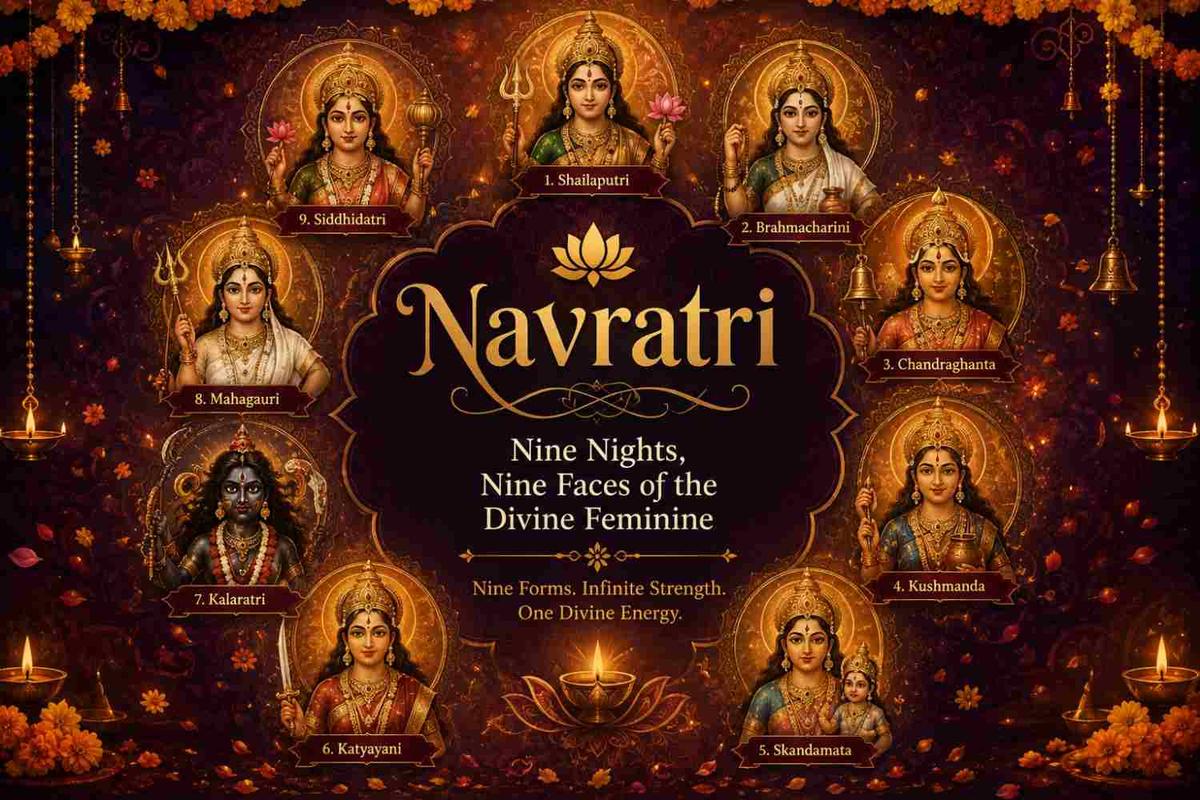
Navratri: Nine nights, nine faces of Shakti
The first indication of Navratri usually comes not from any temple. This could be a spontaneous display of a tiny kalash in the corner of your house, the planting of new barley seeds into the moist so