When Mysuru turns royal for Dasara

RIYA SHARMA
HRDYAM - DISCOVER SACRED JOURNEYS, WISDOM & WELLNESS
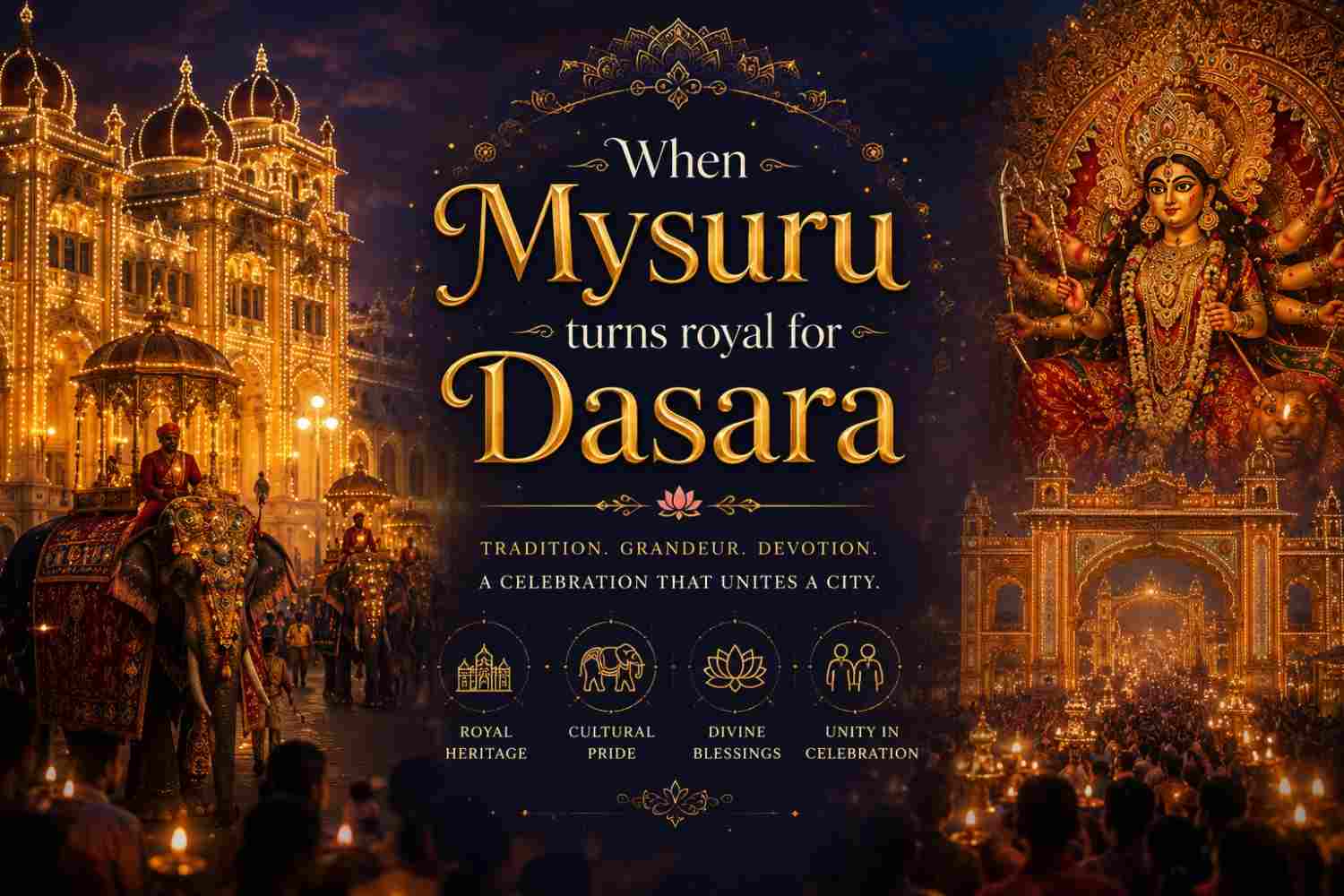
As the festival of Navratri approaches, Mysuru brings out its glorious past of royal culture.
The lanes become bright, music resounds through historical buildings, and the grandiose Mysuru Palace takes centre stage in celebrating Dasara-the ten-day festival of Karnataka that is called Karnataka's Nadahabba (state festival).
However, it is not merely a festival of royalty. In the middle of it all is the Goddess Chamundeshwari, the deity of Mysuru, and her triumph over the buffalo demon Mahishasura. Mysuru is even named after Mahishasura, who is said to have been defeated by the Goddess on the Chamundi Hills close to the city.
Apart from this, there is the factor of royal history that adds to the significance of Dasara in Mysuru. The tradition of celebrating Dasara goes back many centuries and has been endowed with glory by the Wodeyar dynasty.
Thus, while Mysuru celebrates Dasara, it does not merely celebrate a mythological victory. It celebrates its entire royal heritage.
How did royal splendour find its way to the streets?
The glory of Mysuru Dasara has been a process of many years. Over the centuries, the royal nature of Mysuru Dasara was developed. The Wodeyar Dynasty has turned Dasara into the most magnificent celebration of royalty, culture, and religion. According to tradition, Dasara celebrations began as early as 1610 at Srirangapatna and later on were transferred to Mysuru when power was relocated to this city.
The festival used to be deeply associated with the court during the royal period. The King himself performed in magnificent clothing, processions took place in the city streets, and artists, musicians, and other performers were supported by the royal court. What was previously limited to the palace walls turned out to be much more extensive-it became a festival available for everyone to celebrate.
This royal heritage is still preserved nowadays. The palace becomes the center of attention at Dasara, but music, dances, folk performances, exhibitions, and public celebrations bring it much further.
Thus, when celebrating Dasara in Mysuru, the city is doing something really amazing: It transforms a courtly festival into a public celebration.
Where does the Goddess travel in golden splendour?
Next up comes the long-awaited festival of Vijayadashami and Jamboo Savari of Mysuru.
The gates of Mysuru Palace open, and the celebrations shift out of the Palace into the streets. The focal point of the celebration is the image of the Goddess Chamundeshwari, borne in the spectacular Golden Ambari mounted on a decorated elephant. Alongside the image, there are musicians, performers, horses, camels, tableaux and processional groups.
This procession is steeped in history. At one point, the Wodeyar king himself would have been mounted on the Ambari, but now, it is the turn of the Goddess to be the image of royalty that once used to grace the howdah.
As the procession winds its way toward Bannimantap, Mysuru assembles itself on either side of the procession. What was once a festival of kings has become a festival for all to watch, with the palace, the elephants and the Goddess forming one single moving tableau.
In a few hours, the ancient royal city gets transported back to an earlier age. The King does not ride anymore in the Ambari, but the Goddess is at the head of the procession.
What if the palace itself became the theatre?
But the Mysuru Dasara is not limited to the procession alone.
For ten days, Mysuru becomes an open-air stage. The Mysuru Palace is lit up with almost a lakh bulbs, while music, classical dances, folk plays and concerts take place in historic locations all around the city.
Meanwhile, there is the Dasara Exhibition that showcases handicrafts, locally produced goods, food and entertainment, allowing for a peek into life in Karnataka that extends beyond its princely past. There are sports events, wrestling matches and other activities that further enrich the festival experience.
It is rather theatrical. By day, Mysuru has a dignified air of a historic princely state; after nightfall, the illuminated palace, music and crowds turn the city into a dream world.
Standing in front of the shining palace, one can easily understand why the connection between the Dasara Festival and Mysuru has been so strong. For ten nights, the city celebrates its history.
What does a royal celebration taste and sound like?
There is another facet to Dasara which emerges beyond the royal spectacle and is enjoyed by common people.
Throughout the city, food festivals, exhibits, crafts, music, and dances make for a very vibrant cultural scene. The Dasara Exhibition, usually conducted on the other side of the palace at Doddakere Maidan, features handcrafted items, regional products, and foods, thus making the festival an expression of everyday Karnataka, as well as the glory of its past.
Then comes the food. The aroma of Mysuru Pak, along with Karnataka’s snacks and dishes, fills the air while concert performances and folk shows continue. For visitors, these events offer something the royal procession does not-a leisurely exploration of the region through food and art. Because Mysuru Dasara is more than just a spectacle.
How does Mysuru set the night ablaze?

And when the royal procession is over, Mysuru is not quite ready to sleep.
At Bannimantap, the celebrations reach their dramatic finale with the Torchlight Parade, or Panjina Kavayatthu. What began historically as a display of royal military tradition has evolved into a spectacular concluding ceremony featuring disciplined formations, equestrian displays, music, lights and other performances.
Something is fitting about ending Dasara this way. For ten days, Mysuru has moved between devotion and spectacle-from the quiet rituals of Chamundi Hill to the splendour of the palace, from classical performances to the magnificent Jamboo Savari. Now, as torchlight illuminates the night and the final celebrations unfold, the festival seems to gather all those threads into one last burst of energy.
Which old traditions still whisper beneath the celebration?
But there is more to Dasara than palace lights and grand processions. It lives on in the households and neighborhoods of Mysuru.
The delightful practice of Gombe Habba is part of the celebration. As part of the Dasara celebration, it is traditional practice to put up dolls and idols made by family members, arranged in elaborate displays that include stories from mythology and day-to-day activities. This custom dates back to the Vijayanagara era and is an ongoing practice in Mysuru.
Then there are folk traditions that find a voice during the Dasara period. Dancers and performers from all over Karnataka participate in folk arts such as Dollu Kunitha, Pooja Kunitha, theater, and puppet shows. These dances were once enjoyed by the royal court and have found a place in the streets of Mysuru for all people to witness.
Even in the smallest way possible, the celebration continues through home decoration, exchanging sweets with the neighbors, doll exhibitions attended by children, and the performing artists who have found a platform in the city.
Thus, while the image that the world sees of Dasara is that of Jamboo Savari, it tells a story of the festival in another way, where Dasara is lived in the house itself.
When does a royal festival become Karnataka's own?
Mysuru may capture the limelight, but Dasara is the festival of the entire cultural scene of Karnataka. The festival takes diverse forms across Karnataka, in keeping with the traditions and contexts.
While in Mysuru, Dasara is all about the royal procession and palace functions; elsewhere, the festival is more likely to manifest itself through folk theatre and other community celebrations and activities. Even festivals like the Bombe Habba, the festival of dolls, ensure that Dasara is brought into people's homes in the form of colorful tableaus of myths and everyday life, accompanied by visits of guests and sharing of sweets.
It is this diversity that makes the festival of Karnataka-the Nadahabba-so interesting. The festival does not insist upon uniformity in the mode of celebration everywhere.
What happens when Dasara climbs into the sacred hills?
Before the celebration of the palace, the spiritual essence of Mysuru Dasara ascends above all-the Chamundi Hills.
The Chamundeshwari Temple is located there, and the Goddess Chamundeshwari is revered as the guardian deity of Mysuru. In accordance with legends, the hill was the place where the Goddess killed the demon Mahishasura and thus connected the city with an old Dasara story.
During the time of Dasara, the ceremonies on the hill create a more pious side of the grand festivities. When hundreds of people celebrate the illuminated palace, the temple becomes a place for prayers.
Moreover, there is a physical experience for those who wish to visit the temple-they have to climb 1,008 stone stairs, seeing the giant statue of Nandi on the way. At the top of the hill, the entire city can be seen-palaces, neighborhoods, and the landscape of Mysuru. This is the place where all the glory of the celebration is grounded.
When music fills the palace, who can stay still?
While the ceremonies and procession are part and parcel of Mysuru Dasara, it also stands for the performing arts of Karnataka. The festival features traditional musicians, dancers, folk and contemporary artists on the stages of the city, thus transforming historical locations into music and dance venues.
There is constant musical change, and one day might be dedicated to classical music, another day to folk forms, while large-scale public programs attract young people. Folk forms, cultural performances, and concerts guarantee that Dasara is not only about watching but also listening and experiencing.
And maybe that is the beauty of Dasara because the pompous royalty never stands alone.
When does a royal festival become everyone's?
Apart from the grandeur of the royals’ parade, there is also the rhythm of the city itself during Mysuru Dasara Festival.
Bazaars get crowded, tourists start flooding the streets, craftspersons showcase their creations, while people come out to admire the exhibits, food stalls, music performances, and more all over the city. Of course, the Dasara Exhibition is particularly representative of the coming together of crafts, textiles, regional goods, food, and entertainment.
It is here that the celebration starts resembling more of a festive event than a solemn ritual. One moment you could be watching a classical music concert, and the next you may well find yourself at a folk art performance or enjoying an edible, buying handicrafts of Karnataka before ending up under the palace’s light in the evening. And it is here that the true character of the festival lies.
Who carries the weight of Mysuru's splendour?

There is nothing as memorable as seeing decorated elephants walking on the streets of Mysuru during Mysuru Dasara. However, behind this amazing spectacle comes months of practice.
Elephants used in the Jombo Savari go through a special training program to enable them to withstand large crowds, noise, lights, and activities. The decorations are done to suit them specifically so that they change from being working animals to magnificent creatures of one of the most memorable traditions of Karnataka.
The most notable ones carry the decorated palanquin containing the Goddess Chamundeshwari. Others, such as the elephants, horses, camels, musicians, folk dancers, and tableaux, are seen moving around it, thereby forming a parade of animals, humans, and festivities.
However, what is important to note in all this splendor is the fact that the elephants are not mere decorations.
What if you could walk into Mysuru's royal story?
Mysuru Dasara will truly be experienced by the traveller only when it is not observed as an event from afar, but lived through devotion, royalty, and the vibrant culture of Karnataka.
At HRDYAM, visitors can understand the spiritual side of the celebration at Chamundeshwari Temple, learn about the heritage of Mysuru, admire the beauty of the lighted palace, and the surrounding culture of Nadahabba. The spiritual journeys of HRDYAM have been crafted with the intention to combine spirituality, culture, and an easy travel experience, with confirmed guides and carefully selected experiences.
Right from the Goddess at Chamundi Hills to the golden Ambari passing on the streets of Mysuru, everything about Dasara is unique in its own way; it's like the end of a spiritual trip in its own way.
Conclusion
As the final procession winds its way through the streets and the lights in the palace finally fade away, Mysuru resumes its peaceful pace. The elephants and the stages are put back into storage as the crowds begin to dissipate.
But Dasara doesn't leave empty-handed.
It leaves with the picture of Chamundeshwari looking down from above, the glittering Ambari passing down through cheering streets, drums beating through the night sky, and a majestic palace shining through the darkness.
Maybe this is why Mysuru Dasara has been celebrated for centuries. It is not merely the festival of an ancient legend or a remembrance of old kings. It is a vibrant confluence of faith, history, art, and people-a celebration where the legacy of Karnataka finds a place in its present.
And as the last light fades out, one thing stays in mind: The festival lasts ten days, but Mysuru Dasara endures throughout the year.
Spiritual travel researcher, Vedic cultural writer, and contributing editor at HRDYAM.
You Might Also Like
Tags
More Articles
View all
What is HRDYAM? The AI-Powered Spiritual Ecosystem
The spiritual essence of India has not merely consisted of temples alone. It is found in pilgrimage circuits, old rituals, Vedic astrology, Yoga, Ayurveda, sacred rivers, traditions of the region, art

How HRDYAM blends spirituality with sustainability
How would pilgrimage change if it were no longer viewed as a trip to a shrine but as an engagement with the entire sacred geography? The river next to the shrine, the communities that live by the shri
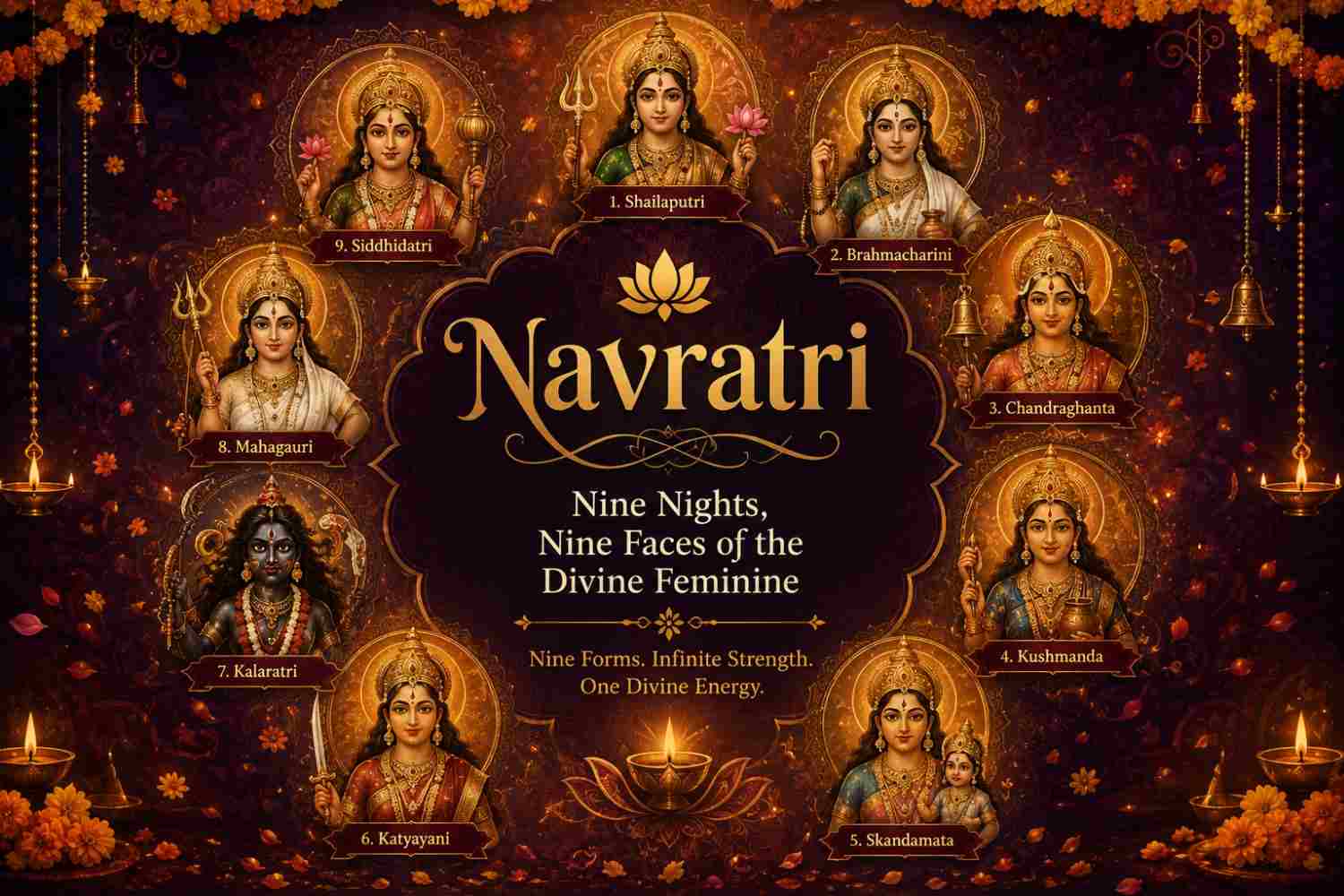
Navratri: Nine nights, nine faces of Shakti
The first indication of Navratri usually comes not from any temple. This could be a spontaneous display of a tiny kalash in the corner of your house, the planting of new barley seeds into the moist so