Maa Siddhidatri: where the journey finds its fulfilment

RIYA SHARMA
HRDYAM - DISCOVER SACRED JOURNEYS, WISDOM & WELLNESS
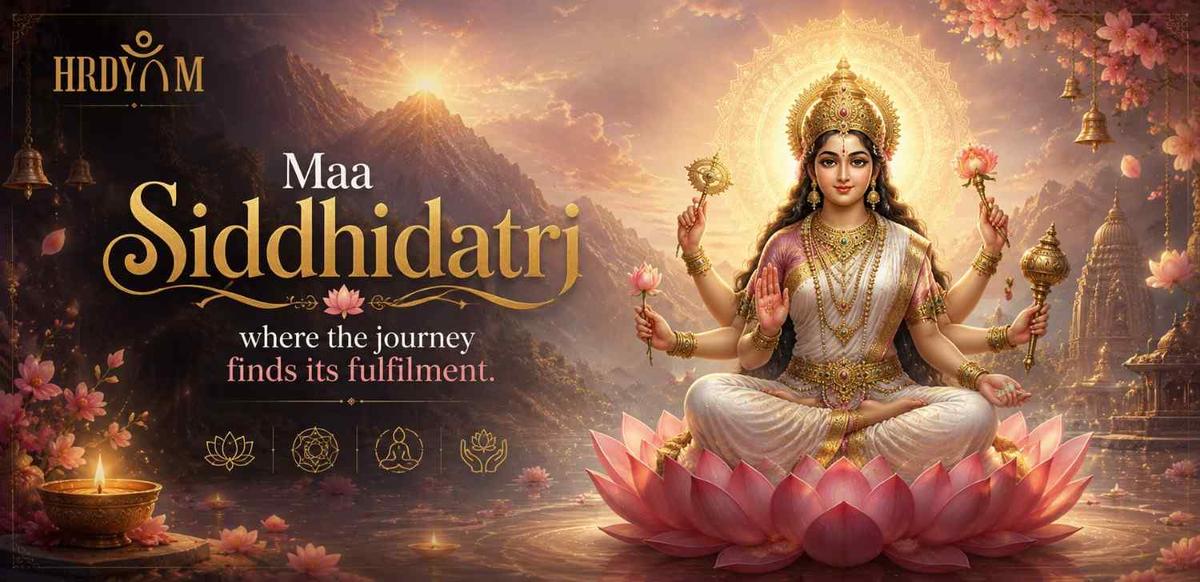
Day nine marks the end of the journey of the Navdurga with Maa Siddhidatri.
Maa Siddhidatri is generally considered the ninth manifestation of the Mother, and she is worshipped during Mahanavami. Her name is derived from the two words Siddhi, which means achievement or accomplishment, and Datri, which means the giver; thus, she is the giver of siddhis or spiritual accomplishments.
Traditionally, Maa Siddhidatri is said to be sitting on a lotus seat and having four hands holding a chakra, conch, mace, and lotus.
The image of Maa Siddhidatri signifies completion and peace associated with the last day of Navratri. Her importance can be better understood in the context of the entire Navratri journey.
Our Navratri journey started with Shailputri, who signifies the grounding and starting of something new.
Next came discipline, devotion, courage, nurturing, action, fighting against darkness, and finally the process of cleansing by Mahagauri.
Now the stage of Siddhidatri has come-the stage of attaining something.
However, the term siddhi need not necessarily mean supernormal power. It could also signify the attainment of wisdom, clarity, and completeness that results after hard work and transformation.
Thus, Maa Siddhidatri sends us an especially profound message: Growing up is not just about becoming powerful; it is also about becoming complete.
Traditional narratives have also attached the fact that the great lord Shiva received his siddhis as well by the grace of Siddhidatri, and her appearance out of the left half of Lord Shiva is also related to the philosophy of Ardhanarishvara, representing the complementary existence of male and female entities.
Thus, it brings forward yet another important philosophy: balance.
Complete fulfillment can be achieved by developing only one side of us. Wisdom requires empathy. Power requires knowledge. Aspiration requires moderation. Actions require contemplation.
This pilgrimage does not conclude once the worship of all nine avatars is complete. It concludes when the teachings of these nine avatars start taking shape within us.
Maa Siddhidatri teaches us that ultimate achievement is not in acquiring more powers. It lies in being wise enough to use knowledge and power in the best possible way.
Who is the goddess of spiritual fulfilment?
Siddhidatri Maa is revered on the ninth and last day of the Navratri festival, called Mahanavami. She is the ninth incarnation of the Navdurga and embodies siddhi, fulfillment, enlightenment, and knowledge.
Even the name of the goddess makes it evident that she is the embodiment of attainment and perfection because “siddhi” means attainment or perfection and “Datri” is the giver. Therefore, Siddhidatri is considered to be the goddess who provides the devotee with all kinds of siddhis.
She usually has four hands, is sitting on a lotus, and in some traditions, is accompanied by a lion. In her hands, she holds chakra, gada, shankha, and lotus.
The importance of the goddess is most evident in terms of the culmination of the Navratri period.
These gradually brought into focus various aspects of Shakti: stability, discipline, creation, nurturing, courage, destruction of darkness, and purity.
Siddhidatri signifies what follows as a result of these aspects starting to converge together: integration and completion.
There is yet another myth associated with this form of Mother, where she is said to be responsible for giving siddhis to Lord Shiva, following which the Shiva-Shakti combination was established as Ardhanarishvara.
This adds another dimension to her manifestation: completeness in harmony.
True spiritual growth does not lie in developing oneself as a powerhouse of one aspect alone. Wisdom needs compassion. Courage needs intelligence. Discipline needs adaptability. Power needs humility.
Therefore, Maa Siddhidatri signifies a state where all these qualities don’t compete against each other, but collaborate.
This makes her the ideal deity of the ninth day. Nine days of transformation lead us to completeness, not battle.
Maa Siddhidatri shows us that the greatest attainment lies not in acquiring power but in having the wisdom to wield it properly.
How did the mother become the source of Siddhis?
The mythological stories of Maa Siddhidatri are not restricted to the typical tale of good versus evil. The myth of Maa Siddhidatri includes her involvement in the creation of the world, divine powers needed to uphold the world, and completeness.
According to another tradition, in the early stages of the creation of the world, Trimurti-Brahma, Vishnu, and Shiva-turned to the Divine Mother for wisdom and divine powers. Maa Siddhidatri appeared in front of them and granted them the powers needed to carry out their cosmic duties.
Maa Siddhidatri is also linked with the eight traditional siddhis-Anima, Mahima, Garima, Laghima, Prapti, Prakamya, Ishitva, and Vashitva. They are forms of divine accomplishment and mastery.
Yet another tradition describes the link of Maa Siddhidatri with Lord Shiva and Ardhanarishvara. According to that tradition, it was due to her divine grace that Lord Shiva gained siddhis. Shiva and Shakti are depicted in the form of Ardhanarishvara, which means half male and half female.
The process of creation requires both consciousness and energy. Power needs wisdom. Action needs awareness. Each ability becomes powerful when they complement each other instead of competing.
That is why the story of Maa Siddhidatri seems to be an ending point for the entire festival.
She tells us about the first steps, endurance, nurturing, struggle, challenge, purification, and transformation of everything. But she invites us to find harmony between all of these.
Thus, the conclusion of the story shows that true attainment is never about acquiring any power.

What do her four hands reveal?
The form of Maa Siddhidatri symbolizes the culmination of the Navdurga peregrination process. The symbolism associated with her image includes tranquility as well as power, signifying that spirituality cannot involve renunciation of strength but rather a proper balance between various attributes.
The Lotus
Maa Siddhidatri sits on a fully blooming lotus, which symbolizes purity, enlightenment, and the blossoming of consciousness. The fully blooming lotus is very appropriate for Maa Siddhidatri as it symbolizes the fulfillment of something.
The Chakra
Chakra is a symbol of cosmic order and time. Chakra also implies the idea of overcoming all difficulties and maintaining the right direction of movement.
The Gada
The gada, or mace, symbolizes strength and power to surmount any obstacles. Through Siddhidatri, strength comes to be one of the means necessary to achieve spirituality.
The Shankha
The conch shell signifies the divine sound and the awakening of consciousness. It is a symbol of the link between consciousness and universal rhythm.
The Four Hands
Through her four hands bearing these sacred items, it is implied that various powers can come together: wisdom, strength, purity, and consciousness.
The Lion
The lion, when the goddess is depicted in that form, symbolizes courage and victory over fear. This links the last form with the power gained during the previous forms of Navratri.
The Siddhis
Perhaps the most unique symbol of Goddess Siddhidatri is the siddhi, which is essentially an extraordinary spiritual power. There are eight main siddhis according to tradition and associated with Maa Siddhidatri.
However, there is more to learn from that.
The ultimate purpose of spiritual development is not gaining extraordinary abilities but mastery over oneself.
After the grounding of Shailputri, Brahmacharini's discipline, Katyayani's courage, Kalaratri's transformation, Mahagauri's purification, and finally, Siddhidatri signifies the moment of integration of all these qualities.
The conclusion is not in being more powerful than others, but rather in becoming more complete in oneself.
How is the ninth day of Navratri observed?
Navami marks the ninth day, and so the worship of Maa Siddhidatri becomes the concluding part of Navratri puja. The puja can be kept simple, and the main focus should be on devotion and gratitude.
Puja Steps
First, clean your puja place and take a bath before performing puja.
Put the idol or picture of Maa Siddhidatri next to the Kalash.
Light a ghee diya and offer incense sticks.
Offer kumkum, chandan, akshat, and flowers; lotus is preferred if possible.
Offer fruits, coconut, sweets, or Navami bhog.
Mantra to chant: ॐ देवी सिद्धिदात्र्यै नमः॥
If your family ritual includes it, carry out havan on Navami.
Kanya Puja is another ritual that takes place on Ashtami or Navami for many families, where girls are given food and respect.
Carry out the aarti of Maa Siddhidatri and give out the prasad.
The most significant part of worshipping Siddhidatri is the prayer at the end of it. After worshipping different aspects of Shakti for nine days, Navami is an appropriate time to thank God for everything learned along the way.
What offering completes the ninth day?
During Navami, Maa Siddhidatri is usually given sattvic food items like halwa, puri, and black chana that form an integral part of Navratri Puja. Fruits, coconut, and kheer can also be used for offering.
Traditional Bhog
Halwa - particularly sooji halwa
Puri
Black chana
Fruits
Coconut
Kheer
The food combination of halwa, puri, and chana also has a natural link to Kanya Pujan, which takes place in many households on Ashtami or Navami.
It would be apt to end the nine-day celebration with such a comforting food combination. With all the symbolic meaning of Shakti, struggle, cleansing, and transformation, it is on Navami that the Goddess makes her presence felt in the most intimate form possible-prasad.
Why does purple mark the final night?
Purple is usually connected with the 9th day of Navratri and Maa Siddhidatri. The meaning of the color during the celebration is deep spirituality, wisdom, ambitions, and fulfilment.
How to Include the Color in Your Festivities?
Wear a purple saree, suit, kurta, or dupatta.
Add purple flowers or decorative elements to your puja space.
Put on purple bangles, earrings, or other accessories.
Choose purple for your rangoli or home decorations.
This color isn’t obligatory since traditions of Navratri colors may differ among various calendars, regions, and communities. For some, Day 9 is linked to pink or white.
The color seems to be the best match for Maa Siddhidatri as it reminds me of an intersection of power and tranquility. After nine days of experiencing different manifestations of Shakti, the last color may serve as a metaphor for the process of transition from the state of striving to wisdom, balance, and fulfillment.
What does her worship awaken within us?
Maa Siddhidatri is worshipped traditionally for knowledge, spiritual development, satisfaction, inner peace, and the development of higher powers. Being the last form of Navdurga, her worship signifies the end of the nine-day spiritual pilgrimage.
Devotees seek her blessings for:
Knowledge and wisdom: Getting wisdom and more understanding.
Spiritual development: Reaching inner awareness.
Satisfaction: Satisfying oneself in the things that one tries to do.
Inner peace: Balancing the different aspects of life.
Freedom from ignorance: Getting more knowledge about oneself and one's aim.
Strength and power: She blesses devotees with siddhis (powers).
Peace and satisfaction: Getting calmness in one’s mind.
Freedom: Maa Siddhidatri is also known for giving the gift of liberation in the devotional tradition.
However, the most significant aspect may well be that of integration.
Navdurga comprises nine manifestations that could be seen as a process: initiation, discipline, courage, nourishment, activity, confrontation, cleansing, and, ultimately, attainment.
Siddhidatri is Maa who signifies the transformation of all those experiences into knowledge.
Her wish, therefore, should not be taken literally as: “I hope I get whatever I desire.” It could also mean: “I hope I am wise enough to know what I require, able enough to accomplish it, and modest enough to use it wisely.”
What should be avoided on the final day?
Maa Siddhidatri is associated with achievement and spiritual accomplishment, which means that the last day is not about pomp and show, but about ending the Navratri celebrations with sincere devotion and gratitude. Traditionally, Navami celebrations may involve puja, havan, and Kanya Puja, based on individual preferences and practices.
- Considering Siddhis the Primary Objective
Siddhi may be interpreted as supernatural skills, but the real message of Maa Siddhidatri is wisdom and spiritual growth. Do not turn her worship into a request for supernatural skills.
- Not Reflecting on the Journey of the Nine Days
Navami is the end of Navratri. Take some time to contemplate the meanings of the nine forms of the goddess and what you have learned from your own Navratri experience.
- Carrying Out Kanya Puja in an Irreverent Manner
If Kanya Puja is a part of your Navami celebration, then traditionally the girls are worshipped with all due respect because they symbolize the Goddess.
- Turning into Obsessive with Material Success
Siddhidatri is linked to fulfillment, but spirituality does not depend only on material richness and success.
Think about it: “Which type of success will make me feel fulfilled in life?”
- Comparing Rituals
The practices of Navami vary from family to family and from region to region. Some practice havan; others practice Kanya Puja; others are just involved in household puja. There is no need to criticize other people’s rituals as they are different from your own.
- Losing Gratitude
The final day after nine days of worship is a chance to express gratitude for strength in hard times, for wisdom gained, and for a chance to start anew.

Is Siddhi really about supernatural power?
The term “siddhi” may simply denote supernatural power, but the significance of Maa Siddhidatri is far more profound than that. She has traditionally been considered the bestower of siddhis and the end point of the Navdurga pilgrimage.
A siddhi, however, may also denote attainment-that which comes as an outcome of discipline, devotion, wisdom, and transformation.
Such an interpretation of the ninth day carries great significance.
For most of our lives, we struggle to achieve things-knowledge, wealth, status, skills, and success. Siddhidatri asks a different question: What transformation has occurred in your life as a result of all that you have achieved?
The nine aspects can thus be looked upon as a transformation process:
Shailputri - grounding
Brahmacharini - discipline
Chandraghanta - courage and balance
Kushmanda - creativity
Skandamata - nurturing
Katyayani - decisiveness
Kalaratri - dealing with darkness
Mahagauri - purity
Siddhidatri - completion and integration
Which is why Siddhidatri has to be placed at the end. This is no longer a case of overcoming another challenge; it’s all about integrating all that you’ve learned.
The greatest of all siddhis is not, therefore, having superpowers, but the wisdom to control oneself, discover one’s purpose in life, and make use of one’s powers.
Can a mantra lead the mind toward stillness?
As the ninth and last Navdurga, the worship of Maa Siddhidatri relates to chanting mantras, meditation, and thoughts on attaining spiritual perfection. Her primary mantra is:
ॐ देवी सिद्धिदात्र्यै नमः॥
Om Devi Siddhidatryai Namah.
A simple practice on Navami would be to sit quietly in front of the Goddess, light a diya, and chant the mantra aloud for some minutes.
Instead of focusing all your attention on what you wish to get, use your meditation to focus on becoming what you wish.
You could think about:
What quality have I cultivated over these nine days? What fear have I overcome? What do I need to let go of? In what areas do I require more balance? How may I make better use of my talents?
The traditional dhyana mantras associate Siddhidatri with the four-armed Goddess sitting on the lotus flower that symbolizes spiritual fulfillment and bestowing siddhis.
This makes meditation on her particularly appropriate for the last day.
Siddhidatri’s prayer is not simply “Give me more.” It is “Help me deserve what has been given to me.”
Why is the girl child honoured on Ashtami or Navami?
One of the most significant rituals conducted during Navami is Kanya Puja. Young girls are worshipped as representations of the Goddess in many houses and are offered food, gifts, and blessings. The ritual can take place on Ashtami or Navami depending on regional or familial customs.
The Significance Behind It is that Kanya Puja brings the concept of Shakti down to Earth.
Shakti, or the Goddess, cannot be confined to temples or idols alone. The ritual urges devotees to recognize and honor the divine feminine principle in all living things.
Halwa, puri, and black chana are traditionally prepared in many houses and presented to the girls with utmost respect before presenting gifts or dakshina.
However, there is a great lesson behind this ritual.
If devotees worship the Goddess but fail to honor those around them, then their worship is incomplete.
That makes Kanya Puja a very appropriate ritual to perform on the last day of Navratri after thinking about different aspects of Shakti for nine days.
What are the eight Siddhis she represents?
Maa Siddhidatri is said to be connected with eight different Siddhis, which are spiritual powers of great significance. They include Anima, Mahima, Garima, Laghima, Prapti, Prakamya, Ishitva, and Vashitva.
The Eight Siddhis
Anima - Being able to become very small or subtle.
Mahima - Becoming of huge size.
Garima - Becoming very heavy.
Laghima - Being able to become very light.
Prapti - Attaining that which one needs or being able to acquire whatever cannot normally be attained.
Prakamya - Fulfilling all wishes.
Ishitva - Being a master over all worldly affairs.
Vashitva - Being able to command or control.
However, a more meaningful way to understand these concepts can be found.
In addition to viewing them as supernatural powers, they can also encourage contemplation on the ability to master the inner self.
Anima can symbolize humbleness-recognizing when one needs to become small.
Mahima can be taken to mean expanding one’s viewpoint.
Laghima can help one to drop unneeded weights.
Garima can symbolize being grounded.
Prapti can encourage one to achieve a certain goal with purposefulness.
Prakamya can be taken to mean understanding the true desires of oneself.
Ishitva can remind one to cultivate self-mastery.
Vashitva, on the other hand, can simply mean self-control.
All this helps to return to Maa Siddhidatri.
The ultimate power is not the ability to control your surroundings but being able to master yourself to the point that you no longer have to worry about being controlled by the surroundings.
Experience Maa Siddhidatri with HRDYAM
Devotion to Maa Siddhidatri is the last step in the Navdurga pilgrimage-the point of union of dedication, discipline, knowledge, and transformation. And this idea fully corresponds to what a pilgrimage can become when it is not just a physical way to reach the destination.
Using HRDYAM, people can make their intention true and organize the real spiritual journey with the help of temple tours, Shakti experience, VIP darshan, spiritual guides, and an itinerary. HRDYAM now provides tours to such sacred places as Kamakhya, Varanasi, Ayodhya, Ujjain, Char Dham, and others.
The tour devoted to Maa Siddhidatri can give much more than temple visits. It will allow devotees to slow down, connect again with their practice, learn Indian traditions, and receive inspiration.
The HRDYAM program incorporates pilgrimage, puja ceremonies, Vedic knowledge, wellness, and spiritual tourism in an integrated ecosystem to ensure that these activities are more organized and accessible.
Let the last day of Navratri be the start of your very own sacred journey.
With HRDYAM, experience the sacredness of India through its wisdom and devotion rather than just seeing it.
Conclusion
Maa Siddhidatri brings the Navdurga journey to its culmination-from grounding and discipline to courage, transformation, purification, and finally spiritual attainment. She represents the wisdom and fulfilment that emerge when all these qualities come together.
But the journey of Navratri does not truly end with Navami. The real purpose is to carry the qualities of the Goddess into everyday life-to live with greater courage, compassion, discipline, clarity, and faith.
And perhaps that is the greatest siddhi of all: To become the person your spiritual journey was trying to awaken within you.
As the nine days come to an end, let the devotion continue beyond the temple, beyond the festival, and into the journey of life.
Navratri might conclude with Maa Siddhidatri, but the start of your path towards self-realization can happen now.
Spiritual travel researcher, Vedic cultural writer, and contributing editor at HRDYAM.
You Might Also Like
Tags
More Articles
View all
What is HRDYAM? The AI-Powered Spiritual Ecosystem
The spiritual essence of India has not merely consisted of temples alone. It is found in pilgrimage circuits, old rituals, Vedic astrology, Yoga, Ayurveda, sacred rivers, traditions of the region, art

How HRDYAM blends spirituality with sustainability
How would pilgrimage change if it were no longer viewed as a trip to a shrine but as an engagement with the entire sacred geography? The river next to the shrine, the communities that live by the shri
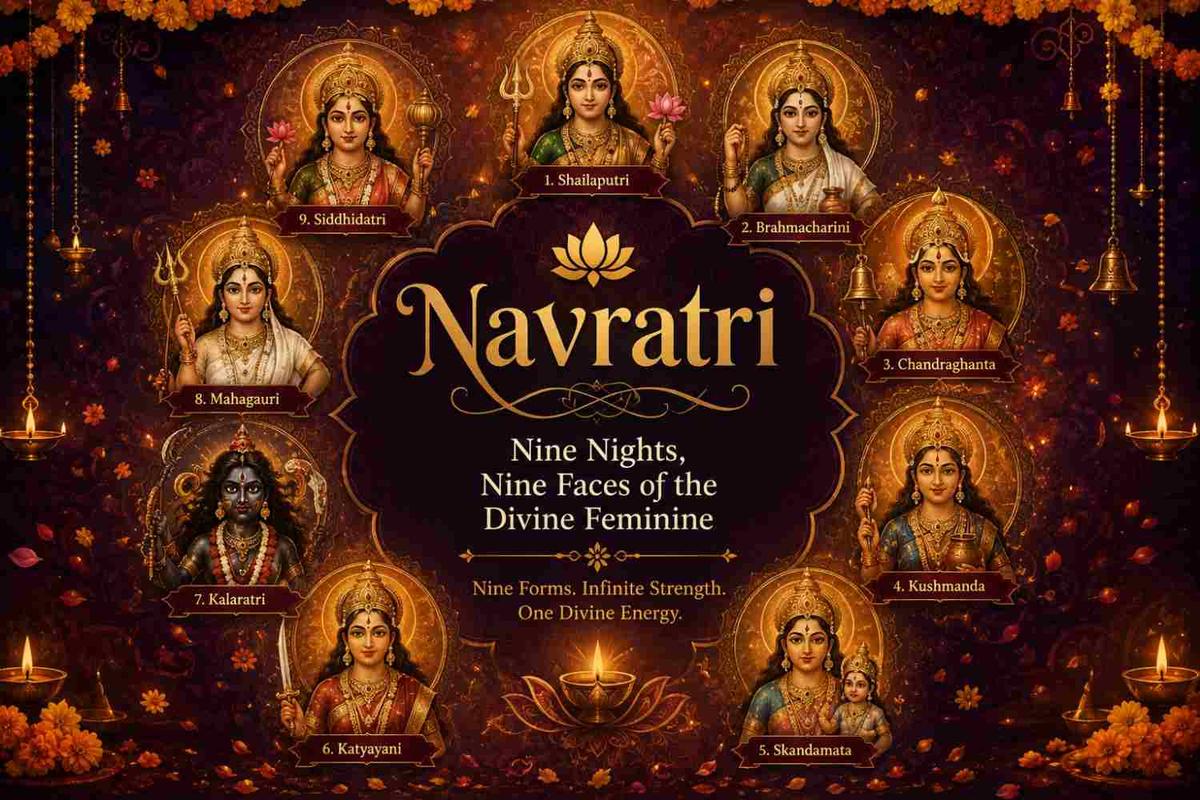
Navratri: Nine nights, nine faces of Shakti
The first indication of Navratri usually comes not from any temple. This could be a spontaneous display of a tiny kalash in the corner of your house, the planting of new barley seeds into the moist so