Maa Chandraghanta: The bell that awakens courage

RIYA SHARMA
HRDYAM - DISCOVER SACRED JOURNEYS, WISDOM & WELLNESS
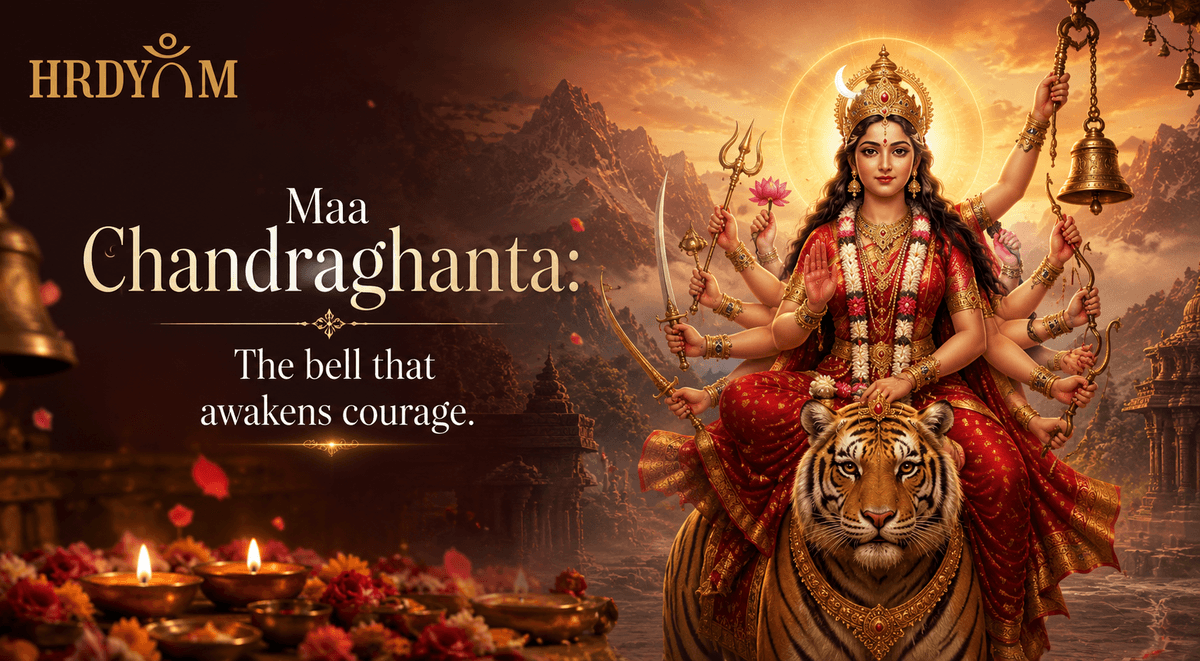
A change occurs in the appearance of Navratri from its third day onwards.
While the still determination of Maa Brahmacharini transforms into a manifestation that seems to get ready for an act of war. With a crescent moon on her forehead resembling a bell and weapons in hand, she prepares for a fight in a calm, commanding manner.
Maa Chandraghanta is the third form of Navdurga.
The name itself is very descriptive. In Hindi, 'Chandra' means moon and 'Ghanta' means bell. Her crescent-shaped moon on the forehead resembles a bell; thus, the name Chandraghanta. She is typically represented as having many arms, wherein she holds weapons as well as makes gestures of protection and blessings.
However, what fascinates me about her is this contradiction in her very form.
While being a symbol of courage and willingness to stand up against injustice, there is a side of her which also represents peace and serenity. Maa Chandraghanta is definitely not a representation of blind anger but rather a symbol of peace that has to be fought for sometimes.
Thus, making Navratri Day 3 a turning point in the journey of the Navdurga.
Maa Shailputri taught us how to position ourselves on the first day. Maa Brahmacharini taught us on Day 2 about the commitment that is needed. Now, on Day 3, Maa Chandraghanta teaches us to take that inner strength and use it in case we need courage in life.
This particular deity is very much relevant for the present times. Peacefulness does not necessarily mean pacifism. Kindness does not mean allowing other people to overstep all of your boundaries. Calmness does not mean inability to stand up for yourself.
Sometimes courage takes the form of praying silently. Other times it takes the form of saying 'no'. And sometimes, it simply means placing oneself between that which is right and that which would threaten it.
Thus, on the 3rd day of Navratri 2026, Maa Chandraghanta teaches us that courage does not have to be noisy. It can be poised and protective like a ringing bell.
The warrior goddess with the crescent moon
Maa Chandraghanta is the third goddess who is worshipped during the nine days of Navratri and is considered the third manifestation of Navdurga. The name Chandraghanta signifies Chandra, meaning moon, and Ghanta, meaning bell. The crescent moon on her forehead has the shape of a bell, hence the name Chandraghanta.
There is something very interesting about the transformation of Maa Chandraghanta during the Navratri journey after the completion of a penance of long hours. After Maa Brahmcharini, Parvati in the form of a married goddess is worshipped with all the power and responsibilities attached to it. She rides a lion with ten arms holding weapons and signs, and two of her arms show protection signs.
Initially, she appears to be ferocious, but she is calm within her. The balance of both these qualities is essential to know about her persona. She is not someone who seeks a fight, but she is capable of standing up against any threat.
The bell-shaped moon above her forehead has its own importance too. A bell rings-it breaks the silence and brings attention, showing that something significant is going on. For Maa Chandraghanta, it can be considered an indication to awaken our courage whenever necessary.
Her lion shows fearlessness and power, while the weapons held in her hands show her willingness to challenge all those powers that disrupt the peace. But she still provides her blessings to those devotees who come to her for protection.
So, it can be considered the next distinct phase of Navdurga. Maa Shailputri has taught us how to create our presence. Maa Brahmacharini has taught us to be loyal and devoted. Maa Chandraghanta has taught us to use this power with courage whenever needed.
Her teachings are very simple yet powerful. It is not necessary to avoid the battle to keep peace. Sometimes, one has to fight in order to maintain peace.
When peace took the form of power
The tale of Maa Chandraghanta comes at an entirely different juncture of Parvati's life compared to all others. Following the intense penance undertaken by Maa Brahmacharini, the desire for unity with Lord Shiva was granted. Her marriage with Shiva brought forth yet another form, which was both gentle like a bride and a warrior.
As per tradition, following her marriage, Parvati started wearing a crescent moon on her forehead. The shape of this moon was similar to that of a bell, or ghanta, thus earning Parvati the name 'Chandraghanta,' meaning the Goddess whose forehead is marked by a moon-shaped bell.
However, the imagery of a newly married Parvati soon changes course in her legend.
She is shown in a fearsome warrior incarnation, riding a tiger or lion, and possessing many arms armed with weaponry. While her looks signify her preparedness to battle those who seek to disrupt peace, the look on her face is calm and not enraged. This dichotomy is the essence of Maa Chandraghanta.
Her tale shows that courage is not incompatible with compassion. One can be gentle but not cowardly, peaceful but not powerless.
In addition to her other meanings, the bell-shaped moon on her forehead provides yet another. The bell proclaims its presence through sound. It calls for attention; it breaks the silence and tells us that some significant event is happening. In the figure of Maa Chandraghanta, it might be interpreted as a call to awaken our own courage in situations where we need to take action.
That is why the appearance of Maa Chandraghanta on Navratri Day 3 gains additional significance. With Maa Shailputri, the journey began with stability. With Maa Brahmacharini, the journey gained strength because of discipline. With Maa Chandraghanta, this discipline is turned into courage.
Hence, her tale cannot be reduced just to fighting with her enemies.
A form where grace meets fearlessness
The appearance of Maa Chandraghanta is probably the most unique among all Navdurga. It is because she represents a combination of the gracefulness of Parvati and the readiness of a warrior. Beauty and strength coexist in this embodiment.
The Crescent Moon and the Bell
The most distinct part of Maa Chandraghanta is the shape of her forehead-the crescent moon in the form of a bell. The origin of her name can be found here, in the combination of Chandra (moon) and Ghanta (bell).
The moon is often considered a symbol of the mind, whereas the bell symbolizes an awakening. In this context, we may interpret this symbol as a mind that is calm but awakened, peaceful but alert.
Her Lion
Chandraghanta Maa is depicted riding a lion, which symbolizes courage, confidence, and the capability to face danger.
Also, the lion brings about another change in the mood of the form of the goddess. She is not only sitting in meditation but is prepared to act when there is a need for action. This indicates that courage is not just the lack of fear; rather, it is the readiness to act in spite of fear.
Her Weapons
Maa has numerous hands that hold various weapons and objects of reverence like trishul, sword, mace, bow and arrow, lotus, and kamandalu.
Instead of considering the use of the weapons only as acts of war, we may consider them as different kinds of power in life: discernment, courage, protection, and determination, as well as the readiness to face the dangers that come against peace.
Her Calm Expression
Undoubtedly, the most striking contrast is in her imagery.
While she is surrounded by weapons and mounted on a ferocious beast, the depiction of Maa Chandraghanta is one of peace and tranquility. There is no indication of anger overtaking her. That means that strength need not necessarily imply a loss of inner calm.
Ten Hands
Her ten hands signify her ability to react to several challenges at once. Her ten hands also symbolize the various roles that strength entails, such as protection, guidance, confrontation, and nurturing.
It is for these reasons that Maa Chandraghanta holds immense significance. Strength and gentleness are two sides of the same coin. It is possible to maintain one's gentleness within despite being strong enough to stand firm in difficult situations.
Perhaps this is the real message in her imagery-peace can only have meaning if it is backed by the strength to protect it.
Awakening the courage within

On the third day of Navratri, the path takes yet another twist. Maa Shailputri has shown us how to start, and Maa Brahmacharini has shown us how to persevere. Maa Chandraghanta poses a new challenge: How do you respond when the test of your mettle comes along?
With courage and poise, according to Maa Chandraghanta.
While the warrior image of Maa Chandraghanta may seem threatening at first glance, it must be noted that her calm demeanour is just as important as the weapons she wields. This goddess symbolizes the ability to face tough situations without getting consumed by fear or rage. She possesses strength but is unflappable in thought.
Courage doesn't necessarily involve doing anything spectacular all the time. It sometimes involves having a hard conversation, standing up for those who are being bullied, setting boundaries, or confronting your fears.
There is also an important difference between anger and courage. Anger makes us react immediately; courage gives us the freedom of choice about our reaction. The representation of Maa Chandraghanta perfectly illustrates this difference-she is ready to fight, yet she is not represented as losing her control.
Her bell-shaped crescent moon symbolizes the next part of her teaching. A bell shatters the silence and draws all attention to itself. You can see the bell as a symbol of awakening-realization of the need for change and courage to act instead of passive tolerance.
Find out where fear was making decisions for you, where you need more boundaries, and where you confused peace with passivity.
Maa Chandraghanta doesn't show us that we should look for fights everywhere. Instead, she teaches us to be ready for a fight when it comes.
Because sometimes maintaining your peace may require more than being silent. It requires courage to defend it.
Honouring the warrior spirit
By the third day of Navratri, the mood of the puja gets different. The mood of austerity in connection with Maa Brahmacharini transforms into something that signifies fearlessness, protection, and the desire to take action. Thus, you can perform the puja with a little more vigor without losing the simplicity of a home puja.
Firstly, clean the puja place as well as yourself and then arrange the offerings. Arrange the image or idol of Maa Chandraghanta in front of the Kalash and light the ghee diya.
Puja Vidhi Procedure
Start the process by offering Ganesh Vandana and make yourself mentally prepared before you begin the puja proper.
Invoke Maa Chandraghanta by offering flowers, akshat, kumkum, sandalwood, and water based on the custom followed by your family.
Offer Jasmine flowers, as these are typically offered while worshipping her.
Light up the diya and the incense so that the puja area becomes calm and peaceful.
Offer bhog, and milk-based dishes like kheer are commonly offered as part of her offerings.
Chant Maa Chandraghanta Mantra: ॐ देवी चन्द्रघण्टायै नमः॥
Ringing the temple bell during the worship or the aarti is very relevant on this day because the bell-like crescent on the forehead of Maa Chandraghanta is an important aspect of her identity.
Devotees should spend some time praying or meditating. Instead of only seeking protection from the obstacles and hardships in their life, devotees can pray for having the strength and clarity of mind to overcome them.
Offering the aarti comes next, after which the devotees will offer their prayers to Maa Chandraghanta.
It would be beneficial for devotees to understand the significance of this ritual on the third day of Navratri. While the puja is conducted for seeking protection from the Goddess, the reason behind the worship is not to ask the Goddess to take away all the hardships in their life but also to be courageous enough to face those challenges.
That makes the Maa Chandraghanta Puja Vidhi so significant: the ritual seeks protection from obstacles and hardships, whereas the myth teaches one how to be strong enough to face them.
The sacred essentials for day 3
Navratri day three is where everything that was done on day one for puja preparation is almost complete. Now all that remains is the worship of Maa Chandraghanta, who symbolizes peace but is a warrior too. The milk offerings are traditionally offered to her.
| Puja Samagri | Purpose |
|---|---|
| Maa Chandraghanta's image or idol | Main focus of the puja |
| Kalash established on Day 1 | Continues to be worshipped throughout Navratri |
| Fresh flowers | Offered to the Goddess |
| Jasmine flowers | Traditionally associated with her worship |
| Akshat (unbroken rice) | Used during prayers |
| Kumkum / Roli | Tilak and offering |
| Chandan | Traditional puja offering |
| Gangajal | Purification |
| Ghee diya | For lighting during worship |
| Incense / Dhoop | Used during the puja |
| Milk | Offering and ingredient for bhog |
| Kheer / milk-based sweet | Traditional bhog for Day 3 |
| Fresh fruits | Sattvic offering |
| Betel leaves and supari | Used according to family tradition |
| Camphor | For aarti |
| Puja bell | Particularly symbolic for Maa Chandraghanta |
| Japa mala | For mantra chanting |
The bell must be specially emphasized on this day. As the crescent moon on the forehead of Maa Chandraghanta looks like a bell, the act of ringing the temple bell takes added significance in her worship.

Offerings made with reverence
Maa Chandraghanta’s offerings portray the softer aspect of her fighting goddess avatar. Although she is shown as a warrior goddess ready for war, worshipping her is also linked to the concepts of peace, sustenance, and emotional balance.
It is believed that Maa Chandraghanta is offered milk and other dairy products such as kheer during the third day of Navratri.
| Bhog | Significance |
|---|---|
| Kheer | A traditional Day 3 offering associated with nourishment and sweetness |
| Milk | Represents simplicity and purity |
| Sabudana Kheer | A vrat-friendly variation that can be offered during Navratri |
| Mishri | Adds sweetness to the offering |
| Milk-based sweets | Simple sweets such as peda or barfi may be offered |
| Fresh Fruits | A light and natural sattvic offering |
Sabudana kheer could be an easy option for the devotees on Navratri vrat, as they can make it without the forbidden ingredients for vrat. Another simple option for you would be a milk kheer that can be made based on the tradition followed by your family.
It is recommended that the bhog is prepared fresh and offered after performing the main puja. After offering, the bhog can be consumed by the family members as prasad.
Another interesting point about the bhog is the beautiful combination of Maa Chandraghanta herself and the bhog. She holds weapons, sits on a lion, but one of the bhogs offered to her is as soothing as milk or kheer.
Grey: the shade between calm and courage
In respect of Chaitra Navratri 2026, the color of Day 3 will be grey. This denotes harmony, calmness, and balanced strength. An amazing selection of color for the worship of Maa Chandraghanta because it embodies the union of two opposite aspects, the peacefulness of the moon and the valor of a warrior.
Being a neutral color, grey is neither very light nor very dark. In this case, it symbolizes harmony. The lesson of Maa Chandraghanta is that one should not hide one’s strength nor should one get lost in it, but instead should be able to control it.
How to Wear Grey on Day 3
Consider wearing a grey saree, kurta, suit, dupatta, or even an accessory.
Introduce grey elements in your traditional wear during the festivity.
Adorn the puja area with silver-colored items, keeping in mind the symbolism of the moon.
Combine grey color with white or any other light colors for an elegant look. Wear grey for your evening dance in Garba or Dandiya if you choose to respect the tradition of the day.
Grey is not a mandatory color for the worship of Maa Chandraghanta. It is a part of culture.
What makes grey so well-suited to her is the concept behind it: strength need not always make its presence felt through blaring trumpets. At times, the strongest individual in a situation may be the one who stays cool-headed while everyone around him/her falls apart.
Finding fearlessness in faith
Maa Chandraghanta's worship is associated with bravery, protection, alertness, and tranquility. Her image symbolizes the quality of facing tough situations with courage and not letting fear dominate us.
Devotees usually seek blessings from her for:
Freedom from fear: She embodies the idea of courage and being able to meet uncertainty head-on.
Protection from negativity: This goddess of war is called upon for protection against negativity and obstacles.
Mental peace: Even though she appears to be fearsome, her facial expression is tranquil. Her worship is linked to peace of mind.
Greater confidence: It denotes the ability to make decisions and stick with them.
Clarity in challenging times: It encourages followers to think rationally rather than react rashly due to fear or anger.
Strength in overcoming obstacles: She is the one who can help one face challenges instead of running away from them.
Harmony and wellbeing: She is also prayed to for peace and harmony in the family life of devotees.
The real meaning behind this worship does not lie in the idea that life will always be trouble-free. The true meaning lies in the fact that you can build up the courage to face these problems without feeling ruffled from inside.
Maa Chandraghanta shows that you can have power as well as compassion. You can take care of yourself without becoming hard, hold your ground without becoming prideful, and deal with conflict without it ruffling your feathers.
Keeping the sacred practice sincere
The worship of Mata Chandraghanta is connected with being brave and strong. However, Day 3 is not about becoming aggressive and making all disputes into a fight. This form shows that there should be a balance between strength and self-control.
- Mistaking Anger with Courage
The warrior aspect of Maa Chandraghanta does not mean that anger should influence our behavior. We can make a clear-headed response by using courage. On the contrary, lack of control may cause people to respond to stimuli impulsively.
- Hurrying through the Puja
It could be very exciting with the sounds of the bell and different parts of her form. However, there is no need to hurry through the recitations and rituals.
- Making the Day One Long Argument
There is a possibility to learn how to remain calm in difficult situations on Day 3. Do not start unnecessary arguments, quarrels, and provocations just because the Goddess appears in warrior form.
- Using Fasting as a Challenge
If you observe a Navratri vrat, it is not necessary to take physical pain as proof of faith. It is better to choose a fasting regimen suitable for you.
- Neglecting the Protective Role of Her Devotion
In addition to being depicted with weapons and wars, Maa Chandraghanta also gives us a sign of abhaya and blessings. Remember the protective and kind side of her representation.
- Negligence of Fire Safety During Aarti
Taking into consideration that diya, incense sticks, camphor, etc., are used during pujas, do not place them in an unstable and flammable position around loose garments and curtains.
- Always Seeing the War
But probably the most serious mistake is when one does not get her message right. Strength is not always about beating everybody up; sometimes it's about leaving the situation, sometimes it's about being assertive, and sometimes it's about protecting somebody else.
Where every region welcomes her differently
The third day of the Navratri celebrations marks the beginning of the festival’s more energetic phase in several parts of India. While devotees continue worshipping the Goddess in their homes and temples, people start getting involved in music, dancing, decorating, and other regional customs.
| Region | How Day 3 is Celebrated |
|---|---|
| Gujarat | Evening Garba and Dandiya gatherings become increasingly lively, with devotees dressing in traditional attire and dancing around the symbolic representation of the Goddess. |
| Maharashtra | Families continue their daily Devi worship and fasting traditions, while temples and community spaces host devotional programmes and cultural events. |
| North India | Devotees continue their Navratri fasts, visit Durga temples, perform daily puja, and participate in jagran or devotional singing in many communities. |
| West Bengal | Devotional traditions centred around the Goddess remain an important part of Bengali religious culture, with temples and households observing their own forms of worship. |
| South India | Golu/Kolu displays continue to be visited by friends and relatives, accompanied by devotional songs, prayers, and distribution of traditional prasadam. |
| Himachal Pradesh | The region's strong connection with Devi worship is reflected through visits to local Goddess temples, prayers, and traditional offerings. |
That is the charm of Navratri in its diversity. For instance, the same goddess can be worshipped through meditation in one household and dancing in another.
Day 3 itself can be experienced in many different ways. In the morning, for instance, one devotee could chant the mantra of Maa Chandraghanta while sitting in silent meditation, while by the evening he is already taking part in a community event with songs and dances.
All this is devotion in its true essence.
This might be especially appropriate in the case of Maa Chandraghanta since her very image is made up of two contrasting qualities-peace and strength, beauty and courage, passivity and activity.
Bring intention to every celebration
The third day of Navratri is filled with a different kind of energy altogether. The story of Maa Chandraghanta calls us to go from being disciplined in our personal lives to having the strength to face obstacles that come our way. This can be the perfect day to take action on this and go on the journey either by going to a temple, on a pilgrimage, or spending time with any tradition connected to India's spiritual legacy.
At HRDYAM, we create carefully curated spiritual journeys for people who wish to explore the sacred places of India in a way that goes beyond a regular touristic experience. We offer pilgrim journeys to Devi temples, Shakti Peethas, or personalized pilgrimage experiences. These spiritual journeys involve the history, rituals, architecture, culture, and the local traditions of each destination.
In case of people observing Navratri, visiting the temple will become all the more enriching once you get the story behind the deity you are worshipping. HRDYAM makes it easy for you to get this experience.
In addition, one can go on to explore personalised guidance from Vedic astrology and spiritual services via HRDYAM as well.
As per the teachings of Maa Chandraghanta, might doesn’t always mean looking for a fight. It means knowing where one should channel one’s courage and the poise to do so when the occasion arises.
In Navratri this year, rather than visiting a sacred site, take some time to learn why it is sacred in the first place.
Carry her courage forward
With the arrival of the third day of Navratri, we can definitely notice the change in the path that Navdurga has taken. Maa Shailputri taught us how to stand our ground. Maa Brahmacharini showed us the importance of discipline. However, now Maa Chandraghanta teaches us that all strength is useless without the courage to use it.
It is the contrast which makes this form so strong. She holds a weapon but keeps calm; she is sitting on a lion yet protects people; the moon on her forehead symbolizes peace, and the bell stands for awakening and readiness.
Of course, there will be times when it is better to keep quiet, but there will be moments when keeping quiet would mean letting wrong things happen.
Chandraghanta Maaji shows us that we should not be fearless because we have convinced ourselves that danger does not even exist. She is the embodiment of the courage to stand up to it without letting fear dictate our choices.
As the fourth day of Navratri 2026 approaches, remember that it is about safeguarding our peace and standing firm on our beliefs without ever mistaking kindness for weakness.
Real strength does not come from the noise we make fighting. It comes from how quietly we stand our ground.
Spiritual travel researcher, Vedic cultural writer, and contributing editor at HRDYAM.
You Might Also Like
Tags
More Articles
View all
What is HRDYAM? The AI-Powered Spiritual Ecosystem
The spiritual essence of India has not merely consisted of temples alone. It is found in pilgrimage circuits, old rituals, Vedic astrology, Yoga, Ayurveda, sacred rivers, traditions of the region, art

How HRDYAM blends spirituality with sustainability
How would pilgrimage change if it were no longer viewed as a trip to a shrine but as an engagement with the entire sacred geography? The river next to the shrine, the communities that live by the shri
Navratri: Nine nights, nine faces of Shakti
The first indication of Navratri usually comes not from any temple. This could be a spontaneous display of a tiny kalash in the corner of your house, the planting of new barley seeds into the moist so