Garba & Raas: When Gujarat turns devotion into dance

RIYA SHARMA
HRDYAM - DISCOVER SACRED JOURNEYS, WISDOM & WELLNESS
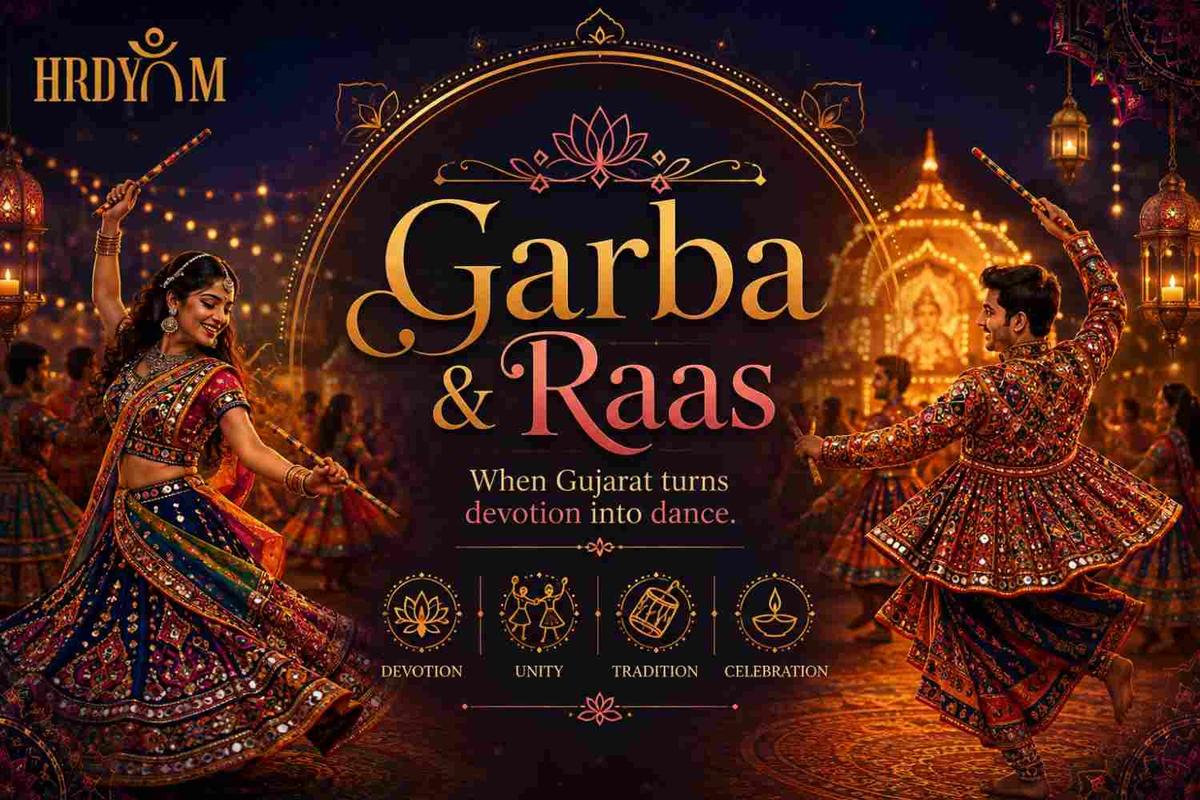
Think of a Navratri evening in Gujarat. The lights are on, the sounds of dhols are filling the atmosphere, and somewhere far away, hundreds of people have started gathering. The women are wearing their colorful chaniya cholis, men are wearing their embroidered kediyas, and families are moving towards the sound of the drums.
And then the first beat of Garba starts. A few beats. Some steps. More circles joining in. In no time at all, it feels like the entire floor is moving.
This is the beauty of Garba and Raas-some of the most beautiful and well-known traditional dances in Gujarat, which embody devotion, music, movement, and community coming together. What appears to be fun and a celebration has a lot more going on under the hood.
While Garba is basically linked to the worship of the Divine Feminine during the nine days of Navratri, Raas, mainly the Dandiya Raas, has very close connections with the life world of Lord Krishna. Garba and Raas have grown up together over many years and cannot be separated from the festival atmosphere of Gujarat.
However, to understand Garba, one should first of all focus on the circle. This is because Garba is not simply a dance form but rather a story of the circle.
The circle around the Divine
The core idea of traditional Garba is that of people dancing around the source of light in a circular form.
Traditionally, dancers surround either a garbo, which is a pot made out of soil with a lamp inside, or images of Goddesses. Dancing and clapping around the garbo, the lamp itself stays in the center, whereas everything else keeps on moving all the time.
There is a great symbolism involved in this image. A circle is something that has neither beginning nor end, just like life processes, natural phenomena, and time itself. Dancers keep on changing their places, but nevertheless, they continue rotating around the same center. The center symbolizes Divine Femininity, or Shakti, whereas the motion is an eternal rhythm of life.
Moreover, Garba has a close connection with garbha, which means the womb-another symbol of life and creation. Thus, the little flame inside the earthen vessel symbolizes life and divine power inside it.
And that may be what makes Garba different from just viewing a dance recital. The dancer does not perform for the center. The dancer moves with it.
From a sacred ritual to Gujarat's grandest celebration
Devotion ultimately leads to celebration.
For the nine nights of Navratri, Gujarat becomes a large-scale stage for music and dance. As the evening approaches, crowds start gathering at courtyards of villages, temples, open grounds in neighborhoods, and cities. But amid all the glittering lights and exuberant music lies the older tradition behind Garba-gathering together to pay tribute to Shakti, the divine feminine power.
The old custom of Garba involved singing songs dedicated to the Goddess and moving rhythmically in circles as a symbol of fertility, life, and triumph of divine power over darkness. With the passage of time, it evolved into the grand public event it is today.
Its spirit, however, never died out.
Passing on an old move from one generation to another, friends joining a group circle of Garba dancers for the first time, or people from a whole neighborhood dancing together-all of this helps to preserve the tradition of Garba. It is a living tradition which gets transmitted through participation rather than through texts and books.
And then, the Dandiya begins
As the beat speeds up, there is another element introduced into the night: the clicking sound made by two pieces of wood hitting each other in rhythm.
It is called Raas, and today it goes by the name Dandiya Raas.
Whereas Garba is closely linked to the worship of Shakti, Raas takes us into an entirely different realm of emotions, traditionally related to Lord Krishna and the Raas Leela. The steps of Raas are more communicative in nature, as dancers stand face-to-face and hit each other's dandiyas.
One beat against another. One dancer against another. The circle keeps turning.
It is a conversation of sorts. The sticks are transformed into musical tools through which dancers convey messages to each other without saying a word.
Over time, the dances of Garba and Raas have naturally merged with the Navratri celebrations in Gujarat. Now, in a single night, one can see the fluidity of the transition from the rhythmic clapping of Garba to the Dandiya dance with ease. And maybe it is precisely this aspect that adds to the beauty of the transition: where Garba converts devotion into dance, Raas converts dance into connection.
Garba and Raas: two dances, two stories
| Feature | Garba | Raas / Dandiya Raas |
|---|---|---|
| Religious association | Primarily associated with Shakti and Goddess worship during Navratri | Traditionally associated with Lord Krishna and the Raas tradition |
| Movement | Circular movement around a central lamp, pot, or shrine | Circular group movements with coordinated stick patterns |
| Main prop | Traditionally a garbo/earthen pot with a lamp or a central image of the Goddess | Dandiya sticks are commonly used |
| Hand movements | Clapping, snapping fingers, and rhythmic hand gestures | Striking sticks together in coordinated patterns |
| Music | Devotional Garba songs, bhajans and folk compositions | Rhythmic Raas/Dandiya songs, often linked to Krishna traditions |
| Central symbolism | The circle represents the continuity of life and the presence of Shakti | The circular movement and paired sticks create a rhythmic communal dance |
| Where seen during Navratri | Community Garba grounds, temples, neighbourhoods and large events | Navratri grounds, community celebrations and organised Dandiya events |
Whereas both the words Garba and Raas may appear to be interlinked, they both have their own cultural history attached to them.
For instance, Garba is associated more with the worship of Goddess Shakti during Navratri. The circling movements, clapping, and singing associated with it create a feeling of a dance in motion.
In comparison to this, Raas is linked with the playfulness of Lord Krishna. The beats created by striking dandiya sticks give the dance performance an element of communication between dancers.
But this classification is not absolute now. In Gujarat as well as outside, both these dances have co-evolved by sharing elements. The Navratri celebration in modern times may switch from Garba to Dandiya Raas without any fuss, since the difference lies in knowing the mythological stories of the dance rather than its structure.
And that is precisely why they are interesting: one dance praises divine energy and the other one brings out divine frolic-but in either case, spirituality becomes corporeal.
The circle that keeps the circle alive

Before the dancing even starts, music is present.
In traditional Garba, songs are the medium by which the story is told, along with clapping and the beats of percussion instruments like the dhol, dholak, and tabla, which help set the festive mood. The songs can be about the Goddess, about Navratri, express devotion, or just be happy songs of coming together.
And then there is the music of the crowd. The leader sings the first line, and the dancers respond. Clapping in rhythm and tapping of the feet create a music of their own.
And in Raas, the music takes yet another dimension in the form of the distinct clicking of the dandiya sticks, which must meet in time with each other to create music.
But over the years, the music has also changed. While traditional folk songs and rhythms still play alongside, they are also accompanied by more contemporary songs and music.
Because music in Garba does not exist in the background. It is what connects everyone in the circle.
The color, crafts, and costumes of Garba
In the lights of Navratri, Garba becomes a performance-chaniya cholis whirl with each turn, mirror work sparkles under the light, kediyas are decorated with embroidery, and silver ornaments add more glitz.
Not only do they decorate the festive Garba dancers, but they also represent the rich tradition of craftwork and art of Gujarat, especially its fondness for embroidery, mirror work, brightly colored fabrics, ornamentation and ornamentation.
It all comes alive in the whirling movements of the dance: skirt spins, mirrors glimmer, ornaments shine, and suddenly it all starts moving as a living example of folk art.
Modern-day Garba cannot help but adopt contemporary fashion, but traces of the traditions can still be seen.
And maybe that is what makes dressing up for Garba such a special experience-you do not just dress up in a costume to dance; you bring a piece of visual heritage of Gujarat to life through your dancing.
Beyond the nine nights: Garba as living heritage
Garba might have strong connections with Navratri, but its history does not end after the celebration of the ninth night.
This dance form has traveled a long way from the courtyards and neighborhoods where it was practiced. Today, Gujarati communities all over the country and the world hold events of Garba and Raas, spreading the traditions, clothing, and songs to other places.
Still, this dance tradition lives and develops not because it stays unchanged for centuries. Every generation takes part in the creation of the dance form. The traditional songs might get new arrangements and choreography; the new celebrations might turn into big cultural events, while at the same time the devotional roots stay evident.
Garba of Gujarat was listed on UNESCO's Representative List of the Intangible Cultural Heritage of Humanity in 2023, recognizing the cultural significance of the dance and its ability to unite communities.
However, the listing seems to be absolutely adequate for Garba because this dance form does not live behind glass.
The heritage can be enjoyed only while dancing it, with the light of a lamp and with the melody playing.
A traveller's evening in Gujarat
Visiting Garba in Gujarat means realizing that the experience of spectating is not complete on its own.
As dusk falls on Ahmedabad, Vadodara, Surat, or any other part of Gujarat during Navratri, the mood changes. Streets get brighter; there are sounds of music everywhere, and the families start moving to where the party will be held that evening. The scent of local dishes blends with that of percussion instruments, and colorful costumes transform the regular meeting places into cultural venues.
A visitor doesn't need to understand all the movements. On the contrary, some uncertainty is a part of the joy.
Look at the circle for a bit. Observe the rhythm of clapping. Let yourself learn the simple movement of the dance from others. Listen to the songs rather than recording them. Take notice of the work that went into costumes, of the rituals' spirituality, and of how people make room for one another.
This is when Garba stops being a spectacle that one has traveled to witness. This is when Garba becomes an experience that one gets involved in.
Frequently asked questions
What distinguishes Garba from Raas?
Garba dance is the traditional devotional dance involving the central light, pot, or image of the Goddess, whereas Raas is the rhythm dance typically done with dandiyas and related to Krishna traditions.
Why is Garba dance considered an offering to Goddess Durga?
It is because of the fact that Garba is a traditional folk dance which takes place during the Navratri festival celebrated in honour of female divine power, or Shakti. The devotional ritual includes the circle dance around the central lamp, earthen pot, or mother goddess image.
When was Garba included in the UNESCO list of heritage practices?
The Garba of Gujarat became part of the UNESCO Representative List of the Intangible Cultural Heritage of Humanity in 2023.
Experience the living spirit of Gujarat with HRDYAM

Visiting Gujarat during the time of Navratri is not only about seeing one of the most amazing festivals ever. It is also a way of being immersed in a culture which has been passed on through ages-through music, traditions, handicrafts, cuisine, and, above all, people.
At HRDYAM, you can make your visit a deeper journey into the culture, learning the secrets of Gujarat's temples and traditions, interacting with the local communities that preserve this heritage, and marveling at the splendor of traditional costumes and Garba-Raas performance.
After all, there are some things that you just cannot comprehend when standing afar. You can plan your spiritual trip as well.
You need to listen to the drum. You need to see the flame at the center. You need to go around the circle. And sometimes, all you need to do is get in and start dancing.
Conclusion
Slowly, the tempo of the music fades out.
The dandiya get tucked away, the skirts cease to twirl, and the throngs of people start to wend their way back home. But there is something left behind-perhaps some tune lingering in somebody’s mind, the drum beats still faintly audible, or the experience of the circle that saw people dancing together like they knew the dance for all their lives.
That is the magic of Garba and Raas. They are not mere performances preserved from ages past. They are vibrant customs that are sung, danced, reimagined, and handed down through generations upon generations.
They rest on something profoundly simple: faith, dancing, and unity. The lamp continues to remain at the center. The circle continues its motion.
And at every Navratri, whenever the music is resumed in Gujarat, we are reminded that heritage is not just something we inherit. It is something we preserve by being a part of it.
Spiritual travel researcher, Vedic cultural writer, and contributing editor at HRDYAM.
You Might Also Like
Tags
More Articles
View all
What is HRDYAM? The AI-Powered Spiritual Ecosystem
The spiritual essence of India has not merely consisted of temples alone. It is found in pilgrimage circuits, old rituals, Vedic astrology, Yoga, Ayurveda, sacred rivers, traditions of the region, art
How HRDYAM blends spirituality with sustainability
How would pilgrimage change if it were no longer viewed as a trip to a shrine but as an engagement with the entire sacred geography? The river next to the shrine, the communities that live by the shri
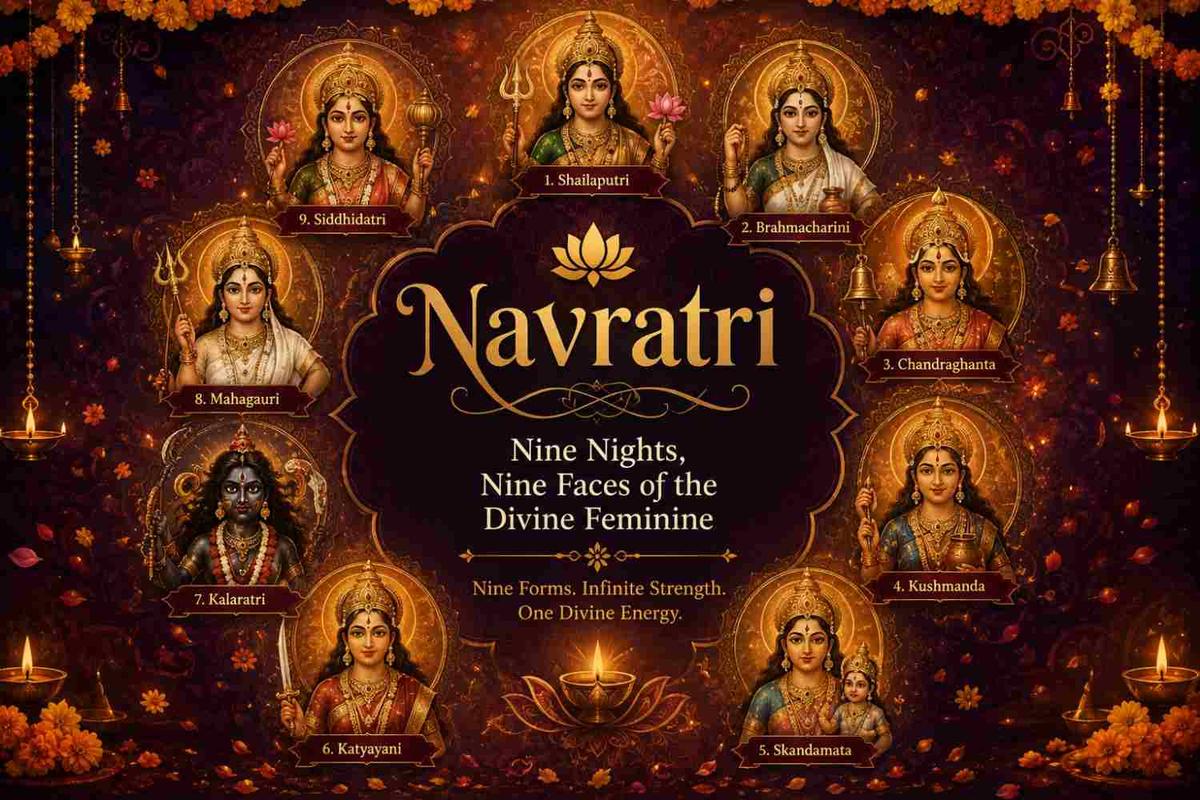
Navratri: Nine nights, nine faces of Shakti
The first indication of Navratri usually comes not from any temple. This could be a spontaneous display of a tiny kalash in the corner of your house, the planting of new barley seeds into the moist so