Navratri 2026: A complete guide to the Nine Nights of Shakti

RIYA SHARMA
HRDYAM - DISCOVER SACRED JOURNEYS, WISDOM & WELLNESS
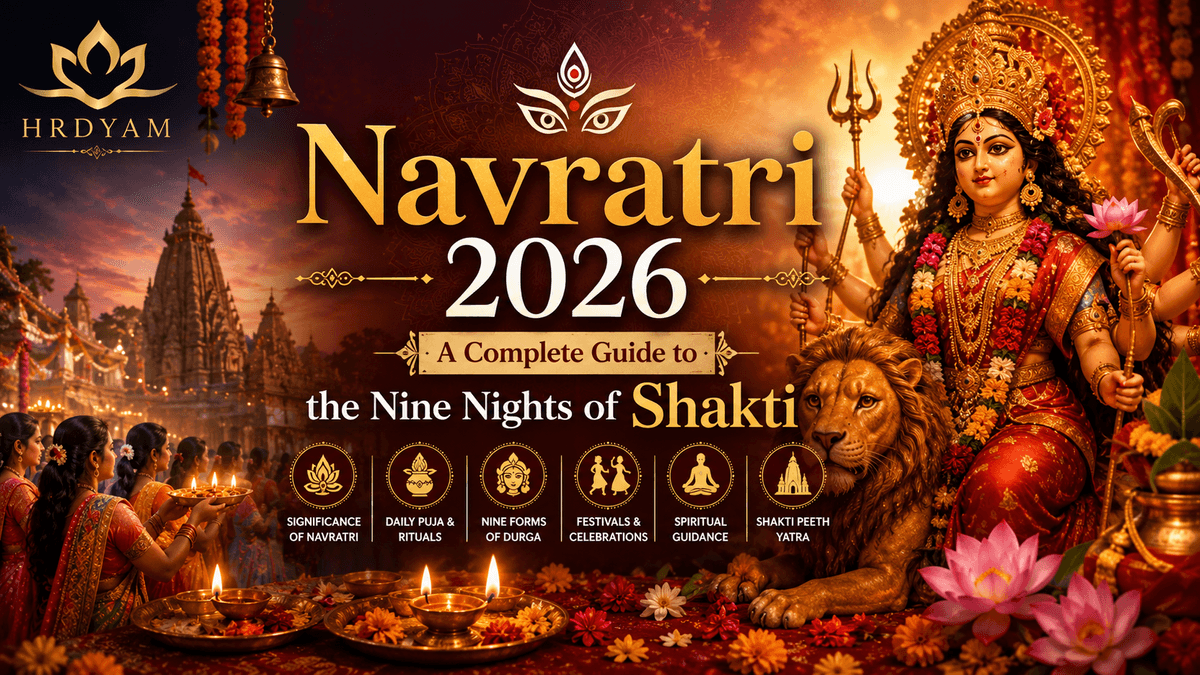
Once a year comes a silent time when it feels like India suddenly undergoes an entire transformation overnight. Temple bells peal a bit louder, houses start having that scent of incense and new flowers, and markets get filled up with marigolds, oil lamps, vibrant chaniya cholis, and coconut shells ready to be offered during prayer. The arrival of Navratri 2026 does not come with just one signal, but with numerous smaller signals coming together to invite the Divine Mother into people’s everyday lives.
Celebrating "nine nights," Navratri is one of the most popular Hindu festivals devoted to the worship of Shakti - the all-powerful feminine energy of the universe, which gives birth to all the things we see in our world. During those nine nights, Hindus pay tribute to the Navdurga - the nine manifestations of Goddess Durga, embodying every stage of her spiritual path from bravery and determination through compassion and knowledge until the highest freedom.
Unlike other festivals which revolve around a particular ritual, Navratri can be observed in many ways all over India. In Gujarat, the nights get illuminated with Garba and Dandiya, where people celebrate the Mother Goddess through music and dance in circles. In West Bengal, Pandals made for Durga Puja become the places of art and devotion. Ghatasthapana and then Durga Saptashati katha along with fasting are carried out in all households in North India, and Kanya Pujan becomes a part of the conclusion of the festival, ending with Vijayadashami when goodness triumphs over evil.
Navratri in 2026 will fall on Sunday starting from 11 October, with Ghatasthapana (Kalash Sthapana) being performed on the first day of the festival. The recommended timing for Ghatasthapana Muhurat 2026 in New Delhi is between 6:19 AM and 10:12 AM, and there is also Abhijit Muhurat later in the day. However, the timings of muhurat vary slightly for different cities; therefore, devotees need to refer to the local Panchang before performing this ritual.
But behind all the rituals, the colors, and the celebrations, there is the beauty of Navratri. Nine nights subtly inform us that strength does not always have to be shown loudly. It can sometimes be exhibited through patience, compassion, or even the subtle strength to start over. And this is why, year after year, millions of people embrace Navratri in their homes, not just as a festival, but as a yearly chance to revive their faith and reconnect with the Divine Mother.
Nine nights, one divine journey
Even though Navratri is celebrated throughout India, this festival lasts for nine days, where each day is devoted to worshiping Navdurga, who are the nine incarnations of Durga. It starts with the Ghatasthapana ceremony and ends with Vijayadashami (Dussehra), which celebrates the victory of good over evil.
| Day | Date (2026) | Goddess (Navdurga) | Significance |
|---|---|---|---|
| Day 1 | 11 October (Sunday) | Maa Shailputri | Ghatasthapana, beginning of Navratri |
| Day 2 | 12 October (Monday) | Maa Brahmacharini | Devotion, penance, and inner discipline |
| Day 3 | 13 October (Tuesday) | Maa Chandraghanta | Courage, protection, and fearlessness |
| Day 4 | 14 October (Wednesday) | Maa Kushmanda | Creation, vitality, and positive energy |
| Day 5 | 15 October (Thursday) | Maa Skandamata | Motherhood, compassion, and wisdom |
| Day 6 | 16 October (Friday) | Maa Katyayani | Strength, justice, and determination |
| Day 7 | 17 October (Saturday) | Maa Kalaratri | Destruction of negativity and fear |
| Day 8 | 18 October (Sunday) | Maa Mahagauri | Purity, forgiveness, and peace |
| Day 9 | 19 October (Monday) | Maa Siddhidatri | Spiritual fulfilment, blessings, and Kanya Pujan (observed in many traditions) |
| Day 10 | 20 October (Tuesday) | Vijayadashami (Dussehra) | Victory of good over evil; Durga Visarjan in many regions |
Beyond celebration lies transformation
If you ask ten people the meaning of Navratri, you would probably receive ten different answers. To some people, Navratri is nine days of fasting; to others, it is the fun and frolic of Garba and Dandiya or the beauty of Durga Puja pandals or family gatherings. However, there is much more to the festival than just these celebrations. Navratri is basically a process of self-discovery.
According to mythology, the fight between Goddess Durga and the buffalo demon Mahishasura symbolises the fight between good and evil in the universe. However, the myth did not end there. According to the legends, Mahishasura also symbolises those traits that develop in human beings - the ego, anger, greed, fear, and attachment. The victory of the Goddess signifies that these battles can be won through perseverance and faith in God, not through power and strength.
Thus, the nine forms of the goddess, also known as Navdurga, represent the Goddess to be worshipped during Navratri. They are qualities that we should cultivate during the festival. Shailputri is stability; Brahmacharini teaches perseverance; Chandraghanta teaches courage; and Siddhidatri teaches the greatest spiritual attainment - the happiness within.
Maybe that is one of the reasons why Navratri seems so personal for people. Each devotee comes with their own set of prayers - some wish to be strong in a hard time, others ask for peace in their families, still others need clarity on their future. The rites themselves might appear alike to everyone, but there is a personal story behind each prayer.
This is how the tradition of fasting, worshiping, and Ghatasthapana is linked to such an important purpose of Navratri 2026. It allows the devotees to take a break from their routine lives and to reflect on their past and future. Thus, fasting here is not an attempt to give something up but to make space for something better.
As the number of nights passes, the atmosphere becomes completely different. People have silent prayer meetings in the evening, temples are filled with oil lamps at night, and communities celebrate together after the darkness falls. This is how the real essence of Navratri 2026 is seen.
With the arrival of Vijayadashami, there comes an affirmation that the triumph of the Goddess not only remains confined within the scriptures of olden times but also has the potential within ourselves. With the commencement of Navratri, there arises the following question: Which aspect of yourself would you like to transform?
Nine days of sacred living
No two families celebrate the Navratri festival in the same way, and this is one of its charms. While one family could begin the Navratri day with a single lamp lit for the Goddess, another could have the reading of the Durga Saptashati, communal bhajans or garba dance sessions till midnight. Customs may vary in different parts of the country, but the purpose is almost the same: dedication of these nine days to the Divine Mother in sincere and disciplined ways.
In many devotees' houses, each day may start with early morning bathing, cleaning of the household shrine, offering flowers, fruits, incense sticks, and a lamp filled with ghee to the Goddess. Ghatasthapana devotees would be worshipping the Kalash every day in those nine days because they consider it to be a live embodiment of Shakti in the house.
Fasting is yet another significant observance of Navratri 2026. Some devotees may be fasting on all nine days, and some others may only be fasting on the first and eighth or ninth day. Fasting is not considered to be any form of endurance test, but it is seen as a process of mindful simplification of one's eating and lifestyle.
Several families also spend their time each day in reading sacred scriptures like the Durga Saptashati (Devi Mahatmya), Durga Chalisa, Lalita Sahasranama or Siddha Kunjika Stotram. Some people who find themselves unable to read out a whole scripture make it a point to read out some verses each day.
Evening time brings about another sort of energy. The temples look brighter with rows of lit oil lamps. In most areas of western India, the open ground becomes a circle where Garba and Dandiya are danced. It might appear to be a form of dance, but in reality, it is another form of worship of the Goddess through dance and music.
Kind acts are also an integral part of Navratri celebrations. People also participate in various forms of charity by donating food grains, clothes, or any other essentials, or even cooking food for the neighbors or pilgrims.
On the ninth day, the practice itself seems almost natural. The practice of morning prayers, simple meals, the aarti in the evenings, and reflection in silence seem to converge in order to form an experience that goes beyond being religious. These become the chance for introspection, for connecting with oneself and embracing the qualities of the Navdurga. This is perhaps what makes the practice of Navratri not one limited to nine days but something that carries on well past the celebration.
Traditions that keep faith alive

There are distinct traditions observed in Navratri in each home, which have been handed down from generation to generation in the family. There are elaborate rituals, and there are simple rituals such as lighting the lamp during the early hours of dawn, offering a flower with folded hands, and meditating quietly before starting the day. Navratri 2026 would be meaningful if the rituals were observed with dedication and sincerity.
Navratri celebrations begin with the Ghatasthapana ritual, in which the Kalash, which represents the Divine Mother, is installed ceremonially. Many people plant barley seeds along with the Kalash as a sign of prosperity, rejuvenation, and cultivation of faith during the nine days.
There are different deities of Navadurga who are celebrated on the nine different days. Many devotees offer flowers, fruits, sweets, and bhog as per their local traditions. Aarti is performed in the morning and at night time along with the chanting of Durga Chalisa, Devi Mahatmya, or hymns of other kinds meant for worshiping the goddess. There is a ritual in many households to light the lamp on the first day, which remains lit throughout the duration of the festival.
Apart from this, a lot of devotees choose to wear colours dedicated to every particular day of Navratri. Though such practices are growing more and more common lately, they do not belong to religious rituals but rather represent traditions. More significant in this case is the spirit of humility, gratitude, and peace of mind of the person who celebrates Navratri.
Visits to temples are also an integral element of the celebration. Some families choose to visit their local Durga temple every night, whereas others prefer to embark on pilgrimages to famous Shakti Peethas throughout the festival. The atmosphere during Navratri is unique and cannot be compared to any other period of time. The temples echo with devotional music and the smell of burning incense while long lines of devotees wait impatiently to see the Goddess.
Over the course of the festival, various communities arrange bhajans, readings of the Durga Saptashati, as well as cultural programmes bringing people of different generations together. During Navratri in Gujarat and neighboring regions, such programmes automatically turn into dancing performances called Garba and Dandiya.
The last few days of Navratri are of great importance. Kanya Pujan is another ritual carried out by most devotees, where food and gifts are offered to young girls representing the Divine Mother, either on the ninth or eighth day of Navratri. The culmination of Navratri is Vijayadashami, which represents the victory of wisdom and power over ignorance and fear.
Maybe that is the subtle beauty of the rituals associated with Navratri. In themselves, each of them could be considered simple-lighting a diya, offering a prayer, offering flowers, fasting; however, collectively they ensure nine days filled with awareness of the need to invite the Goddess not only at home but in one’s life as well.
Where every circle tells a story
As the evening aarti draws to a close, yet another rhythm takes charge. The drum beats intensify, lights come alive in courtyards, and dancers start forming circles around the beautifully decorated lamp/image of the Goddess. For millions of people, it marks the climax of the Navratri 2026 celebrations - Garba and Dandiya.
For a newcomer, Garba might look like just any other folk dance. But in actuality, Garba is more than that. Garba is a ritualistic act. Garba is a Sanskrit term which means womb - the abode of creation, life, and the feminine principle. The traditional Garba dance is performed in circles around a lamp/image of Goddess Durga, with acknowledgement of Shakti as the center of all life forms.
Whereas Garba is performed with graceful steps and clapping, Dandiya Raas adds colorful wooden sticks, which the dancers hit in syncopation. This dance form is linked to the Goddess's triumph over Mahishasura, and the rhythmic moves are considered symbolic of the triumph of good over evil. Currently, Garba and Dandiya Raas are performed together in many parts of western India, although both have their distinct origins and meanings.
One place where the practice has gained great popularity is Gujarat, where Navratri celebrations last for the entire night. In cities like Ahmedabad, Vadodara, Rajkot, and Surat, local neighborhoods, temples, and cultural clubs witness festivities throughout the night. People dressed up in traditional chaniya choli, kediyas, mirror work, jewelry, and turbans join these festivities.
However, Garba is now celebrated not just in Gujarat. People all over the world come together during Navratri for music and dance performances. Whether you are in Mumbai, Delhi, Bengaluru, London, or New Jersey, the melody of Garba will help you stay rooted in your traditions but also open the party for all people.
Nevertheless, Garba has been and remains an occasion which is more about devotion rather than fun. In fact, most Garba events begin with prayers addressed to the Goddess before dancing begins because Garba is first of all an event of gratitude and only then a cultural celebration.
Maybe this is the reason for the popularity of Garba and Dandiya among generations. These dances unite people from all generations, with diverse backgrounds and beliefs, into one circle in which nobody but the Divine Mother is in the center. For nine days, the melody of music becomes a prayer, the performance of dance becomes meditation, and celebration turns into faith.
Nine faces of Divine Power

One of the most fascinating features of Navratri 2026 is that each day is dedicated to a particular manifestation of the Divine Mother. These nine forms collectively are called Navdurga. In other words, these are not nine different goddesses but represent nine steps in the spiritual journey from empowerment to knowledge and finally divine grace.
The first day is celebrated in honor of Maa Shailputri, who is the daughter of Himalaya. She is an incarnation of peace, courage, and the strength to restart once again in life. Every spiritual journey needs a firm base, and the teachings of Shailputri show that one should always be rooted firmly in faith.
The second day of celebration is for the worship of Maa Brahmacharini, who symbolizes penance, self-discipline, and determination. Her story tells us that often patience and persistence yield the best results.
The third day is celebrated in the worship of Maa Chandraghanta, who has a crescent on her forehead.
Maa Kushmanda, venerated on the fourth day, is believed to have created the entire universe with her enchanting smile. She symbolizes creativity, vibrancy, and the life force that sustains everything.
The fifth day of Navratri worships Maa Skandamata, the mother of Lord Kartikeya. She symbolizes boundless love, compassion, and the nurturing strength that supports families and communities.
The next day is dedicated to Maa Katyayani, one of the most terrifying forms of Goddess Durga. Maa Katyayani, the destroyer of evil, represents courage, justice, and the will to fight against injustice.
The seventh day of Navratri venerates Maa Kalaratri, the terrifying form of the Goddess that often takes many by surprise. Despite her terrifying form, Maa Kalaratri is regarded as a benevolent protector who dispels fear and ignorance.
The eighth day is the day for worshipping Maa Mahagauri, symbolising purity, forgiveness and peace. The calm image of Maa Mahagauri inspires devotees with the power of love and compassion.
On the last day of Navratri, people worship Maa Siddhidatri, who blesses devotees with divine knowledge and wisdom. She symbolizes fulfillment and guides devotees toward the greatest accomplishment that lies not in material prosperity but in the blissful state of self-awareness.
With each passing day, worshiping the Navdurga is not merely a routine of rituals but an invitation to develop these very attributes in our daily lives. When Navratri ends, it is not just the end of the celebration; rather, it marks the beginning of the realization of her strength, wisdom, and compassion in oneself.
The sacred beginning
Each Navratri starts with one special ritual performed on the first day itself to set the spirit for the coming nine days - Ghatasthapana, also known as Kalash Sthapana. Performed on the very first morning of Navratri 2026, it marks the entry of the Divine Mother into the house. The holy Kalash of water is placed on a bed of grains, usually accompanied by barley seeds, which grow into shoots during Navratri.
The Ghatasthapana Muhurat 2026 is best done according to your local Panchang, as this time differs from city to city. Once the Kalash is placed inside your house, it is considered the spiritual centre point of your home until the end of Navratri. Each day, people offer flowers, incense sticks, fruits, and bhog to the Goddess, along with the recitation of various prayers like Durga Chalisa, Durga Saptashati, or just the chanting of mantras. Some people light up the Akhand Jyot (eternal flame) for the entire duration of nine days.
Daily Puja does not have to be anything too fancy. All that it requires is a proper altar, a few minutes of sincere prayers, and some offerings done in thankfulness. The essence of these nine days is creating a routine of devotion which, in turn, brings about an inner transformation in the home and the individual.
Items to be Kept Ready for Ghatasthapana Samagri
Before the beginning of Navratri, ensure you have the following ready:
Kalash (copper, brass, silver, or earthen)
Water or Gangajal
Mango leaves (Ashoka leaves where traditional)
Coconut covered with red cloth or chunari
Red cloth for Kalash
Barley seeds for planting
Soil or earthen pot
Kumkum and haldi
Flowers and flower garlands
Betelnut leaves and betel nut.
Agarbatti and camphor
Ghee or oil diya
Cotton wick
Seasonal bhog and fruits
Durga Maa idol or picture (if worshipping only Kalash)
Prayer book (Durga Chalisa, Durga Saptashati or any other)
Fasting with purpose

To most devotees, the process of fasting is considered among the most significant observations of Navratri 2026. But in addition to refraining from specific foods, the significance of the Navratri vrat includes simplifying the individual's lifestyle, practicing discipline, and giving more time for contemplation, meditation, prayers, and worshipping Navdurga.
The fasting is done in different ways, as it depends much on local traditions and family habits. It is not obligatory to fast during all nine days, as it could be either for the first day and then for the eighth and/or ninth days or only during the first day. Most people usually have one satvik meal at nighttime, while some devotees eat fruits, milk, and other appropriate foods throughout the day.
Navratri Vrat Food Items
Common food items consumed during the fast include:
Fruits & fresh juice from fruits
Milk, curd, buttermilk, and paneer
Makhana (fox nuts)
Potatoes, sweet potatoes, and arbi
Sama Rice (Barnyard Millet)
Kuttu flour (Buckwheat)
Singhara flour (Water Chestnut)
Sabudana (Tapioca Pearls)
Peanuts & dry fruits
Rock Salt (Sendha Namak) instead of Table Salt
Food items are generally made with the above-mentioned items, including sabudana khichdi, kuttu puri, sama rice pulao, makhana kheer, and fruit chaat.
Items Generally Not Consumed by Most Devotees
Wheat, Rice, Lentils (except black variety)
Onions and garlics
Eggs, meat, and fish
Tobacco and alcohol
Packaged junk food
Table salt (depending on the traditions of the family)
Since such rituals differ from region to region, there is nothing wrong about adhering to the practices followed by your family members.
What is more significant, however, is that many spiritual gurus advise devotees that fasting is not only physical but mental as well. Being honest, not getting angry, doing good deeds, helping people who are in need, and keeping a calm demeanor - all this is treated as worshipping in its own way. After all, the Goddess is believed to be happy not because of what we consume but because of how we behave during those nine holy days.
The Hymn of Hidden Power
Amongst the countless hymns chanted during Navratri 2026, very few hymns are held in such high regard as the Siddha Kunjika Stotram. The hymn can be found in the Rudrayamala Tantra, and it is widely believed to encapsulate the entire Durga Saptashati (also known as Devi Mahatmya). Hence, many worshippers recite it on a daily basis during Navratri when they are unable to recite the entire Durga Saptashati.
It is said that Lord Shiva once gave the Siddha Kunjika Stotram to Goddess Parvati, revealing that it had been designed in a way that ensured her blessing to any devoted person who recites it with a sincere heart. Although it is believed to protect, remove obstacles, and increase spiritual fortitude, it is best viewed as an offering of devotion and not some miraculous solution to problems. The real purpose of this hymn is to bring one’s mind to a state of focus and receptivity.
It can be recited either after morning worship or aarti in the evening, preferably before a burning lamp or diya along with the image of Goddess Durga or her Kalash. While some devotees do it throughout the nine-day festival, others do it only during Ashtami and Navami. If it is your first time, it is said that reciting it with understanding is better than doing it quickly. As with any other ritual of Navratri, devotion is much more important than perfection.
Honouring the living goddess
The period of Navratri comes to an end with many households celebrating one of the most beloved rituals of Navratri-Kanya Puja. This ritual is celebrated either on the eighth or ninth day of Navratri as a tribute to the young girls who represent the Divine Mother. It serves as a constant reminder that the very same Shakti revered in temples exists within each child, each woman, and each kind deed.
In accordance with tradition, nine girls, who serve as the symbols of the Navdurga, are invited to participate in the ritual. In certain areas of the country, a young boy is also invited to join as Langur or Bhairav, the manifestation of Bhairava-the divine protector of Goddess Durga. The feet of the children are washed, tilak is applied, and they are offered a satvik meal. Poori, kala chana, and sooji halwa comprise the traditional food items served in North India, followed by fruits, sweets, dakshina, or gifts.
Kanya Pujan goes far beyond being just a ritual. It serves as a reminder to devotees that their adoration for the Goddess must go beyond the boundaries of the temple, to life itself. Through dignity, respect, and kindness, every girl and woman becomes an embodiment of reverence for the Feminine. With the conclusion of Navratri comes another message of great importance. Not only is the Divine Mother worshipped through the idol form, but also through the presence of people surrounding us. This humble spirit of gratitude is what makes Kanya Pujan such a significant event during Navratri 2026.
One festival, countless traditions

Another amazing thing that can be observed about Navratri 2026 is how differently it is celebrated in different parts of the country despite the fact that everyone worships the Goddess during it. Even though it is all the same Divine Mother, the celebrations differ in accordance with the culture and history of every region.
For instance, in Gujarat, it is Garba and Dandiya which come to mind when talking about Navratri. As evening falls, people gather in streets, temples, and public spaces with music, bright clothes, and dance in circles around a lantern that represents the Goddess. Despite how festive it might seem, this dancing is, essentially, a devotion to Shakti.
In West Bengal, the festival of Navratri comes as the great celebration of Durga Puja. Splendid pandals, beautiful idols of the Goddess, cultural shows and delicious meals make such cities as Kolkata a place to visit. Indeed, for many families, Navratri is a time of unity just as much as it is a religious holiday.
In North India, the observance of Navratri includes fasting, Ghatasthapana, reading the Durga Saptashati every day, and Kanya Pujan on Ashtami or Navami days. Thousands of people from Himachal Pradesh flock to the Shakti temples of Jwala Devi, Naina Devi, and Chintpurni, whereas Tamil Nadu, Karnataka, and Andhra Pradesh observe Navratri through Bommai Golu or Bommala Koluvu, where beautiful dolls depicting tales from Hindu texts are placed in order.
These varied regional customs are unique in their own way, but all have the same ending place. No matter how one worships God, whether through dance, prayers, music, fasting, or pilgrimage, Navratri ends up celebrating the eternal might of the Divine Mother.
Walk the path with reverence.
Navratri can be called a festival of devotion, yet it is also a time of disciplining yourself, offering gratitude, and being mindful of everything around you. Though there may be slight differences from household to household, there are several things that may be helpful when trying to celebrate Navratri 2026 with reverence.
Do's
Perform Ghatasthapana in an auspicious muhurat prescribed by the Panchang of your region.
Start your day with a clean altar decorated with fresh flowers and a prayer to the Mother Goddess.
If following a Navratri fast, stick to a satvik diet and keep yourself hydrated.
Listen to/read the sacred literature like Durga Chalisa, Durga Saptashati, or Siddha Kunjika Stotram.
Engage in Garba and Dandiya dancing with devotion and respect for the traditions of your region.
Do Kanya Pujan with humility, treating each girl with respect and dignity.
Make donations of food, clothes, and other essentials, since charity is seen as an important aspect of the festival.
Don'ts
Fasting should not be seen as just another dietary practice; it is meant for inner discipline and spiritual introspection.
Stay away from arguments, foul language, and pessimism during these nine days.
Do not consume alcohol, smoking materials, or meat if you are a traditionalist and follow Navratri rituals.
Also, do not waste food and flowers offered in puja; dispose of them according to the local tradition.
Do not compare your practices with those of others, as there are natural differences among the Navratri practices.
Ultimately, Navratri should be celebrated more as a practice of awareness rather than a strict adherence to all practices. Your peace of mind, compassionate behavior, and devoutness please the Goddess better than the performance of any ritualistic practice devoid of intention. As these nine nights proceed, let your prayers be supplemented with compassion, patience, and gratefulness.
Everything at a glance
| Topic | At a Glance |
|---|---|
| Festival | Shardiya Navratri 2026 |
| Navratri Dates 2026 | 11 October - 19 October 2026 |
| Vijayadashami (Dussehra) | 20 October 2026 |
| Duration | Nine nights dedicated to the worship of Goddess Durga |
| Presiding Deity | Navdurga - the nine forms of Goddess Durga |
| Festival Begins With | Ghatasthapana (Kalash Sthapana) |
| Key Rituals | Ghatasthapana, daily puja, Durga Saptashati recitation, fasting, Garba and Dandiya, Kanya Pujan |
| Major Celebration | Worship of the Divine Mother through prayer, fasting, music, dance, and community celebrations |
| Popular Bhog | Fruits, kheer, halwa, poori, kala chana, coconut, and other satvik offerings |
| Common Fasting Foods | Sabudana, sama rice, kuttu flour, singhara flour, makhana, fruits, milk, and dry fruits |
| Important Hymns | Durga Chalisa, Durga Saptashati (Devi Mahatmya), Siddha Kunjika Stotram, Lalita Sahasranama |
| Best Places to Experience Navratri | Ahmedabad & Vadodara (Garba), Kolkata (Durga Puja), Varanasi, Mysuru, Kullu, and major Shakti Peethas across India |
| Ideal Pilgrimages | Vaishno Devi, Kamakhya, Ambaji, Kalighat, Jwala Ji, Naina Devi, Chintpurni, Chamundeshwari, and Tara Tarini |
| Festival Concludes With | Vijayadashami, symbolising the victory of good over evil and the triumph of inner strength over ignorance |
Celebrate without the Hassle
Navratri is not only nine days; it is an occasion to rejuvenate the connection with the Divine Mother through prayers, pilgrimage tours, and soul-searching. No matter whether you wish to undertake a pilgrimage to one of the celebrated Shakti Peeths, enjoy the vibrancy of Garba and Dandiya in Gujarat, or be a part of Durga Puja in Kolkata, proper planning will definitely make your tour more enriching.
At HRDYAM, we assist you in having an enriching experience of Navratri 2026 by providing you with proper advice and guidance with respect to both the spiritual and tour aspects of your pilgrimage tours. Our pilgrimage tour experts will be able to plan for you a personalized itinerary covering some of the most holy Shakti temples such as Kamakhya, Kalighat, Jwala Ji, Naina Devi, Ambaji, Chamundeshwari, Tara Tarini, and a lot more.
For people who want a personalized spiritual experience, HRDYAM’s team of experts from Vedic Astrology, headed by Dr. Aaadietya Pandey, can provide favorable timings for the Ghatasthapana ceremony, Navratri puja every day, and other significant rituals through your birth chart. Whether you want to follow the whole nine-day ritual, do Kanya Pujan, or take a pilgrimage to Shakti Peeth, our services will guide you towards fulfilling your spiritual desires.
To make your Navratri rituals complete, we have a carefully selected range of puja requirements and ritualistic needs, including other devotional products. Because every pilgrimage has a destination at the end, but the best pilgrimages always begin with an intention and end with a heart closer to the Divine Mother.
When the Goddess stays within

Each year brings back Navratri, but not as the one before. One grows up, becomes more responsible, and his prayers become more mature, but still, there are these nine days when he gets a chance to stop, meditate, and recharge himself with the power of the Divine Mother. This could be the reason why millions of people wait for Navratri 2026 with such impatience. Not just a festival to enjoy, but an experience to be experienced.
Throughout the nine-day celebration, the Devi is glorified in her different manifestations - as a fierce warrior who protects and defends, as the merciful mother, as a teacher who imparts wisdom, as the creator of the universe, and so on. People worship Her with fasting, Garba and Dandiya, continuous prayer, Kanya Puja, or a pilgrimage to the Shakti Peethas. These are various ways that teach us how to be strong, having conquered oneself with fearlessness, compassion, and humility.
As the last aarti is performed and Vijayadashami comes around, Navratri leaves something much more to cherish other than the memories of elaborately adorned temples or merry-making. These nine days leave the subtle message that the light which we search for outside has always been there inside us. Even if Navratri has left us with some extra gratitude, resilience, and compassion in our daily lives, then Navratri will have blessed us in many ways other than celebration.
Spiritual travel researcher, Vedic cultural writer, and contributing editor at HRDYAM.
You Might Also Like
Tags
More Articles
View all
Hinglaj Mata: Where faith crosses every border
The journey to some temples starts with the sound of temple bells. However, when it comes to the pilgrimage to Hinglaj Mata Temple, the starting point of this journey is not sound but silence - the si
Tripura Sundari: Where beauty becomes divine
One of the few temples in India that has been named based on a profound philosophical thought, rather than a location, is called "Tripura Sundari," which means "The Beautiful One of the Three Worlds."

5-Day Meghalaya Itinerary
There's a version of this itinerary floating around every travel blog that promises you can do Shillong, Cherrapunji, Dawki, and Mawlynnong in five days without breaking a sweat. Technically true. Pra