Ramlila & Kanjak: When the Ramayana steps into everyday life

RIYA SHARMA
HRDYAM - DISCOVER SACRED JOURNEYS, WISDOM & WELLNESS
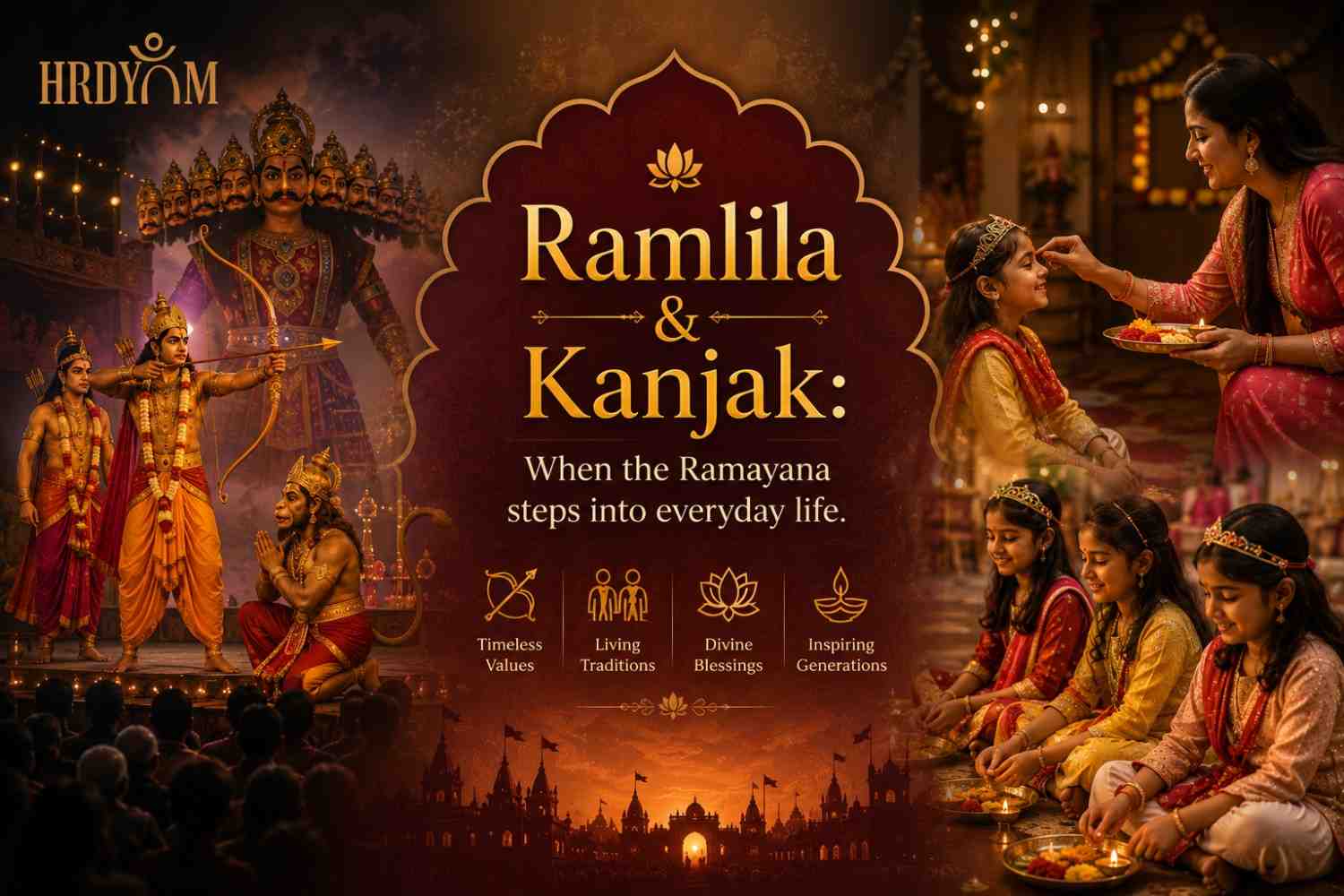
There is a distinct type of evening that comes with Navratri.
Incense, festive meals, and a sweet smell fill the air. In one corner of the city, there is always a group of children who recite dialogues that were passed down to them for generations. The crowds gather to watch as the tale of Ram, Sita, Lakshman, and Ravana is narrated yet again.
And in those few hours, the Ramayana becomes something that is enacted for you.
Ramlila is the traditional enactment of selected episodes from the Ramayana, especially popular in the northern regions of India during Navratri-Dussehra. It is a theatrical performance that uses dialogue, music, costumes, and performance.
However, besides the big Ramlila show, there is another ritual that takes place.
Little girls are invited to houses where their feet are washed, they are fed, given gifts, and are treated as the embodiment of Divine Femininity. This is called Kanjak, also Kanya Pujan.
One is an enactment on the streets. The other takes the sacred within your home.
Both rituals tell us something beautiful about Navratri-Dussehra: the divine does not remain distant; it enters the life of ordinary people.
When did the Ramayana begin to breathe on stage?
Picture a village square or a field at nightfall. A humble stage is set up under strings of lights. The spectators gather in the open ground, kids sitting in the front, elders taking their place, and then comes the first scene.
For many generations now, Ramlila has turned such an open space into a platform where scenes of the epic Ramayana are acted out. Instead of just reading the story, actors perform episodes from the life of Lord Rama-His banishment, the kidnapping of Sita, the search for Her, His battle in Lanka, and finally, His triumph over Ravana.
Such plays take place during the season of the Navratri/Dashehra festival. The plays extend for days before reaching the final climax. In many cases, the actors themselves are not professional but belong to the local community.
Its significance lies in more than just being an entertaining performance. Through the enactment of stories, dialogues, songs, and morals of the epic, Ramlila makes way for the transmission of traditions through generations. An audience member witnessing the play today can be its actor in the future.
Why must Ravana fall, year after year?
The narrative slowly progresses towards its most intense point.
After years of exile, finding Sita and the war at Lanka, Rama faces Ravana. In the Ramlila drama, all the tension built up over days comes to a climax. The arrow of Rama strikes Ravana.
However, off-stage the narrative takes an equally dramatic turn. In North India, gigantic effigies of Ravana are made for Dussehra, with Kumbhakarna and Meghnad accompanying Ravana. They are then burned, with the fire rushing through the colossal figures.
Traditionally, the burning of the effigy has symbolized the triumph of good over evil, the defeat of Ravana by Rama. However, there is something else in it: Dussehra comes every year to teach that arrogance, injustice, and misuse of power consume themselves.
The effigy is huge. The fire is dramatic. But the message is strikingly simple: However powerful evil may be, it cannot prevail.
How does the story travel from stage to sky?
As Ramlila draws towards its close, there is a shift in mood. There are hints of what is coming; and yet, the suspense just increases.
On Dussehra, the drama expands into the public sphere. People throng into open spaces, fairs are organized around them, and effigies of Ravana, Meghnad, and Kumbhakarna provide the center-stage spectacle. The burning of these effigies symbolizes Rama's triumph and marks the end of the dramatic journey of Ramlila.
There are stalls selling food, toys, and swings, as well as performances. It is the children running amidst the crowd; it is people returning home with sweets.
It is this combination of the spiritual tale with a public event that makes Ramlila one of the most prominent festivals in India.
The epic may have come to its climax, but the fair around it continues; for Indian festivals have always had their own ways of bringing spiritual tales to life in the public domain.
What changes when the little kids arrive?
Towards the end of Ramlila, however, comes a change in tone. The foreboding begins. However, the suspense level only keeps growing higher.
On the day of Dussehra, the drama takes place in open public places. Large crowds gather in the open fields, which become the venues of the fairs, and the effigies of Ravana, Meghnad, and Kumbhakarna become the focal points for this drama. The burning of these effigies becomes an indication of the victory of Lord Rama and thus marks the culmination of Ramlila.
Nevertheless, the burning of the effigies is not the only thing that happens on Dussehra.
There are booths selling food items, toys, swings, and entertainment programs. Children are running in the midst of the crowds, and people are returning home with sweets.
This unique blend of a spiritual story with a public festival makes Ramlila one of the most famous festivals of India.
The epic may reach its climax, but the fair continues. This is because Indian festivals have always had a way of breathing life into the spiritual stories through the medium of public festivals.
Why are little girls worshipped during Navratri?

The practice of Kanjak is based on the very notion that Shakti can manifest itself in its simplest and most innocent forms.
In many schools of Hinduism, the young girls represent various embodiments of the Goddess. In the process of Kanya Pujan, they are respected, and offering them food turns into a devotional service rather than a common lunch.
It results in an interesting paradox inherent in the Navratri celebration. While the festival glorifies the powerful warrior Durga, who defeats Mahishasura, in the last days of the nine-day ceremony, the same divine force might be revered through the image of a little girl-gentle, common, and totally human.
It makes the whole ritual unique and beautiful. It proves that strength cannot always manifest itself through its power and force but might also be embodied in innocence, compassion, potential, and future possibilities.
Therefore, when a family worships a girl, washing her feet and offering halwa, puri, and chana, they symbolize more than just respect for the Goddess.
What does a sacred plate hold beyond food?
By the time Kanjak arrives, the kitchen has known about the morning beforehand.
Halwa, puri, and kala chana are cooked in almost all North Indian families, and the air inside the house is filled with the fragrance of a festive morning. Girls invited for Kanya Pujan sit down with their feet washed and tilak marked on their foreheads prior to the preparation of food.
The food itself is quite basic, but very intimate. Halwa, puri, and black chickpeas form an exquisite combination which generations of Indians have come to associate with Ashtami and Navami. Following the food, gifts of some kind are given to the girls-dresses, money, and other presents.
This is what makes this ritual special and unique. It doesn't require huge platforms; it doesn't require a spectacular performance and procession. It requires just a family sitting around food and elevating a very ordinary thing, like feeding a child, to the level of worship.
Perhaps this is the reason behind the long-lasting success of the custom. Some festivals require a grand stage; Kanjak requires nothing but a plate, prayer, and a little girl.
What if the whole neighbourhood became the stage?

Whereas a Ramlila can start in one place, Kanjak begins in another; yet, there is one aspect of them that is the same-they bring people together.
A Ramlila performance is dependent on many aspects: an audience, actors, participants, musicians, and organizers. The same locality that sees the unfolding of the story often provides help in the construction of the stage, arranging of costumes, crowd management, and preparation for celebrations.
Kanjak, on the other hand, often extends beyond the walls of one household. Children of neighbours are invited, relatives bring their daughters, and exchanges of greetings and festive foods are made. Sometimes, collective Kanya Pujan involves many households.
Thus, here the festival goes beyond the rituals. Ramayana is being celebrated outside in the open air while the blessings of the Goddess are being exchanged at the dinner table. The first one makes one story common; the second one makes the dinner common.
Thus, between the two, the whole community finds reason enough to halt their daily activities and come together in joy.
Perhaps that is the hidden strength of the tradition; the strength of keeping the faith alive through participation.
Who will carry the story when we are gone?
If one pays attention to how Ramlila grounds function, one will discover an amazing thing: the tradition keeps introducing itself to a new generation.
The kids watch the performance in awe, learn the dialogues by heart, act like Hanuman or Rama, and sometimes even dream of performing there as well. When it comes to Kanjak, the new generation acquires its traditions through ritualistic actions-taking part in the ritual of being fed by eating halwa-puri and receiving blessings from the old people.
This is how the traditions live on without any textbooks needed. A kid might not have learned every verse of the Ramayana, but would remember that night when their neighborhood turned into Ayodhya. They might not know all the historical background of Kanjak rituals, but would remember being in the midst of other kids and having halwa-puri and blessings.
Many years later, they would find their own way to connect to the festival through those memories. After all, a tradition is not just what we inherit from the past.
What remains when the flames and rituals fade?
There is a subtle message that lies behind the grand spectacle of Ramlila and Kanjak.
Ramlila is a story told through deeds-decisions, reactions, bravery, loyalty, and ultimately, the triumph of dharma. Kanjak provides a different perspective on the celebration of the same festival, calling upon the devotees to see and pay tribute to Shakti in a little girl.
While one tradition draws us to a battlefield, the other tradition draws us to a place where meals are eaten.
But both invite us to go beyond appearances. Rama’s triumph was not just in beating Ravana, and Kanjak was not merely about offering a feast. Ramlila and Kanjak were about merging worship with values intended to carry over to our daily lives-reverence, humility, compassion, courage, and responsibility.
And maybe that is what keeps these traditions alive and relevant despite changing modes of celebration.
Experience Ramlila & Kanjak with HRDYAM
Experience Ramlila and Kanjak with HRDYAM to know Navratri not just through its grandeur, but through the stories, rituals, food, and people who continue these traditions.
From seeing the performance of a traditional Ramlila and celebrating Dussehra to learning the rituals of Kanya Pujan, the trip with HRDYAM becomes a chance to experience many aspects of the festive Indian culture all in one go. It is a chance to experience the festivities without being just a spectator, but knowing the traditions behind them.
For the most memorable parts of any festivity are not always those which are celebrated with grandeur.
It is the small rituals, the familiar stories, the food, and the moments when an age-old tradition suddenly seems to become personal. With the addition of spiritual trips, this whole experience becomes even more meaningful.
Conclusion
The stage of Ramlila eventually falls silent. The gigantic effigy of Ravana is gone and reduced to ashes; people begin to depart, and the mirth-filled Kanjak dishes are cleared.
It offers tales of the journey of Rama, of the victory of righteousness, of the power of Shakti, and of the humble practice of offering food. All of these customs are alive since they do not exist only in temples and old scriptures, but are practiced in neighborhoods and households, and handed down naturally from one generation to another.
This could be the everlasting appeal of Ramlila and Kanjak. While one immerses us in the world of Ayodhya and Lanka, the other makes us realize the divinity in a little kid sitting right in front of us.
Spiritual travel researcher, Vedic cultural writer, and contributing editor at HRDYAM.
You Might Also Like
Tags
More Articles
View all
What is HRDYAM? The AI-Powered Spiritual Ecosystem
The spiritual essence of India has not merely consisted of temples alone. It is found in pilgrimage circuits, old rituals, Vedic astrology, Yoga, Ayurveda, sacred rivers, traditions of the region, art

How HRDYAM blends spirituality with sustainability
How would pilgrimage change if it were no longer viewed as a trip to a shrine but as an engagement with the entire sacred geography? The river next to the shrine, the communities that live by the shri
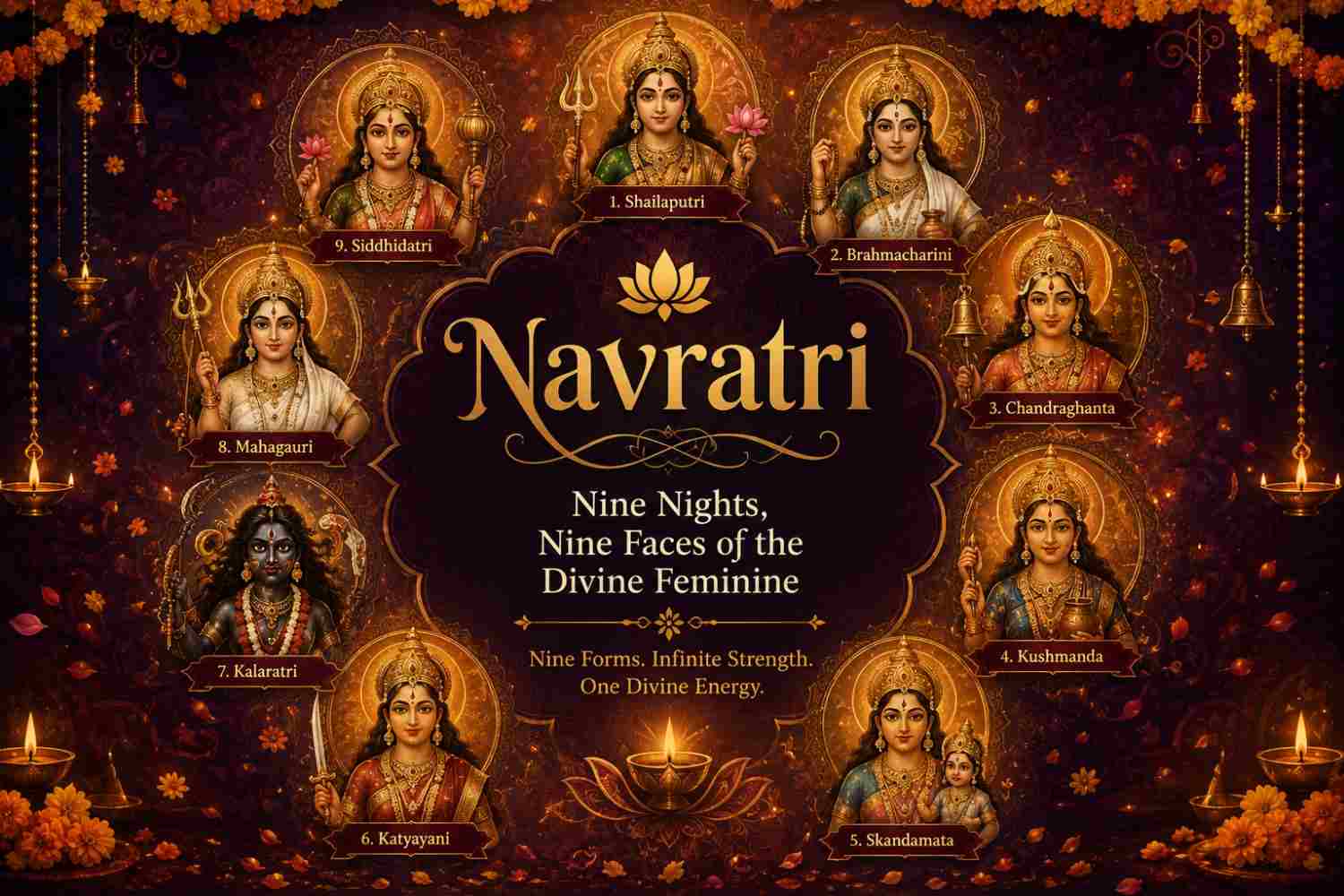
Navratri: Nine nights, nine faces of Shakti
The first indication of Navratri usually comes not from any temple. This could be a spontaneous display of a tiny kalash in the corner of your house, the planting of new barley seeds into the moist so