Maa Katyayani: the fearless warrior mother

RIYA SHARMA
HRDYAM - DISCOVER SACRED JOURNEYS, WISDOM & WELLNESS
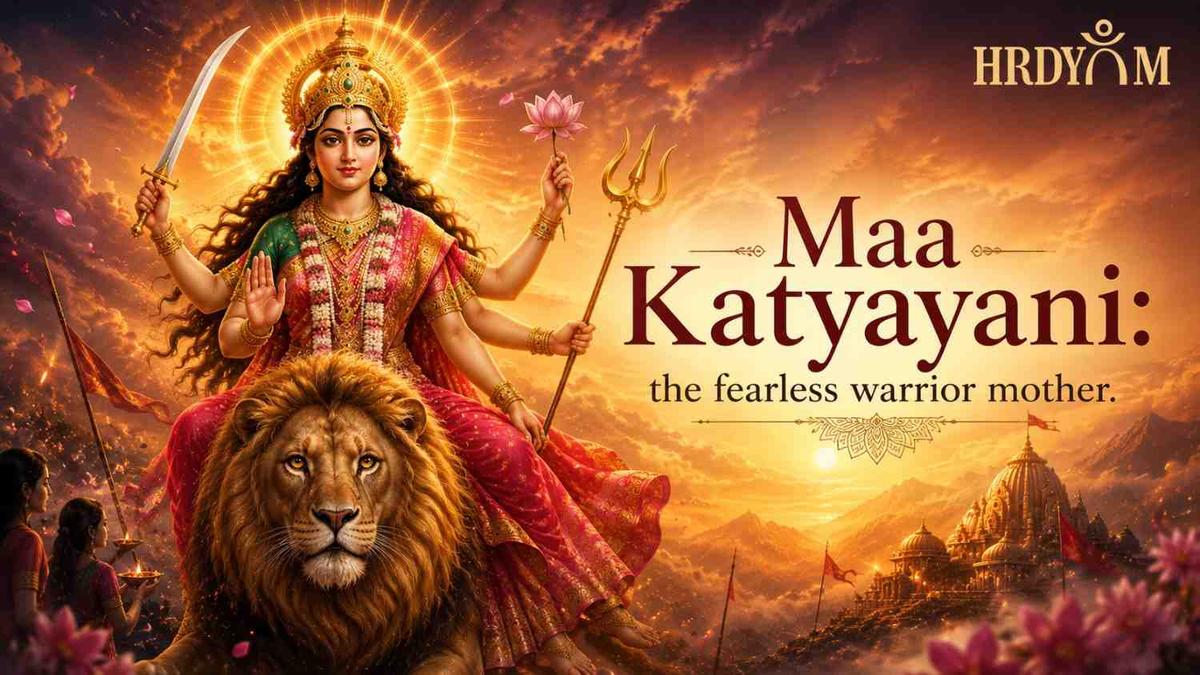
On the sixth day of Navratri, followers pay their respects to Maa Katyayani, the sixth form of the Navdurga. This form signifies bravery, willpower, justice, and strength to fight against injustice.
As opposed to Maa Skandamata, who is associated with motherly qualities and nourishment, Maa Katyayani is depicted as a fierce Goddess-warrior. She rides a lion and holds different weapons like a sword and lotus in her four hands.
The origin of this form goes back to the sage Katyayana, who practiced severe penance with the intent of having the Goddess as his daughter. The tradition has it that Maa Katyayani appeared before him as his daughter and later defeated the demon Mahishasura.
She becomes a very significant form of femininity. The strength she possesses is never passive or hidden; rather, she comes forward whenever there is a need for danger to be tackled.
However, the message of Maa Katyayani goes beyond mere physical combat.
Her story may also mean standing up against fear, oppression, bad practices, and other situations that keep us stuck from going forward. Sometimes the toughest fight lies not outside but inside oneself.
Her lion means courage and self-assurance, whereas the arms she holds symbolize preparedness and determination.
Thus, the sixth day raises a new question on the path to Navratri: Are you courageous enough to act when something is wrong?
In that sense, Maa Katyayani tells us that strength is not about power per se but rather its application.
The sixth day of Navratri is dedicated to the person who cannot let injustice go unnoticed and acts accordingly.
This year’s message of Maa Katyayani is simple: courage starts when one decides that fear won’t choose our decisions anymore.
Why is she known as the fearless form of Shakti?
Katyayani Maa is worshiped during the sixth day of Navratri and is the sixth incarnation of the Navdurga. She is considered the most courageous form of Goddess Durga and is known for destroying injustice.
Her name is usually linked to Sage Katyayana. In one legend, the Goddess was born as his daughter following his meditation, while in others, Sage Katyayana was one of her earliest devotees.
Katyayani Maa is usually represented as a four-armed deity riding a lion and carrying a sword and lotus, while her other hands are shown giving blessings and protection.
She is famous for fighting Mahishasura, the buffalo demon, who had become a menace to the gods and the earth. She defeated him and came to be known as Mahishasuramardini.
Thus, she is different from Maa Skandamata. Whereas Day 5 was all about nourishment and guidance, Day 6 is about assertiveness and action.
Maa Katyayani is the power to realize that there is something wrong and the power to challenge that.
It’s not about winning the battle, but about building the courage to do that which is right, setting one's limits, and not sitting silently in the face of injustice.
How did she rise to defeat evil?
According to ancient traditions, the Gods were worried about the increasing prowess of Mahishasura, who had become a danger to all three worlds. Being unable to fight him separately, they combined their energies, from which appeared the mighty figure of Maa Durga.
There is an ancient tradition, according to which this form of Durga is connected with the name of Sage Katyayana, who conducted rigorous penance in order to please the Goddess. Appearing as his daughter, she started being called Katyayani.
Equipped with the divine weapons and riding a lion, Maa Katyayani fought with Mahishasura. After a fierce fight, she managed to defeat him and kill him, restoring the balance of the world.
This story is significant in terms of the fact that Mahishasura was not just an enemy. On a deeper level of the story interpretation, this fight symbolizes the struggle with arrogance, injustice, unrestricted force, and disturbance of harmony.
Thus, the victory of Maa Katyayani reminds us that sometimes difficult situations cannot be solved with the help of patience only; at certain times, a decisive action is necessary.
Moreover, this story proves one principle: power is meaningless without any purpose.
It turns Navratri Day 6 into a day devoted to determination and bravery. It motivates the devotees to know what they need to fight in their own lives, whether it is fear, injustice, negative behavior, or some barrier that they have been avoiding.
In the end, the legend of Maa Katyayani urges us to progress from recognizing the wrong thing to fighting against it.
What do her weapons, lion, and four arms signify?
The form of Maa Katyayani is known to reflect courage, determination, protection, and dominance of good over injustice. Each feature of Maa Katyayani serves as a part of her warrior symbolism.
The Lion
Maa Katyayani is usually depicted sitting on a lion that symbolizes courage, self-confidence, and boldness. The lion represents her bravery that makes it possible for her to face powerful entities.
The Sword
The sword is a sign of the power that cuts through obstacles as well as ignorance. The sword can also be interpreted as a means to define right and wrong.
The Lotus
The lotus is a sign of purity and spiritual awareness. Its presence together with the sword reveals an essential balance since strength does not mean the loss of purity and compassion.
Her Four Arms
She is depicted with four hands that mean her ability to protect, bless, and face difficulties at once. Her weapons show her readiness to fight, while other gestures express comfort.
Her Warrior Form
Unlike nurturing images of Maa Skandamata, Maa Katyayani’s image openly reflects Shakti as a power. In fact, she does not wait until injustice goes away by itself.
Mahishasura
The vanquished Mahishasura embodies the evil attributes of ego, pride, oppression, and destruction. The fall of Mahishasura denotes the return to balance.
When does courage become a spiritual strength?

Maa Katyayani introduces the concept of action in the path of Navratri.
Her legend is not one of waiting for the problematic circumstances to sort themselves out. She is the goddess who takes on the courage to identify problems and fight them.
This makes day 6 very pertinent to our lives as well. We might not have problems like demons and wars in the form of legends, but we do come across many instances where we need the courage to do something-that decision, bad habit, discrimination, or setting up boundaries. Maa
Katyayani encourages us to ask ourselves:
What am I putting up with that must be changed?
In what areas must I become more decisive?
Am I avoiding something only out of fear of the repercussions?
What is worth fighting for?
Her tale also shows us that bravery does not equate to being reckless. The warrior requires clarity, control, and a purpose rather than mere aggressiveness.
That is how her strength is different from anger. Anger may make us respond; purpose lets us act.
How should Maa Katyayani be worshipped on Day 6?
The puja of Maa Katyayani can be done with the usual Navratri requirements, along with flowers and other offerings that are normally offered while worshipping her.
Steps in Puja Vidhi
Clean the puja place and have a bath before doing the puja.
Place the image or idol of Maa Katyayani near the Kalash.
Burn a ghee diya and do the puja after lighting an incense stick, with peace of mind.
Offer flowers, akshat, kumkum, and sandalwood to the Goddess.
Offer red flowers, as red flowers are traditionally offered to Maa Katyayani.
Offer bhog like honey, fruits, and other simple sattvic items.
Chant the mantra of Maa Katyayani: ॐ देवी कात्यायन्यै नमः॥
Pray for courage, protection, guidance, and power to overcome obstacles.
Aarti can be performed, and the puja can be ended by seeking the blessings of Maa Katyayani.
What belongs on the day 6 Puja thali?
For Goddess Katyayani, the sixth-day puja can be conducted using the usual Navratri requirements as well as a few additional offerings made to her.
| Puja Samagri | Purpose |
|---|---|
| Maa Katyayani's image or idol | Main focus of the puja |
| Kalash | Continues from Day 1 |
| Red flowers | Traditional offering |
| Other fresh flowers | Additional offering |
| Kumkum / Roli | Tilak and puja |
| Akshat | Used during prayers |
| Chandan | Traditional offering |
| Ghee diya | For lighting during worship |
| Dhoop / Incense | Used during puja |
| Honey | Traditional bhog |
| Fruits | Sattvic offering |
| Mishri | Sweet offering |
| Panchamrit | Used according to family tradition |
| Camphor | For aarti |
| Japa mala | For mantra chanting |
It should be noted that red-colored flowers are highly appropriate for Maa Katyayani since their color goes well with the strong, energetic avatar of the goddess.
One should not put too many things on the list. If you are doing the puja in your own home, then flowers, fruits, bhog, and other basic requirements will suffice.
What offering is made to the warrior mother?
The bhog prepared for Maa Katyayani is normally sattvic in nature. Honey has a special connection with the worship of Maa Katyayani on the sixth day of Navratri.
| Bhog | Significance |
|---|---|
| Honey | Traditional offering associated with Maa Katyayani |
| Kheer | Simple milk-based offering |
| Fresh fruits | Light and sattvic |
| Mishri | Represents sweetness |
| Dry fruits | Can be included in the offering |
| Panchamrit | Used according to family tradition |
For those people who keep the vrat of Navratri, the bhog can be made in accordance with the fasting tradition followed by their family.
Once the offering is made, it can be shared as prasad.
Honey is a significant offering made on Maa Katyayani’s day since it signifies something sweet and nutritious, making a difference from her form as a warrior.
The life history of Maa Katyayani tells us that one doesn’t have to be cruel in order to be strong. One can be tough at times but remain gentle in nature.
Why does red echo the spirit of Katyayani?

Red is often used in association with the sixth day of Navratri, which is dedicated to Maa Katyayani. It symbolizes strength, passion, valor, determination, and action-attributes that have a very close connection to her as a warrior deity.
How to Include Red on the Sixth Day
Wear a red saree, kurta, suit, or dupatta.
Use red flowers in your puja decoration.
Include red colors in your rangoli and decoration.
Wear red bangles and earrings.
Wear red clothes for Garba or Dandiya dance at night.
The color is not mandatory for the puja; it is just a customary tradition of making a visual connection with the energy that belongs to the day.
The use of red is especially appropriate for Maa Katyayani as her myth reflects bold actions and struggle against wrongdoing. The color symbolizes energy and not tranquility, as in some other forms of the goddess.
The symbolism of red, however, doesn’t necessarily involve anger or aggression.
For Maa Katyayani, it symbolizes the courage to take action, the passion for the protection of loved ones, and firmness where needed.
Can her worship awaken courage and determination?
Katyayani Mata is generally revered for being brave, courageous, and strong. She is a warrior goddess and therefore known for decisiveness.
Some of the things devotees pray for include:
Courage and Confidence: Her warrior form signifies the strength and fortitude to face hard times without being overpowered by fear.
Protection: Devotees pray to her for their protection from any negative influences or hard times.
Overcoming Obstacles: Her fight with Mahishasura signifies the power to overcome tough obstacles.
Decision-making: Her form motivates one to be decisive while making a hard decision.
Freedom from Fear: The lion that she rides stands for fearlessness and confidence.
Justice and Righteousness: The war with Mahishasura stands for standing up against destructive powers.
Determination: Her worship becomes a reminder to stay determined towards the realization of an important goal.
The importance of Maa Katyayani lies not just in the concept of protection but much more than that; her story makes devotees realize the need to have the power within them to confront whatever needs to be confronted.
Thus, her day can be a time for introspection on whether there is something in our lives that we must have the courage to do.
What should devotees keep in mind on Day 6?
Katyayani Devi symbolizes strength and determination, but the martial form that she carries is not supposed to lead anyone to become aggressive and combative.
- Misinterpreting Courage for Aggression
Being strong does not equate to being harsh and starting unnecessary disputes. The strength of Maa Katyayani has a reason behind it.
- Treating Each Dispute as a War
Not all conflicts need to be won. At times, it makes more sense to talk things through or simply leave.
- Relying on Fear as an Excuse to Not Make Tough Choices
Day 6 is about courage. If you have been putting off making an important choice due to your fear, use this opportunity to think things over.
- Fasting as a Competitive Game
Navratri fasting is not a competition of who can endure the most torture. Follow the traditions in your household and attend to your necessities.
- Obsession with the Warrior Role
The weapons of Maa Katyayani indicate strength for a higher cause rather than violence for its own sake. The ultimate message of Maa is one of harmony.
- Overlooking Compassion
It is not necessary that being tough on something means ignoring compassion. Strength gains meaning only when it is realized how our actions affect others too.
- Praying for Things to Just Go Away
You may not only pray for the problems to go away but also for the wisdom to face them yourself.

How does India celebrate the warrior goddess?
Navratri celebrations are usually more intense by the time the sixth day comes around. Even though the Goddess is venerated in her different forms, the manner in which people celebrate the festival is entirely dependent on the location.
| Region | How Day 6 is Celebrated |
|---|---|
| Gujarat | Garba and Dandiya celebrations become increasingly energetic, with communities gathering in traditional attire for evening dance events. |
| Maharashtra | Devotees continue household Devi puja and fasting, while cultural and devotional programmes take place in many communities. |
| North India | Families continue daily puja and vrat, with temple visits, devotional singing, and jagran forming part of Navratri observances in many places. |
| West Bengal | The festive atmosphere surrounding Durga Puja becomes increasingly prominent as communities prepare and participate in elaborate celebrations of the Goddess. |
| South India | Golu/Kolu displays continue to bring families and visitors together, accompanied by devotional music, prayers, and prasadam. |
| Himachal Pradesh | Devotees visit Devi temples and participate in regional traditions of Goddess worship that have been maintained for generations. |
How can HRDYAM bring more meaning to Day 6?
The sixth day of Navratri, which is celebrated for Maa Katyayani, is believed to be related to the concepts of courage, determination, and the strength to stand firm. In this case, one may find that they also have links with the idea of visiting the temples and Shakti Peethas of India.
In the case of HRDYAM, the pilgrimage is not only about getting to the destination point but rather about understanding the legends, rituals, architecture, and culture associated with a specific location.
Be it a trip to the Devi temples, visiting Shakti Peethas, or simply planning your pilgrimage in an informed way, HRDYAM offers pilgrimage and cultural discovery at the same time.
One may explore the offerings of puja essentials, spiritual products, Vedic astrology services, and personalized spiritual journeys at HRDYAM.
The tale of Maa Katyayani is a reminder that an impactful journey calls for courage-courage to move out of our comfort zone, try something new, and see ourselves from a whole new point of view.
In this Navratri season, turn your pilgrimage into a journey of self-discovery and understanding.
The strength to stand fearless
Day 6 of Navratri is dedicated to the warrior quality in the form of Maa Katyayani. The story of Maa Katyayani teaches about courage, resolve, justice, and strong actions.
The fight between Maa Katyayani and Mahishasura is symbolic of the fight between her and the powers of imbalance and oppression. However, the lesson also holds true in our everyday life. Sometimes running away from an unpleasant situation just gives it more power; sometimes we have to muster the courage to speak up, make decisions, or take some action.
Maa Katyayani shows us that courage isn't synonymous with aggression. Courage requires clarity about where our strengths lie, which things need to be challenged, and which have to be left behind.
Let us carry this lesson into the remaining days of Navratri 2026: Stand firm in your principles, face those things which you have been avoiding all along, and use your strengths wisely.
Because courage is not about a lack of fear. It's about not allowing fear to make your decisions for you.
Spiritual travel researcher, Vedic cultural writer, and contributing editor at HRDYAM.
You Might Also Like
Tags
More Articles
View all
What is HRDYAM? The AI-Powered Spiritual Ecosystem
The spiritual essence of India has not merely consisted of temples alone. It is found in pilgrimage circuits, old rituals, Vedic astrology, Yoga, Ayurveda, sacred rivers, traditions of the region, art

How HRDYAM blends spirituality with sustainability
How would pilgrimage change if it were no longer viewed as a trip to a shrine but as an engagement with the entire sacred geography? The river next to the shrine, the communities that live by the shri
Navratri: Nine nights, nine faces of Shakti
The first indication of Navratri usually comes not from any temple. This could be a spontaneous display of a tiny kalash in the corner of your house, the planting of new barley seeds into the moist so