Maa Skandamata: the mother who carries courage

RIYA SHARMA
HRDYAM - DISCOVER SACRED JOURNEYS, WISDOM & WELLNESS
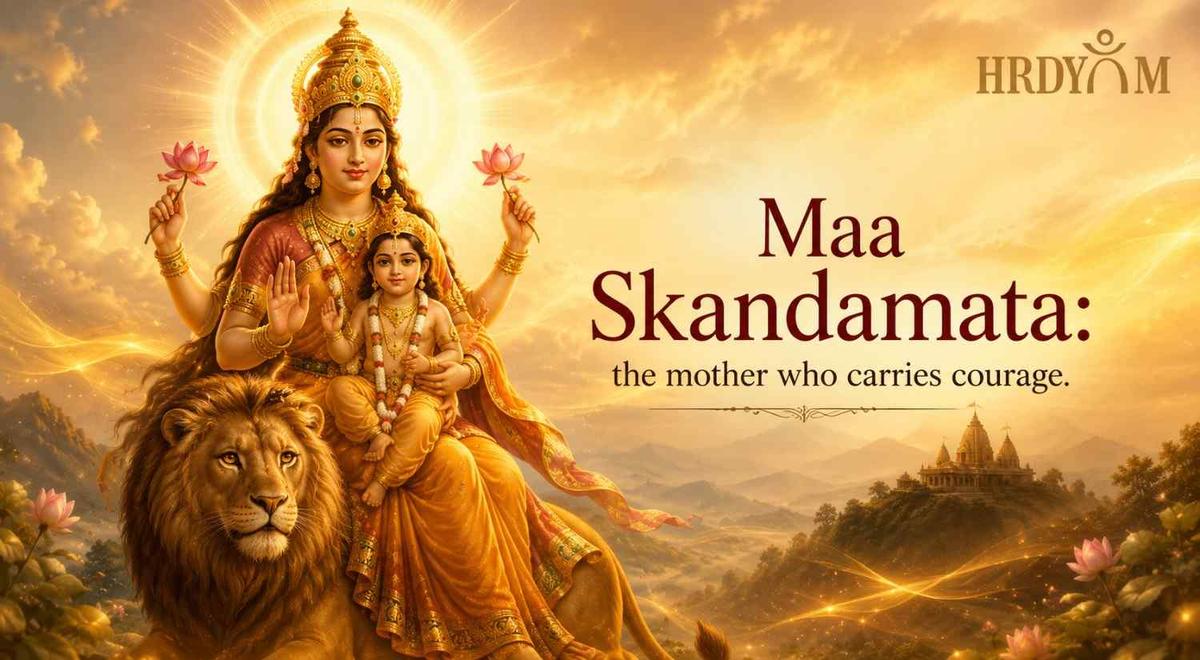
The fifth form of the Navdurga appears on the fifth day of Navratri, which is known as Maa Skandamata.
The name of the goddess 'Skandamata' means 'the mother of Skanda', where Skanda is another name for Lord Kartikeya.
Her depiction is unique in its own way as compared to the depiction of the other goddesses who were worshipped on earlier days of Navratri. Here, Maa Skandamata is depicted as holding her child Kartikeya in her lap, while she holds lotuses in her other hands.
Maa Skandamata rides on a lion and sits on a lotus seat. It symbolizes how a mother can be both loving and powerful at the same time.
It is because it depicts that a mother has the same power that gives her the ability to ride a lion. The tenderness with which a mother takes care of her child and the power that she holds are never contradictory to each other.
Maa Skandamata is associated with attributes like love, compassion, wisdom, protection, and responsibility. Therefore, it is not mandatory for people to be either parents or a family member to understand and appreciate her character and devotion.
The fact that she appears on Navratri Day 5 is another fascinating point on the journey of Navdurga.
Maa Kushmanda was an embodiment of the power of creation. Maa Skandamata is an embodiment of what comes next after creation-taking responsibility for nurturing and protecting what was created.
The child cannot merely be born. He or she requires protection, nurturing, guidance, education, and the space to become strong at last.
It is the deeper meaning of Maa Skandamata’s form.
It reminds us that strength is not just about standing on one's own feet but, at times, is also about empowering another.
Why is she revered as the mother of Skanda?
The fifth goddess, Maa Skandamata, is revered during the fifth day of Navratri and is considered to be the fifth avatar of Navadurga. This goddess is known to be the mother of Skanda/Kartikeya, and hence she is named Skandamata.
In general, the goddess is portrayed as having four arms. In one of her hands, she holds the lotuses, and in another hand she holds her child, Kartikeya, while one of the hands is in a blessing posture. The goddess is seen sitting on the lotus flower, and that is why she is also called Padmasana Devi.
The depiction of the goddess is quite unique in the sense that on one side she depicts purity and spiritual enlightenment through lotuses, and on the other side, her child shows the nurturing aspect. On the contrary, her lion symbolizes courage and strength.
She embodies the notion of the mother being more than just someone who shows love. The notion of responsibility, wisdom, patience, and the willingness to defend someone else while helping them gain their independence are all contained within her.
Her blessings have traditionally been invoked in the name of peace, prosperity, wisdom, and happiness within the family.
Thus, the fifth day of Navratri puts focus on a facet of Shakti which is often ignored, and that is the power needed to nourish.
Maa Skandamata teaches us that nurturing another individual does not render one weaker. In most cases, it requires more patience and courage than standing alone.
How did motherhood become her greatest strength?
The narrative of Maa Skandamata is directly linked with the birth and rearing of Lord Kartikeya (Skanda).
As per ancient beliefs, Kartikeya was supposed to kill the formidable demon named Tarakasura, who had been granted a boon from Brahma that he could only be killed by a son of Lord Shiva. So the birth of this deity became significant due to the cosmic order that needed to be restored from this threat by the demon.
Kartikeya took birth from Parvati, and in this incarnation she is worshipped as Skandamata.
Her idol depicts her in an embrace with young Kartikeya in her lap. In this way, she gains prominence among the Navadurga, as she is not depicted as just a powerful goddess but as a loving mother nurturing and guiding her offspring.
However, she sits on a lion in this incarnation, reminding people that motherhood includes more than just being gentle.
Her story, however, is much more than that of a mother and her son. This story speaks of the duty that lies in making others strong enough to realize their potential.
The presence of Maa Skandamata on the fifth day of Navratri could thus be interpreted as the knowledge that growth requires something more than just creation. The creations require not only development but also protection and guidance.
And this might perhaps be the strongest form of strength that exists not for itself but for the sake of making another being stand on its feet.
What do her four arms and lotus seat represent?

The form of Maa Skandamata contains all the symbols of motherhood, purity, wisdom, protection, and spiritual development. Every element of her representation contributes to the interpretation of her worship on the fifth day.
Baby Kartikeya
One of the most characteristic features is Baby Kartikeya, who is depicted on her lap. This is a symbol of the motherly nurturing nature of the Goddess and her mission to raise a child into a strong and worthy individual.
Lotus
Maa Skandamata is usually depicted as seated on the lotus, which earns her the title Padmasana Devi. The lotus symbolizes purity, spirituality, and grace despite any troubles of life.
Four Arms
Maa Skandamata has four arms symbolizing the mission to nurture, protect, bless, and guide. With one arm, she carries a baby, and with two others, the lotuses. The fourth arm is used to offer blessings.
Lion
The lion symbolizes strength and courage and serves as a strong contrast to the image of a mother and a child.
Her Peaceful Face
As compared to the more warlike images of the Goddess, Maa Skandamata is shown with a serene and caring face. This shows the qualities of patience and emotional strength that come from being a mother.
Taken together, these symbols convey the important message that caregiving itself can be a source of strength.
The image of Maa Skandamata tells us that looking after someone involves not only patience and protection, but wisdom and even the difficult decisions necessary for their growth.
This is why Day 5 of Navratri is not about engaging in battle, but recognizing the strength behind nurturing growth.
Can compassion become a source of strength?
The fifth day of Navratri represents nurturing in the course of the Navdurga journey.
Maa Skandamata is depicted as having the young Kartikeya in her lap, thereby portraying motherhood as an integral part of her incarnation. However, this symbolism transcends biological motherhood, as Maa Skandamata's tale revolves around guidance, protection, and development of another individual's potential.
Thus, Day 5 is a good day to think about the people and responsibilities that we nurture in our lives.
In some cases, nurturing is connected with taking care of one's children. In others, it is providing assistance to friends and family members, mentoring, and developing one's potential.
At the same time, Maa Skandamata teaches us that compassion and strength may coexist in one individual.
While the serene expression of Maa Skandamata symbolizes compassion, a lion at her feet portrays courage. The two do not contradict each other.
This can be expressed through three basic notions:
Nurture that which is important.
Protect without control.
Give guidance without hindering growth.
There is also a wonderful lesson to be learned about personal development. As a mother provides her child with enough security for him/her to one day gain independence, we also need to provide an inner space where our own thoughts and skills may develop.
How is Maa Skandamata worshipped on day 5?
Puja of Maa Skandamata can be done in a very simple manner along with a calm ambiance because her form is related to motherhood and compassion, and therefore, puja can be done with gratitude and reverence towards her.
Step-by-Step Puja Vidhi
First of all, clean the place where puja will be conducted and take a bath.
Keep the image of Maa Skandamata next to the Kalash.
Light a diya with ghee and an agarbatti to initiate the puja.
Offer flowers, Akshat, Kumkum, and Chandan to the Goddess.
Offer lotus flowers, as it is related to her form.
Offer bhog such as bananas, kheer, or other preparations.
Mantra: ॐ देवी स्कन्दमातायै नमः॥
Pray for the good health, wisdom, and safekeeping of your family and loved ones.
Complete the aarti ritual by invoking the blessings of Maa Skandamata.
Though the puja ritual may be a simple one, the meaning behind it is deep-patience, compassion, responsibility, and the ability to take care of others.
What should you keep ready for the puja?

Day 5 ritual of Maa Skandamata may consist of using the basic materials required for conducting Navratri, along with a few materials related to her lotus and nurturing nature.
| Puja Samagri | Purpose |
|---|---|
| Maa Skandamata's image or idol | Main focus of the puja |
| Kalash | Continues from Day 1 |
| Lotus flowers | Traditional offering to Maa Skandamata |
| Other fresh flowers | Additional offering |
| Kumkum / Roli | Tilak and puja |
| Akshat | Used during prayers |
| Chandan | Traditional offering |
| Ghee diya | For lighting during worship |
| Dhoop / Incense | Used during puja |
| Fruits, especially bananas | Bhog offering |
| Kheer | Traditional sweet offering |
| Panchamrit | Used according to family tradition |
| Camphor | For aarti |
| Japa mala | For mantra chanting |
You do not have to go about collecting all of them if they are difficult to find. Fresh flowers, fruits, diya, Puja items, and genuine prayer are what it takes to perform a simple worship ritual at home.
The lotus is especially important for this occasion because of the reason that Maa Skandamata is always shown to be sitting on it.
What is traditionally offered to the mother?
Bhog offered to Maa Skandamata tends to be minimalistic and is more in keeping with Sattvic philosophy. Banana offerings, especially during Navratri, tend to be offered on the fifth day.
| Bhog | Significance |
|---|---|
| Bananas | Traditional offering associated with Maa Skandamata |
| Kheer | A simple, sattvic milk-based preparation |
| Panchamrit | Often included in traditional puja |
| Fresh fruits | Light and natural offering |
| Mishri | Represents sweetness |
| Dry fruits | Can be offered as part of a simple bhog |
In case of people who observe Navratri fast, one can make bhog from food that is allowed to eat during fasting period as per family customs.
Once the offering is done, the bhog can be distributed as prasad to the family members.
It must also be noted that there exists a special relationship between the food offered and the symbol of Maa Skandamata. She, being a mother taking care of her baby, symbolizes nourishment and good health. Thus, the food offered becomes a symbol of daily care and the well-being of another person.
White: the stillness of a mother's heart
White is commonly associated with Day 5 of Navratri and Maa Skandamata. The colour complements her calm and compassionate form and is often connected with peace, purity, serenity, and clarity.
Ways to Incorporate White on Day 5
Wear a white saree, kurta, suit, or dupatta.
Add white flowers to the puja arrangement.
Use white decorations around the worship space.
Choose pearl or silver-toned accessories for a subtle festive look.
Wear white for an elegant evening Garba or community celebration.
White is not compulsory for the puja. It is a festive tradition that allows devotees to symbolically connect with the qualities associated with the day.
For Maa Skandamata, the colour works particularly well with her imagery. Her peaceful expression, lotus seat, and nurturing relationship with young Kartikeya all convey a sense of calmness and purity.
What can devotees seek through her worship?
The traditional worship of Maa Skandamata is for peace, knowledge, protection, and prosperity at home.
Traditionally, devotees seek blessings from her for:
Peace of mind: Her peaceful form as a mother signifies peace of mind.
Wisdom: The worship of Maa Skandamata has traditionally been associated with gaining knowledge.
Protection: Devotees seek the protection of Maa Skandamata for protection against obstacles and harmful forces.
Well-being at home: Being a mother herself, her worship is associated with well-being at home.
Strengthening their ability to take care of others: Being a mother herself, Maa Skandamata is associated with the patience and strength that are necessary to do so.
Welfare of their children and blessings of parenthood: Traditionally, her worship has been considered auspicious for the well-being of children and parenthood.
Spiritual upliftment: The lotus that she carries symbolizes spiritual purity.
What should you avoid during the fifth day?
Worship of Maa Skandamata revolves around motherhood, compassion, and protection. Hence, one can observe more warmth on Day 5 than any kind of rigidity.
- Protection Being Misunderstood as Control
Maa Skandamata protects her child, but it doesn't mean she controls all his decisions. Nurturing is as much about giving enough space for growth.
- Not Connecting with Family during Puja Ceremony
Her day is a great chance to spend some quality time with people close to you. Otherwise, the purpose of the day is being missed.
- Reducing Motherhood to Childbirth
It is not necessary that you have to be a mother to share all those characteristics of a woman represented by Maa Skandamata. Anyone can show them.
- Complex Preparation of the Bhog
An extensive selection of dishes is unnecessary. It will suffice to have a few fruits or other traditional dishes ready to offer.
- Overlooking Self-care
Taking care of others doesn’t mean overworking yourself to the extent of exhaustion. The imagery associated with Maa Skandamata can also serve as a reminder that one cannot take care of others when they themselves overlook self-care.
- Waiting for Instant Benefits
Pujas and devotion are not exchanges. Do not approach the puja with the mentality that everything personal needs to be fixed instantaneously.
- Overlooking the Importance of Independence
It is not the role of a mother to nurture a child and make them dependent on her forever.
How does India honour Skandamata?
The fifth day of Navaratri celebrates the regional variations that exist within the celebration, where every region in India has its own unique way of celebrating the festival.
| Region | How Day 5 is Celebrated |
|---|---|
| Gujarat | Garba and Dandiya continue in the evenings, with communities gathering in traditional clothing and celebrating through music and dance. |
| Maharashtra | Families continue their daily Devi puja and vrat traditions, while women may visit one another and exchange festive offerings. |
| North India | Devotees continue fasting, daily puja, temple visits, and devotional singing. Some communities also organise jagrans during Navratri. |
| South India | The Golu/Kolu tradition continues, with families inviting guests to view their doll displays and sharing prasadam. |
| Himachal Pradesh | Devotees visit local Devi temples and continue the region's strong traditions of Goddess worship during Navratri. |
| Rajasthan | Temple visits, household puja, traditional music, and regional festive gatherings form part of Navratri celebrations. |
What makes Day 5 significant is the way in which the concept of motherhood fits in with family tradition. Navratri is frequently an occasion on which the family comes together to pray, cook traditional foods, visit temples, and pass on tradition from one generation to the other.
In and of itself, this speaks to something at the core of the legend of Maa Skandamata, and that is the need to nurture the tradition that is to be passed on.
From the recipes of grandmothers, the prayers passed down from parents, and songs traditionally sung every year, culture lives through tradition in India.
Celebrate the mother in your own way

The festival of Maa Skandamata is an excellent example of the significance of spirituality and family within a culture. The festival revolves around the ideals of nurturing and motherhood, just like the traditions of pilgrimage in India.
The pilgrimages at HRDYAM are not considered simple visits to the temples but are rather viewed from the perspective of understanding the legends, rituals, architectural details, and other traditions behind India's sacred spots.
Be it Devi temples, Shakti Peethas, or planned pilgrim tours, HRDYAM will help you make your experience meaningful.
Families can also enjoy the services of puja essentials, spiritual products, Vedic astrology, and personalized spiritual experiences through HRDYAM.
The Mata Skandamata teaches us that what is important for us has to be nourished. Likewise, there is a need to preserve India’s spiritual legacy. This is possible if there is a connection with temples, ceremonies, fairs, stories, and customs which can be comprehended and transferred from one generation to another.
This year, during Navratri, make sure that the journey leads to something greater than a destination.
Where the mother's strength remains
The fifth day of Navratri introduces us to a very soft yet powerful form of Navdurga-Maa Skandamata, holding young Kartikeya on her lap.
Maa Skandamata teaches us through her image that strength does not necessarily involve confrontation. In many cases, it involves helping a person get strong enough by patiently bearing with him/her.
The legend of Maa Skandamata also teaches a greater concept of motherhood. Nurturing can occur anywhere where care occurs - whether between parents and children, teachers and pupils, mentors and their proteges, friends, and even ourselves.
As Navratri 2026 progresses beyond Day 5, Maa Skandamata teaches us a very simple principle of caring for what we hold dear and protecting without being overbearing or taking away the growth opportunities from other people.
Because the most powerful form of nurturing is when it creates self-reliance rather than dependence.
Spiritual travel researcher, Vedic cultural writer, and contributing editor at HRDYAM.
You Might Also Like
Tags
More Articles
View all
What is HRDYAM? The AI-Powered Spiritual Ecosystem
The spiritual essence of India has not merely consisted of temples alone. It is found in pilgrimage circuits, old rituals, Vedic astrology, Yoga, Ayurveda, sacred rivers, traditions of the region, art

How HRDYAM blends spirituality with sustainability
How would pilgrimage change if it were no longer viewed as a trip to a shrine but as an engagement with the entire sacred geography? The river next to the shrine, the communities that live by the shri
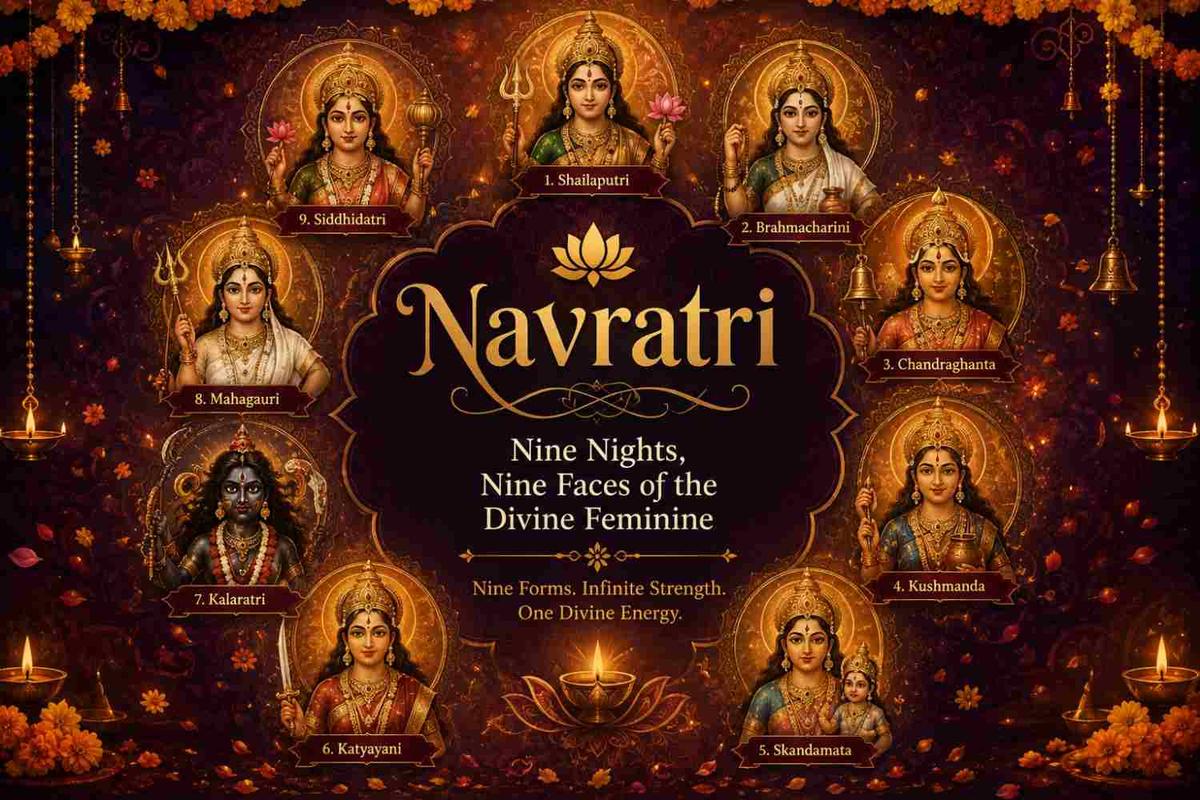
Navratri: Nine nights, nine faces of Shakti
The first indication of Navratri usually comes not from any temple. This could be a spontaneous display of a tiny kalash in the corner of your house, the planting of new barley seeds into the moist so