Maa Kalaratri: mother who teaches us not to fear the darkness

RIYA SHARMA
HRDYAM - DISCOVER SACRED JOURNEYS, WISDOM & WELLNESS
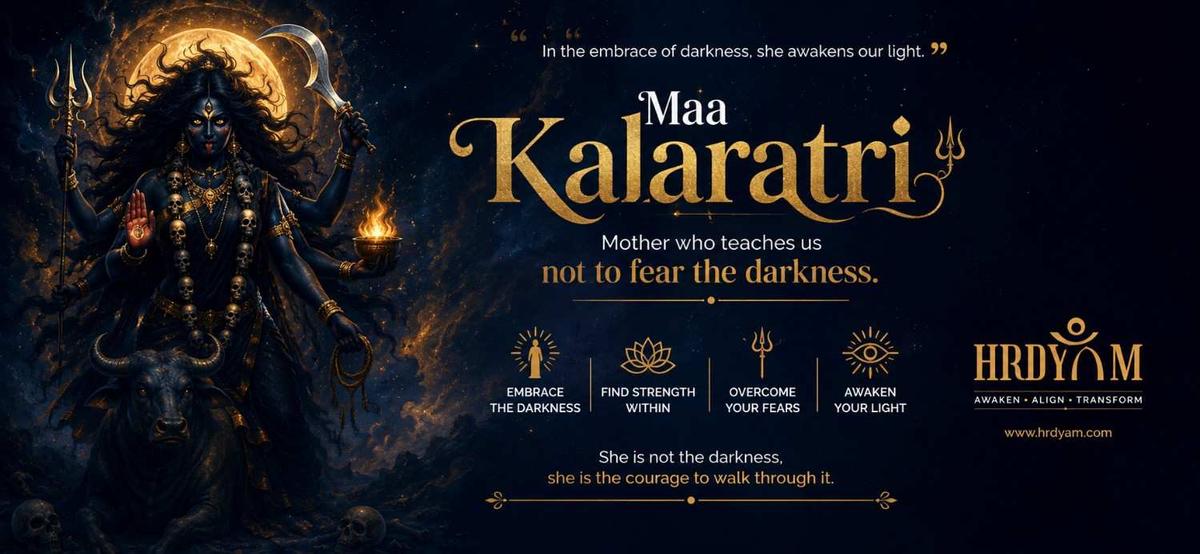
Day seven of Navratri gives us a look at one of the most aggressive forms of the Navdurga-Maa Kalaratri.
She has dark skin, disheveled hair, three eyes, a terrifying appearance, and four arms holding weapons, giving protection and blessings at the same time. Her vahana is a donkey, and she is considered to be the most terrifying form out of all Navdurga.
However, there is an interesting paradox hidden beneath her terrifying appearance.
Maa Kalaratri is not worshipped for being fearful. Maa Kalaratri is worshipped for destroying our fears.
Her name consists of two parts: Kala, which means time and darkness, and Ratri, which means night. Night could be viewed as an unknown part of our lives where we do not see what is awaiting us. Thus, Kalaratri becomes a symbol of fighting the darkness and not escaping from it.
According to traditional stories, she fought demons like Raktabeej, who created another demon when his blood touched the earth.
But her symbols are also deeply personal.
Fear, ignorance, rage, negative habits, and pain can sometimes operate as Raktabeej-each attempt to suppress it gives rise to it in some other form.
Kalaratri is the symbol of having the courage to deal with them right from their source.
Day 7 of Navratri thus becomes a turning point. Following the determination of Maa Katyayani, we now turn our attention inward. No longer is the question, “What shall I fight?”
Now comes the question, “What darkness within me needs to be dealt with and understood?”
And here comes into play the symbolism of Maa Kalaratri in her fearsome form.
She is also called Shubhankari, the auspicious one. Behind her fearsome form lurk the blessings of protection and transformation-from darkness towards understanding.
Sometimes, the very thing that seems most frightening helps us in facing our fears.
Who is Maa Kalaratri beneath her fearsome form?
Maa Kalaratri is worshipped on the seventh day of Navratri, and she is the seventh incarnation of the Navdurga.
The name of Maa Kalaratri is derived from Kala, which means time or darkness, and Ratri, which means night. Thus, the name Kalaratri implies darkness that leads to light.
The physical features of Maa Kalaratri include a black complexion, three eyes, uncombed hair, and four hands. Her mount is a donkey, and she holds a sword and protection weapon in two hands, while the other two hands depict the gestures of blessings and fearlessness.
The look of Maa Kalaratri may appear scary, yet it is her distinct characteristic feature because she signifies that which eliminates fear and negativity.
She is also called Shubhankari, meaning the one who brings auspiciousness. She embodies an important characteristic in her: despite the scary image, she is a protector.
Maa Kalaratri symbolizes fearlessness and being protected against dangers. She helps us to look at our life problems with confidence rather than to be afraid of something and act out of fear.
She also symbolizes transformation. Darkness is not always the thing that needs to be simply shunned. Sometimes you need to face it and see its contents to get rid of it and move on.
Day 7 of Navratri is different from the other days because Maa Katyayani symbolizes boldness in dealing with external injustice. But Maa Kalaratri takes this concept further and symbolizes the boldness in facing fear and darkness.
Her message to us is clear: Do not be afraid of darkness. Be brave enough to go through it.
What is the story of Maa Kalaratri's form?

However, the most popular one is the tale about her fight against the demon Raktabeej, who was almost impossible to defeat due to the nature of his powers. Namely, as the story goes, each time a drop of his blood touched the earth, another Raktabeej appeared.
The Gods and other incarnations of the Goddess failed to cope with such a constant reproduction of the opponent, and Kalaratri decided to assume her fierce shape to change the tactics of the battle. By drinking the blood of Raktabeej instead of letting it create other demons on the earth, she managed to destroy him.
This story is significant due to the fact that it shows that victory is achieved not through increased use of force but by solving the problem at its roots.
Therefore, this story can be applied to our lives to some extent, as many problems appear similar to Raktabeej.
A destructive behavior, anger, fear, or negative thought pattern functions in the same manner.
It is for this reason that Maa Kalaratri is not merely about destruction but also about transformation-having the courage to end an unhealthy cycle in its tracks.
How do devotees worship Maa Kalaratri?
While the appearance of Maa Kalaratri is certainly intimidating, each characteristic of her form has significance that relates to issues of fear, protection, transformation, and overcoming ignorance.
Her Dark Complexion
The color of her skin is meant to represent the magnitude of the night and all the things unknown to us. Instead of looking at darkness as something to be afraid of, Maa Kalaratri reminds us that transformation can take place during periods of uncertainty.
Her Three Eyes
She has three eyes, which symbolize the perception of the past, present, and the future. This also means that her vision goes far beyond the immediate environment in front of her.
Her Unbound Hair
Her hair is unbound and wild, which signifies that she is a powerful goddess without being held back by any preconceptions or concepts of what is considered beauty.
The Donkey
Instead of riding on a lion or tiger, which can be seen as the ride of choice for several other forms of the Goddess, she chooses to ride a donkey.
Her Weapons
The sword and other weapons in her hands are an indication of cutting through destruction, ignorance, and fear. This means that some issues need to be addressed by taking action instead of avoiding them.
Abhaya and Varada Mudras
One of the most important contrasts is that of her hands. As one hand gives abhaya, which means freedom from fear, the other gives blessings. Even in her scariest manifestation, she is depicted as protecting her devotees.
This is precisely the essence of Maa Kalaratri-scary to evil and reassuring to those in search of protection.
In conclusion, her scary appearance is thus not just to scare people but to symbolize the power that can help people overcome their fears.
What belongs in your Day 7 Puja thali?
Maa Kalaratri worship does not have to be complicated at all. One’s fearful demeanor need not turn the puja into an intimidating ritual; Maa Kalaratri also has the name of Shubhankari, which literally means ‘auspicious.’
Puja Vidhi Steps
First, clean the puja room and take a bath before you start the worship ceremony.
Put an idol or image of Maa Kalaratri in front of the Kalash and prepare the puja samagri.
Ignite the ghee diya and incense and start the puja ceremony peacefully.
Offer flowers, kumkum, akshat, and chandan to Maa Kalaratri. Use jasmine or red flowers according to your family tradition.
Different regions have different practices regarding flowers. Use jaggery (gur) or a mixture of jaggery for bhog.
Jaggery is one of the most common items offered on Day 7.
Recite Maa Kalaratri's mantra: ॐ देवी कालरात्र्यै नमः॥
Ask for blessings in the form of courage, protection, knowledge, and fortitude to face adverse situations.
Do the aarti and end the puja with thankfulness.
Puja samagri checklist
In case of Maa Kalaratri, a simple pujan can be undertaken while sticking to the necessary traditional elements. The Kalash installed on the first day is still functional.
| Puja Samagri | Purpose |
|---|---|
| Maa Kalaratri's image or idol | Main focus of worship |
| Kalash | Continues from Day 1 |
| Red or dark-coloured flowers | Traditional offering |
| Kumkum / Roli | Tilak and puja |
| Akshat | Used during prayers |
| Chandan | Traditional offering |
| Ghee or mustard-oil diya | For lighting during worship |
| Dhoop / Incense | Part of the puja |
| Jaggery (Gur) | Traditional bhog |
| Fruits | Sattvic offering |
| Coconut | Can be offered according to tradition |
| Camphor | For aarti |
| Japa mala | For mantra chanting |
Bhog offered to Maa Kalaratri
The bhog that has traditionally been offered to Maa Kalaratri is gur. It can either be offered as it is or in a dish made from it, like kheer.
| Bhog | How it is offered |
|---|---|
| Jaggery (Gur) | Traditional offering for Day 7 |
| Jaggery Kheer | A sweet preparation made with jaggery |
| Fresh Fruits | Simple sattvic offering |
| Dry Fruits | Can be included according to family tradition |
| Panchamrit | Offered according to household practice |
For followers undertaking the Navratri vrat, the preparation process can be adjusted to suit their personal fasting rituals.
The bhog is then distributed to the family members as prasad after the offering.
This brings about an intriguing symbolic difference. While Maa Kalaratri symbolizes fierce destruction of darkness, the jaggery symbolizes sweetness. This acts as a reminder that, despite facing tough situations, life returns to sweetness.
Why does Royal Blue define the spirit of Day 7?

The royal blue color is linked with Day 7 of Navratri and Maa Kalaratri. This rich color symbolizes attributes like strength, depth, stability, confidence, and protection.
How to Celebrate Navratri in Royal Blue Color on Day 7:
A royal blue saree, dress, kurta, and lehenga can be worn.
Blue-colored flowers or fabrics can be used for puja.
Select blue bangles, earrings, or a dupatta for the same.
Royal blue rangolis can be designed on the day.
Royal blue color can be worn along with silver jewelry.
The color is not necessary for the puja ceremony. It is just a colorful custom that is related to the seventh day. "Royal blue" goes really well with "Maa Kalaratri" since it gives the impression of something deep and mysterious. Her appearance demands that we move past the outer layer-meet the unknown without falling into panic.
What can Maa Kalaratri's worship awaken within us?
Maa Kalaratri is traditionally worshipped for being fearless, offering protection, mental strength, and the absence of negativity. The fierce form of Maa Kalaratri signifies the ability to face and conquer fear and not be afraid of it.
Traditionally, devotees seek the blessings of Maa Kalaratri for:
Being fearless: Being able to deal with uncertain and tough situations.
Offering protection: Protection from negative elements.
Mental strength: The courage to stand firm in tough times.
Clearance of obstacles: The fierce form of Maa Kalaratri signifies breaking down the obstacles that hinder a person.
Awareness and clarity: The connection with darkness is symbolic of overcoming ignorance and confusion.
Transformation of the spirit: Worshipping Maa Kalaratri is associated with overcoming negative aspects and making progress inwardly.
Inner confidence: The Abhaya, or fearlessness, gesture of Maa Kalaratri signifies that devotees do not have to live in constant fear.
There is also a further way of understanding her blessings.
Maa Kalaratri is not just someone who embodies a life without fear; she is someone who embodies the power to live through fear and yet remain intact.
Fear may not be gone at once. Situations may not transform immediately. But the ability to face them transforms our experience of them.
Common mistakes to avoid on Navratri Day 7
The scary form of Maa Kalaratri can cause devotees to fear Day 7 needlessly.
- Being Scared of Her Form
This scary form has a deep meaning behind it. She is known as Shubhankari, which means the auspicious one. For devotees, this form is symbolic of protection.
- Conducting the Puja with Fear
Do not approach the Goddess thinking that if one mistake is made, it will automatically result in bad consequences. This practice should instill faith and steadiness within you.
- Refusing to Address Your Negativity
It is the perfect time to be introspective on Day 7. You should not just ask Maa Kalaratri to rid you of all your negativity but find out what causes this negativity.
- Getting into Arguments
Most conventional practices suggest that it is better to avoid being angry and getting into unnecessary arguments and unpleasant encounters on this day.
- Making the Puja Too Complicated
The worship of Maa Kalaratri does not require any complicated ritual. A clean place, diya, flowers, bhog, mantra, and prayer are sufficient for a simple home puja.
- Mixing Up Fierce Temperament with Aggressiveness
Maa Kalaratri’s fierce temperament symbolizes the destruction of all the bad, but not aggression toward other people.
- Not Remembering the Positive Aspect of Darkness
In terms of her symbolism, darkness is not only something negative.
How does Day 7 come alive across India?
However, by the seventh day, Navratri takes on various forms in various regions of India. While the worship of the Goddess differs in form, Navratri is still a festival that brings together devotion, music, and culture.
| Region | How Day 7 is Celebrated |
|---|---|
| Region: Howujarat | Garba and Dandiya celebrations continue with increasing energy, bringing large communities together through music and dance. |
| West Bengal | Maha Saptami marks an important stage of Durga Puja, with elaborate rituals, pandals, devotional ceremonies, and cultural celebrations. |
| North India | Devotees continue fasting, temple visits, household puja, bhajans, and other devotional practices. |
| Maharashtra | Families continue their Navratri worship while communities organise cultural and devotional programmes. |
| South India | Golu/Kolu displays continue, with families inviting guests, exchanging prasadam, and maintaining devotional traditions. |
| Himachal Pradesh | Visits to Devi temples and regional Goddess-worship traditions remain an important part of the festival. |
How can HRDYAM help you experience Navratri differently?
Navratri Day 7 with Maa Kalaratri challenges us to explore spirituality more deeply. The narrative of this mother goddess is all about challenging the darkness of fear and being strong enough to fight through uncertainty.
In such cases, a pilgrimage visit to a Shakti temple would become more special than ever before because these temples keep alive the history, traditions, architecture, and culture that link many devotees across generations. HRDYAM offers spiritual pilgrimage tours to places like Shakti Peetha, which include temple visits and well-planned itineraries.
A spiritual tour is not about getting to a temple but also about discovering the significance of that temple, its traditions, and the connection that many generations of people share with it.
That is where HRDYAM comes in with its pilgrimage tours, temple experiences, puja packages, wellness tours, and spiritual programs.
Maa Kalaratri shows us how change comes when we’re ready to confront that which makes us uncomfortable.
For this year’s Navratri, allow your journey to go beyond tourism and into an experience of the spiritual traditions alive in India today.
A journey from fear to fearlessness
With the arrival of the seventh day, we enter the darkest and most challenging phase of the Navdurga journey. Even though Maa Kalaratri might seem scary, the fierceness of her form bears a very deep message of protection. Moreover, Maa Kalaratri is also referred to as Shubhankari, which means auspiciousness, as the destruction she brings helps to pave the way for peace.
The story of Maa Kalaratri teaches us that there are times when darkness cannot be fought by running away from it. It is necessary to face the fearsome thing, understand its roots, and develop the power to overcome it.
The story of Maa Kalaratri can be used as a metaphor beyond just religion. Fear, insecurity, ignorance, destructive behavior, as well as unresolved emotional issues, can become dark spots in people’s lives, and even though facing them is difficult, it is impossible to overcome them without addressing them properly.
As we move on to the last two days of Navratri 2026, Maa Kalaratri gives us the following thought: The reason why one should not be afraid of the dark is that they dare to walk through it.
The reason is that the darkest hour does not always signify the end of the journey.
Rather, it represents the point where the light begins to dawn.
Spiritual travel researcher, Vedic cultural writer, and contributing editor at HRDYAM.
You Might Also Like
Tags
More Articles
View all
What is HRDYAM? The AI-Powered Spiritual Ecosystem
The spiritual essence of India has not merely consisted of temples alone. It is found in pilgrimage circuits, old rituals, Vedic astrology, Yoga, Ayurveda, sacred rivers, traditions of the region, art

How HRDYAM blends spirituality with sustainability
How would pilgrimage change if it were no longer viewed as a trip to a shrine but as an engagement with the entire sacred geography? The river next to the shrine, the communities that live by the shri
Navratri: Nine nights, nine faces of Shakti
The first indication of Navratri usually comes not from any temple. This could be a spontaneous display of a tiny kalash in the corner of your house, the planting of new barley seeds into the moist so