Maa Shailputri: The goddess of strength, stability & new beginnings

RIYA SHARMA
HRDYAM - DISCOVER SACRED JOURNEYS, WISDOM & WELLNESS
With the onset of Navratri in 2026, Indian households will start their day a little earlier than usual. The courtyards get thoroughly cleaned, lamps will be lit before sunrise, there will be a strong smell of incense, and the Kalash will be created to symbolize the beginning of the nine-day festival Navdurga. This is the time of fresh starts when people either start some new ritual or fast.
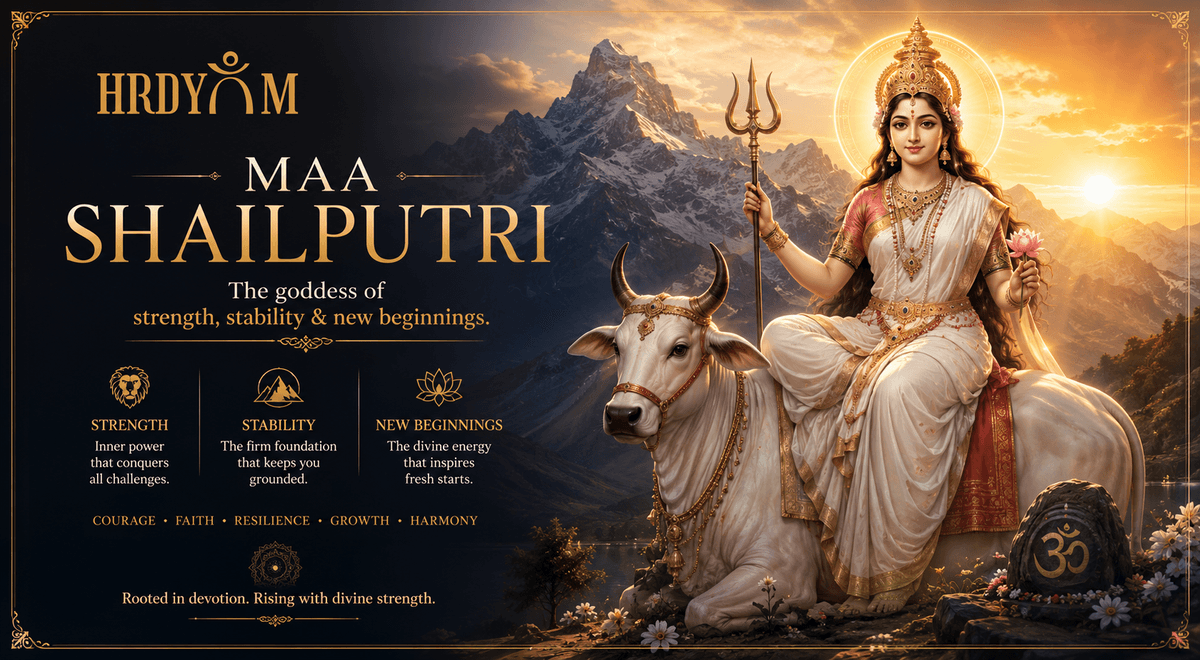
Navratri starts with the first day, which goes to Maa Shailputri-the daughter of the Himalayas who happens to be the first among Navdurga. She appears quietly but very significantly. Ahead of garba, dandiya, Durga Puja, and the triumph of good over evil, Navratri starts with the goddess symbolizing stability, patience, and the boldness of the first step.
And there is a reason for Maa Shailputri being on Navratri Day 1. Any journey requires a sound base. Just as the mountain stands firm despite the change in the season, she inspires us to be solid and unshakeable in the face of life’s changes. She teaches us that strength is not gained instantly; rather, it is developed slowly, with faith, consistency, and humility.
If you are fasting for Navratri for the first time, performing Ghatasthapana, going to the temple, or just curious about why crores of people start their Navratri 2026 journey by worshipping Maa Shailputri, you will find everything about Maa Shailputri's story, significance, Shailputri Puja Vidhi, mantras, bhog, rituals, and the significance of Navratri Day 1 here.
The daughter of the mountains
The name Shailputri is beautifully simple in its meaning. Shail means mountain, and Putri means daughter. Together, the name translates to "Daughter of the Mountains," referring to her birth as the daughter of King Himavan (Himalaya) and Queen Maina. In Hindu tradition, she is the first of the Navdurga, worshipped on Day 1 of Navratri, marking the beginning of the nine-day journey of the Goddess.
But Maa Shailputri's story begins even before her birth as the daughter of the Himalayas.
In her previous incarnation, she was Goddess Sati, the beloved consort of Lord Shiva. After sacrificing herself at King Daksha's yajna, she was reborn as Parvati, determined to reunite with Shiva through unwavering devotion and years of penance. It is this reborn form-young, determined, and full of quiet strength-that devotees worship as Maa Shailputri.
She is often depicted riding Nandi, the sacred bull, holding a trident (trishul) in one hand and a lotus in the other. While her appearance is gentle, every element carries meaning. Nandi represents steadfastness and loyalty, the trident symbolises balance over the three aspects of existence, and the lotus reminds devotees to remain pure even while living amidst the challenges of the world.
Among the Navdurga, Maa Shailputri represents the beginning of every spiritual and personal journey. She is associated with the Muladhara (Root) Chakra, the foundation from which all growth begins. This is why Navratri Day 1 is not only about offering prayers-it is about grounding yourself, setting intentions, and preparing your mind for the eight transformative days that follow. Before seeking wisdom, courage, or victory, the festival teaches us to first build a strong foundation-and that lesson begins with Maa Shailputri.
The first step of Shakti

There is a beautiful sequence hidden within the Navdurga. The nine forms of the Goddess are not arranged randomly-each one represents a stage in a seeker's journey. That is why Navratri does not begin with the fierce warrior who defeats demons or the goddess who grants success. It begins with Maa Shailputri, who teaches us the importance of finding our footing before moving forward.
Think of building a temple. Before the pillars rise or the sanctum is consecrated, the foundation must be laid. In the same way, every new beginning-whether it is a spiritual practice, a career, a relationship, or a personal goal-requires stability. Maa Shailputri represents that foundation. She reminds us that lasting growth is never rushed; it is built with patience, discipline, and faith.
This is also why she is associated with the Muladhara (Root) Chakra, the energy centre connected with stability, security, and grounding. In yogic philosophy, the journey of inner growth begins here. A strong root allows every higher stage to flourish, just as a tree can only grow tall when its roots are firmly planted in the earth.
On the first day of Navratri 2026, devotees perform Ghatasthapana, take a sankalp (sacred resolve), and begin their fasts or daily prayers. These rituals are more than tradition-they symbolise making a conscious commitment to the days ahead. Before asking for blessings, the first day encourages us to prepare ourselves with sincerity and discipline.
Perhaps that is the greatest lesson of Maa Shailputri. Every transformation begins quietly. Before there is celebration, there is preparation. Before there is victory, there is perseverance. And before the remaining eight forms of the Goddess guide us through courage, wisdom, and fulfilment, the first day teaches us to stand firm-just like the mountains from which Maa Shailputri takes her name.
The tale of courage and grace
Many years before becoming Maa Shailputri, the Goddess was known as Sati, the daughter of King Daksha. From the very beginning of her life, Sati had great love and affection for Lord Shiva and married him against the wishes of her father, who could never accept Shiva as his son-in-law due to his simple life in the Himalayas, devoid of all worldly comforts.
The situation took its ugliest form when King Daksha hosted a grand yajna but failed to invite Shiva and Sati to the ceremony. Believing in the fact that a daughter can visit her parents even without an invitation, Sati went there. Instead of being showered with affection, she saw her husband getting insulted. Not being able to bear the insult of Shiva any further, she performed a sacrifice by entering the holy fire of the yajna.
Lord Shiva carried the body of his wife all over the universe in grief. To bring harmony in the universe, Lord Vishnu used the Sudarshana Chakra and tore the body of Sati into many pieces. The various body parts of Sati fell in different parts of India, where these are worshiped as Shakti Peethas now.
However, the tale of Sati did not end here.
Sati was reborn as the daughter of King Himavan, the king of the Himalayas, and his wife Queen Maina. As she was the daughter (Putri) of the mountains (Shail), she became known as Maa Shailputri. Since her childhood days, she stayed devoted to Lord Shiva and spent many years in penance to win him back as her husband. With her perseverance, humbleness, and dedication, her efforts finally paid off, thus making her tale an example of revival instead of loss.
That is the reason why Maa Shailputri marks the very first day of Navratri. It tells us that nothing is ever permanent and every end is always an opportunity to start anew, and every hurdle is just a chance to revive. She is an embodiment of patience and the power to rejuvenate oneself with faith.
Every symbol has a meaning
At first sight, the depiction of Maa Shailputri seems simple and peaceful. She is shown sitting beautifully on Nandi, one hand holding a trident, while the other holds a lotus. However, every aspect depicted here is filled with a deeper meaning, imparting a lesson to people beyond worshipping the idol.
The name 'Maa Shailputri' signifies much about her. Mountains do not move from their place in the changing seasons and weather. They do not hurry, nor do they hesitate. This is what Maa Shailputri symbolizes-the strength and stability to face anything in life. Her qualities are those of stability and peace amidst uncertainties, and it is for this reason that Maa Shailputri is considered an excellent choice to begin Navratri.
She holds a Trishul in her hands, which is believed to remind people of the need to keep a balance between their physical, mental, and spiritual aspects. Moreover, the Trishul is representative of the three timelines-past, present, and future.
In her other hand, she carries a lotus flower, a bloom from the muddy water which doesn’t lose its beauty. This lotus flower signifies the message that what our environment or situation is doesn’t define our inner beauty. It is possible to bloom with grace and compassion even when the conditions aren’t easy.
Nandi the Bull, which is her vahan, is the symbol of patience and loyalty, and at the same time it symbolizes incredible strength. Nandi the Bull never tries to rush to anything, but it always moves wisely and slowly. The way Maa Shailputri’s mount walks represents those qualities that she wants to develop in her devotees.
All these symbols are the reasons why Maa Shailputri is honored during the first day of Navratri. In order to achieve any success in life, one needs to have a firm foundation first.
The power of new beginnings
As the first day of Navratri arrives, not only does it signify the start of a festival, but also the start of an intention. As the oil lamps light up, as the Ghatasthapana is performed, and as prayers are offered from every household and temple, the devotees are encouraged to stop and ask themselves: what is it that I want to nurture over the next nine days?
That is why we worship Maa Shailputri first. We need to understand that for any fruitful transformation, a firm foundation is necessary. Whether you have started your new job, whether you are going to appear for some crucial examinations, whether you are recovering from a tough period, or even whether you want to be more disciplined, any transformation starts with a single step, not the big one.
In yogic science, Maa Shailputri is considered to be related to the Muladhara (Root) Chakra, which is all about our security, stability, and grounding to the earth. Just like the tree needs a firm root to survive through rough winds, similarly, we need grounding of the mind to fight life's obstacles.
Her lesson becomes particularly significant in the current era of instant gratification, where everyone seeks immediate results and transformations. However, she teaches us something different altogether. Instead of teaching the lesson of haste, she preaches patience, and instead of perfectionism, she emphasizes consistency and perseverance.
Maybe that is the reason why the first day of Navratri 2026 looks so promising for everyone. It does not expect us to know everything or make a radical transformation of life. It just requires us to take the first step-take a single grounded step with belief and humility.
Maa Shailputri Puja Vidhi (Day 1 of Navratri)
Day 1 of Navratri 2026 commences with Ghatasthapana (Kalash Sthapana). This is one of the most significant practices associated with the occasion, which is the initiation of the invocation of the Goddess and nine days of worship. After the setting up of the Kalash during the highly auspicious Ghatasthapana Muhurat 2026, the ritual of Maa Shailputri's puja is performed by the devotees in a simple fashion.
There are no great arrangements needed for worshipping Maa Shailputri.
Steps in Puja Vidhi
Ensure that the puja area is clean and have a bath before performing the rituals.
Dress up in new and ideally light-colored or traditional attire.
Ghatasthapana involves installing the Kalash in a bed of grains. Adorn the Kalash with mango leaves and a coconut and invoke Goddess Durga in accordance with your family tradition.
Place an image or idol of Goddess Shailputri near the Kalash. Light a diya and incense sticks to start the puja rituals.
Present flowers, kumkum, akshat (rice), and sandalwood paste, and chant the name or the mantra of Goddess Shailputri.
Offer the traditional bhog, which typically includes pure desi ghee, milk-based sweets, fresh fruits, or seasonal offerings prepared with faith.
Chant the Shailputri Mantra, the Durga Chalisa, or the first chapter of the Durga Saptashati, based on your family tradition and time availability.
Perform aarti and pray for courage, stability, and wisdom. End the puja and seek blessings for the rest of the Navratri days.
Besides fasting during Navratri, many devotees also resolve (sankalp) for themselves on the first day. This could be anything from being patient, practicing self-discipline, or even spending time praying. On this day, one should remember that Maa Shailputri reminds us that no change can come from impatience, but only from our very first step towards it.
Gathering every offering
Among other queries that often occur on Navratri Day 1, one of the frequently asked questions is, "What do I need to get prepared for Maa Shailputri puja?" Though there can be minor differences in traditions across various regions and even families, everything that needs to be prepared is generally almost the same. It would be great if you could prepare your puja samagri one day before the Ghatasthapana Muhurat 2026.
| Puja Samagri | Purpose |
|---|---|
| Kalash (copper, brass, or clay) | For Ghatasthapana (Kalash Sthapana) |
| Coconut | Placed on the Kalash as a symbol of prosperity |
| Mango leaves | Used to decorate the Kalash |
| Gangajal | For purification rituals |
| Red cloth (Chunari) | To offer to the Goddess or decorate the Kalash |
| Kumkum (Sindoor) | Tilak and offerings |
| Haldi (Turmeric) | Auspicious ritual ingredient |
| Akshat (Unbroken rice) | Used during prayers and offerings |
| Fresh flowers | White, red, or fragrant seasonal flowers are commonly offered |
| Garland (optional) | To adorn the idol or image of Maa Shailputri |
| Incense sticks (Agarbatti) | For worship |
| Camphor | Used during aarti |
| Diya with ghee or sesame oil | Symbolises light and knowledge |
| Cotton wicks | For lighting the diya |
| Sandalwood paste (Chandan) | Traditional offering |
| Seasonal fruits | Offered as bhog |
| Pure desi ghee | Considered the traditional bhog for Maa Shailputri |
| Milk or milk-based sweets | Common offerings on the first day |
| Betel leaves and betel nuts | Used in many traditional pujas |
| Durga Saptashati or prayer book | For mantra chanting and recitation |
| Bell (Ghanti) | Rung during the puja and aarti |
Remember that these items are meant to assist you in your worship rather than to define it. If you lack one item, do not stress out about it. Bhakti has always been given higher preference than perfection within Hindu practices. It is more important to offer a sincere prayer rather than a complicated ritual without any intention.
An offering from the heart
Food offered during the prayer service is not only a ritual but a way to show their gratitude and dedication. The first day of Navratri is marked by the preparations of simple, pure, and sattvic offerings for Maa Shailputri. It is said that a person who cooks food with a pure heart and soul offers the best offering to God.
Pure desi ghee is considered the most important bhog for Maa Shailputri. As per tradition, offering ghee brings the blessings of the Goddess for good health and vitality and also for a hassle-free life. Many people donate ghee to temples or others in need as charity on the first day of Navratri.
| Bhog | Significance |
|---|---|
| Pure Desi Ghee | The traditional offering for Day 1, symbolising nourishment, purity, and well-being. |
| Milk | Represents simplicity, peace, and freshness. |
| Milk-based Sweets | Offerings such as peda, barfi, or kheer are commonly prepared. |
| Seasonal Fruits | A natural and sattvic offering expressing gratitude for nature's abundance. |
| Makhana (Fox Nuts) | Often included in Navratri bhog and fasting meals. |
| Mishri (Rock Sugar) | Symbolises sweetness and auspicious beginnings. |
While fasting during Navratri, the bhog is first offered to the Goddess and thereafter enjoyed by the family as prasad. Other foods which can be prepared during this time include sabudana khichdi, samak rice, kuttu puri, and even fruit chaat.
Rather than the number of dishes, what is important is the meaning behind the offerings. Maa Shailputri teaches us that thankfulness must be shown in the simplest way possible. Even a humble offering will suffice when it comes from the heart.
Sacred sounds of day 1
Mantra chanting is one of the most serene methods of connecting with Maa Shailputri on the very first day of Navratri. If you conduct a grand puja or pray from your home, chanting her mantras in full concentration will give you clarity and inner strength along with peace of mind.
In case you are new to mantra chanting and feel apprehensive about long sessions of chanting, even 11, 21, or 108 repetitions of a mantra are considered significant.
Dhyana Mantra
वन्दे वाञ्छितलाभाय चन्द्रार्धकृतशेखराम्। वृषारूढां शूलधरां शैलपुत्रीं यशस्विनीम्॥
Translation: "I bow to the glorious Maa Shailputri, who rides on the holy bull, carries the trident in her hands, has the crescent moon on her head, and fulfils the wishes of her worshippers."
Beej Mantra
ॐ देवी शैलपुत्र्यै नमः॥
This is the simplest and most frequently used mantra for Navratri Day 1. This is the perfect mantra for your daily japa and can be done along with your morning/ evening prayers.
Navadurga Stotram
या देवी सर्वभूतेषु शक्तिरूपेण संस्थिता। नमस्तस्यै नमस्तस्यै नमस्तस्यै नमो नमः॥
Though this prayer may have been written for the Goddess in all her forms, it is often used during the time of Navratri and suits the worshipping of Maa Shailputri.
Chanting Method: Ensure that you are facing either east or north when sitting in a neat and quiet spot. Light a diya at the start of the chanting process. If you choose to chant, you can use Rudraksha or Tulsi mala to count your chants. Pay attention to the clarity of chanting, and not speed. End the process by offering flowers and silently praying for strength, wisdom, and peace.
The mantras of Maa Shailputri are not intended to be chanted in haste and are not meant to be memorized overnight. The actual meaning of these mantras lies in their ability to quiet down the mind in preparation for the nine nights of Navratri.
Wrapped in yellow
There is a unique colour associated with each Navratri day, representing the character traits of the Goddess that are venerated on that particular day. For Navratri 2026, Day 1 will be celebrated using the colour Yellow (it is advisable to go through the annual colour code sequence of your place of celebration, as the same can differ according to location).
Yellow represents positivity, wisdom, knowledge, and a new beginning in life. Yellow represents the warmth of the sunrise and symbolizes the beginning of the day; yellow becomes quite an apt colour for the day devoted to the worship of Maa Shailputri, representing the beginning of the Navdurga period.
Yellow sarees or kurta sets or dupattas are worn by most devotees for Navratri Day 1 Puja, whereas flowers are decorated with yellow colours. Although wearing a color is an age-old practice, it does not come under any religious compulsion; what counts much more is the spirit of devotion.
Where energy finds its roots
Maa Shailputri, according to yogic philosophy, symbolizes the Muladhara Chakra, which is also referred to as the Root Chakra. This chakra is situated at the base of the spine and is the first amongst the seven primary chakras. It signifies stability, security, grounding, and the foundation of life. It is indeed interesting to note that the Goddess invoked during the first day of Navratri is associated with the first energy center of the human body as well.
As no tree can grow without having a strong root system, it becomes impossible for spiritual progress to happen without establishing a proper foundation. The Muladhara Chakra tells us to first stabilize ourselves in our lives before moving forward in gaining wisdom and spirituality. This is the reason why the process of Navdurga takes off with Maa Shailputri.
If this chakra is considered balanced, then a person may have:
A stronger sense of stability and harmony.
Increased confidence to face the ups and downs of life.
Improved focus and self-discipline.
A sense of security and connection to one’s environment.
Being able to handle change with more patience and less fear.
On Navratri Day 1, most devotees make it a point to spend some time meditating after performing the puja ceremony. In their comfortable sitting posture, the devotees may reflect upon qualities like patience, courage, and steadiness in their meditation process in order to pay homage to Maa Shailputri’s teachings. It is not about attaining perfection overnight but about taking that first step towards perfection in consciousness.
No matter what perspective we take regarding the chakra system, whether it is yoga, spirituality, or personal reflection, the point of view always stays the same. Every journey has to start from a strong foundation before one can go further up in life.
Blessings that build within
Each devotee turns to Maa Shailputri with his/her own request. Someone is praying for courage and determination in starting a new phase of life, whereas someone prays for peace in his/her family, good health, or strength to cope with difficulties. According to Hinduism, the sincere worship of the Goddess helps people develop strength and become more rooted in their values.
Despite the fact that the blessings of the Goddess depend solely on faith and devotion, there are a number of traditional beliefs concerning worshipping Maa Shailputri during the first day of Navratri.
Energy to begin new starts: It is said to be especially good luck to worship her when starting out a new chapter of life or pursuing a new educational, professional, or spiritual endeavor.
Inner stability and confidence: Being the Devi of the Muladhara chakra, it is said to bring one patience and emotional stability in difficult situations.
Good health and vitality: Pure desi ghee offered on day 1 as her bhog brings about health and vitality to devotees who seek good health from the Divine Mother.
Unity at home: Many devotees worship this form of the Divine Mother in order to have unity at home.
Ability to persevere in difficult circumstances: She is an example of resilience, as can be seen from the story of how she changed from Sati to Parvati.
Proper beginning of Navratri: This devotion at the start of Navratri sets the tone for the following eight days of the festival.
A few things to remember
Day one of Navratri is full of joy. With so much to do-from preparing for Ghatasthapana, preparing the puja, and fasting-there are many distractions. But Hindu rituals have always emphasized sincerity over perfection. Here are some tips on how to keep away from common blunders that can help your puja be more meaningful.
- Missing out on the Ghatasthapana Muhurat
The Ghatasthapana is when the Navratri festival begins formally. It is always advised to perform the ritual in the auspicious Ghatasthapana Muhurat 2026, if not anything else.
- Taking The Puja as A Task List
Performing the mantras or offering things without paying attention or just to finish the ritual is considered a wrong approach. Even a humble and simple puja with attention and devotion means more than anything else.
- Neglecting Cleanliness
It is a traditional practice to clean your house and the place where you are performing Navratri puja.
- Offering Old Flowers or Foods
Offer only fresh flowers, fruits, and bhog. When preparing the food yourself, make sure that it is clean, sattvic, and prepared carefully.
- Breaking The Fast In The Wrong Way
If you are fasting during Navratri, do not break the fast by overeating. Start breaking the fast slowly with easy and fasting-friendly food.
- Neglecting the Purpose of the Rituals
The flowers, lamps, and gifts are memorable, but not the purpose for which they are offered. The first day of Navratri is focused on laying a good foundation, not only for the rituals but also for your mind and actions.
One Goddess, many traditions

Even though Maa Shailputri is worshipped throughout the nation on the first day of Navratri, there are variations in the way people celebrate this festival in various regions. There can be some differences in the rituals followed in different parts of the country, but the essence of the celebration never changes.
| Region | How Day 1 is Celebrated |
|---|---|
| North India | Families perform Ghatasthapana, observe Navratri fasts, recite the Durga Saptashati, and visit nearby Durga temples. Many households sow barley (Jau) as a symbol of growth and prosperity. |
| Gujarat | Homes begin the festival with traditional puja before communities gather in the evening for the first rounds of Garba and Dandiya. Temples dedicated to the Goddess are beautifully decorated and illuminated. |
| West Bengal | While Durga Puja celebrations reach their peak later, many devotees begin their prayers to the Goddess on the first day of Navratri with chanting and offerings at local temples. |
| Maharashtra | Devotees perform Ghatasthapana, decorate their homes with flowers and rangoli, and offer traditional bhog to Maa Shailputri before beginning their Navratri fast. |
| South India | Families set up the colourful Golu (Kolu) displays of dolls, invite friends and neighbours for prayers, and offer prasadam while celebrating the feminine aspect of creation. |
One of the most beautiful things about Navratri is how it brings together all different kinds of traditions through one festival. It could be the beats of Garba in Gujarat, the elegance of Golu in Tamil Nadu and Karnataka, or even the early morning prayers in households in North India. Various places greets its Mother Goddess in their own unique way.
It is important to remember that no matter how different traditions might be, the importance of Day 1 of the festival will always be the same-a new beginning, full of belief, appreciation, and hope for the coming days.
Celebrate with ease and meaning
Navratri is not just an occasion that is characterized by rituals and festivities. It is also a time when thousands of pilgrims come to Shakti Peethas, take blessings from Navdurga, start new spiritual journeys, and follow the traditions that are handed down from generation to generation. If you want to witness the lively garba festivals of Gujarat, celebrate the pomp and pageantry of Durga Puja in Kolkata, or simply visit ancient goddess temples, you could plan your trip.
At HRDYAM, we arrange unique trips for our clients that extend beyond mere sightseeing tours. Whether you want to undertake your own pilgrimage to the holy Shakti Peethas or Devi temples of India or any other spiritually enriching itinerary, we are here to help you out.
If you are looking for additional support, HRDYAM also provides Vedic astrological consultation services by Dr. Aaadietya Pandey that help you select auspicious dates for traveling, performing special pujas, and any other important events according to your birth chart. Feel free to check out our selection of puja essentials and spiritual experiences that we have prepared specially for your Navratri celebrations.
May you find strength and peace of mind on the way of Navratri in 2026 with the grace of Maa Shailputri! Let the coming days fill your thoughts with serenity, your actions with purpose, and your heart with happiness. For every journey begins with a single step, just like every Navratri begins with the power of the Daughter of the Himalayas.
The journey has just begun

Every year, Navratri starts with the lighting of the lamp, the establishment of the Kalash, and the worship of Maa Shailputri. However, the significance of Day 1 of Navratri will always be the same. Before achieving success, gaining wisdom, and winning over everything, we must start by laying a strong foundation for ourselves. Just like the mountains are her home, Maa Shailputri guides us to stay firm in our path despite the instability in life.
Maa Shailputri is an example of resilience and rejuvenation in Hindu mythology. Right from her birth as Sati to her re-birth as the daughter of the Himalayas, Maa Shailputri shows us that there is always light at the end of the tunnel for us. It is this quality that makes Maa Shailputri the ideal choice to be worshipped on Day 1 of Navratri.
Be it following the Navratri vrat, doing Ghatasthapana, chanting her aartis and mantras, or pondering over her teachings, let this first day of Navratri mean something bigger than just a ceremony. Let this be a moment to stop and make your intentions clear before embarking on the path ahead.
As you move through the nine days, receiving a new lesson from each incarnation of the Navdurga, keep in mind that each and everything starts from the base laid by Maa Shailputri. And maybe that's the greatest gift that Maa Shailputri bestows on us, not the assurance of transformation, but the assurance to begin.
Spiritual travel researcher, Vedic cultural writer, and contributing editor at HRDYAM.
You Might Also Like
Tags
More Articles
View all
What is HRDYAM? The AI-Powered Spiritual Ecosystem
The spiritual essence of India has not merely consisted of temples alone. It is found in pilgrimage circuits, old rituals, Vedic astrology, Yoga, Ayurveda, sacred rivers, traditions of the region, art

How HRDYAM blends spirituality with sustainability
How would pilgrimage change if it were no longer viewed as a trip to a shrine but as an engagement with the entire sacred geography? The river next to the shrine, the communities that live by the shri
Navratri: Nine nights, nine faces of Shakti
The first indication of Navratri usually comes not from any temple. This could be a spontaneous display of a tiny kalash in the corner of your house, the planting of new barley seeds into the moist so