Kali Puja in Bengal & Assam

RIYA SHARMA
HRDYAM - DISCOVER SACRED JOURNEYS, WISDOM & WELLNESS
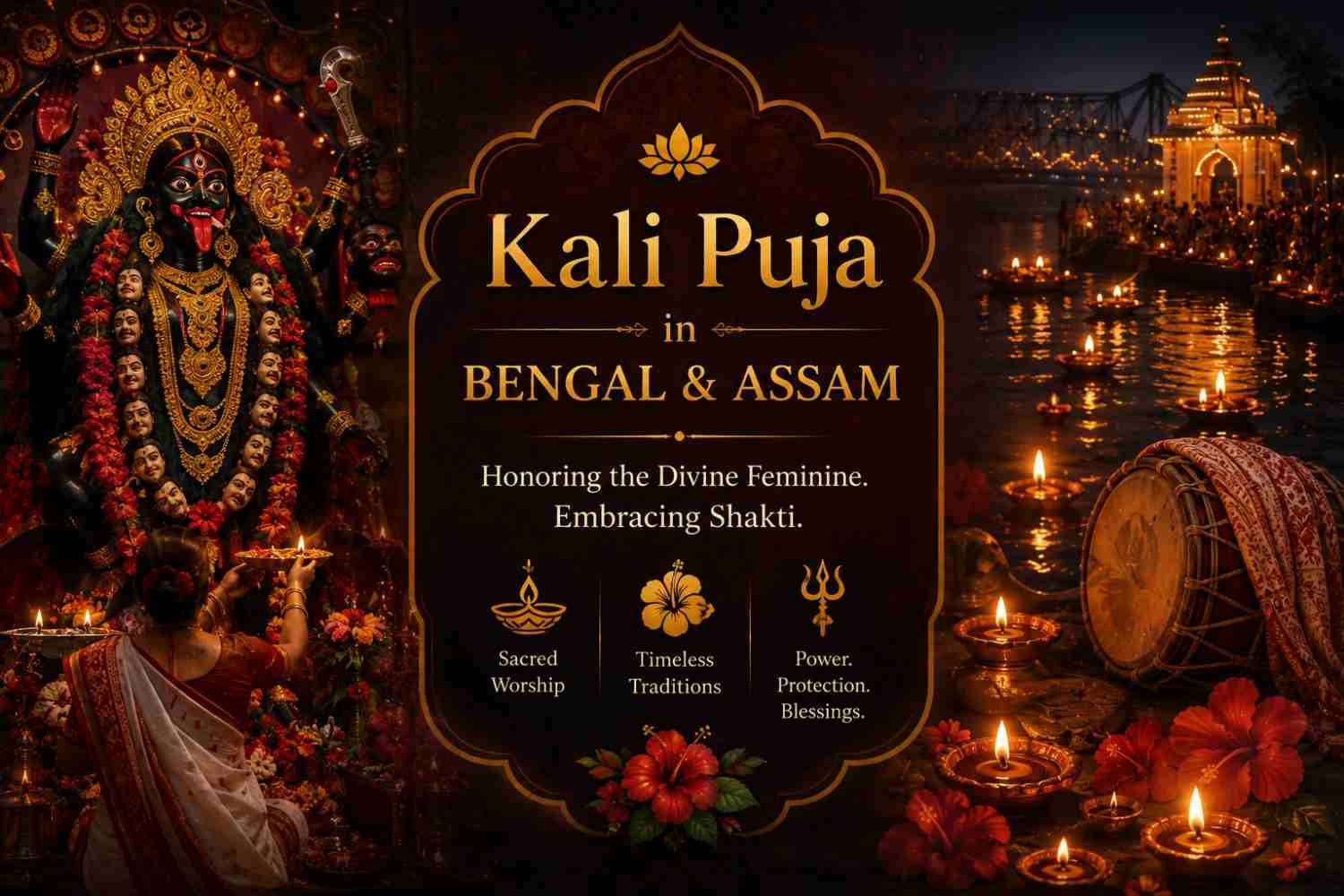
Something very special happens on the night of Diwali in eastern India. As the rest of the nation focuses on worshipping Lakshmi and lighting lamps, the people in Bengal and Assam focus on worshipping another manifestation of the Mother Goddess-Kali.
With the coming of midnight, temples and puja pandals start glowing. Incense fills the air, lamps light up in the darkness, songs ring out in the street, and there stands Kali-dark, fierce, but greatly beloved before the idol.
Also known as Shyama Puja, Kali Puja is celebrated on the night of the new moon in Kartika, which falls on the same day as Diwali. In particular, in Bengal, the night is celebrated as an intimate communion with the Goddess of Shakti, protection, transformation, and destruction of evil forces.
Where does Bengal find its mother in the dark?

Walk through the streets of Kolkata during Kali Puja Night, and you will feel that everything has changed. All houses and areas are lit by lamps, and pandals, made by the efforts of artisans, priests, musicians, and whole communities, create an extraordinary atmosphere.
The central figure of the festival is the image of Kali: her dark skin, long hair, skulls' garland, and frightening look may seem quite intimidating at first glance. However, for Kali devotees, she is not just the Goddess of death and terror, but Ma-the Mother who conquers fear, cares about her offspring, and reveals the truth.
That is one of the most striking features of Kali worship: the frightening Mother can also be addressed tenderly. Her frightening look means the destruction of egotism, ignorance, and evil, while her Maternal look gives the sense of protection.
That is why the Kali Puja festival in Bengal is not just a festival of beautiful decorations. It is the night when fear is submitted to the Divine Mother and turns into bravery.
What stories still breathe at Kalighat and Dakshineswar?
Somewhere amid the celebration of Kolkata lie two places whose names have become synonymous with the spirituality of this holy city: Kalighat and Dakshineswar.
Kalighat houses the ancient tradition of Shakti, and Dakshineswar links Kali worship with the spiritual life of Rani Rashmoni and Sri Ramakrishna. The Dakshineswar temple was founded in 1855 by Rani Rashmoni, whose Bhavatarini Kali became a central figure in the spiritual experiences of Sri Ramakrishna.
The festival of Kali Puja makes this temple shine even brighter. Tens of thousands of lights decorate the temple while divine puja, chants, and spiritual night-long practices take place in honour of the Divine Mother.
History here is not locked in glass. It is worshipped and sung.
Where does Assam meet Kali through Shakti?
Move to the eastern region of Assam, and the tale assumes yet another form of beauty.
On the Nilachal Hill in Guwahati lies Kamakhya, one of the most significant centers for Shakti worship in all of India. This temple complex reflects indigenous, Tantric, and broader traditions of Hindu culture, giving the state its own special approach to the Divine Feminine.
While elsewhere in India, the celebration of Kali is performed as Shyama Kali Puja on Kartika Amavasya with worship of Devi Shyama Kali.
This creates an atmosphere distinct from that associated with Diwali in northern India. Here the Goddess is approached through the symbolism of Shakti-power, change and the magic of the Mother.
And as lamps flicker on the hills of Guwahati, Bengal and Assam seem united by one ancient belief-the Divine Feminine has enough grace to embrace her children and enough strength to destroy that which needs to be destroyed.

What lies behind Kali's fierce face?
For those who are witnessing the goddess for the first time, the very form of Kali seems to be frightening. The dark body, extended tongue, arms carrying weapons, and skulls are so distant from the soft imagery that we associate with motherhood.
However, Hindu mythology rarely communicates through superficial details only.
For the darkness of Kali symbolizes the boundless space beyond our reach; the weapons of Kali stand for the elimination of evil and ignorance; and the frightening face of the goddess serves as a reminder that the transformation does not always happen gently.
| Symbol | Deeper idea |
|---|---|
| Dark form | The infinite and the mystery beyond appearances |
| Sword | Cutting through ignorance and illusion |
| Skull garland | Impermanence and the cycle of life |
| Fierce expression | Courage to confront destructive forces |
| Motherly presence | Protection and refuge |
That is why followers are able to face the wrathful Mother without fear. They are not worshipping destruction for the sake of destruction. They are putting their fears, attachments, and darkness in front of the one who has the ability to transform them.
How does Kali Puja move with a changing city?
In fact, the modern-day Kali Puja celebration is emerging into a dialogue on how to celebrate responsibly in a city.
Kolkata's huge celebration brings together religious fervor, culture, business, and community-but at the same time, it has some environmental problems such as air pollution, noise pollution, and the use of illegal crackers. In 2025, the Calcutta High Court ordered the state government and the Pollution Control Board to enhance implementation of cracker regulations, while the Kolkata police allowed the use of fireworks between 8 and 10 pm.
This is a big step because it marks the emergence of a new facet in the festival-whether one can actually celebrate responsibly.
Indeed, across all major festivals celebrated in India, the question of responsible celebration is being answered in the context of eco-friendly celebrations and waste management initiatives. After all, the sanctity of a festival is not only in its rituals but also in the community, rivers, and cities where it takes place.
What happens when sacred journeys come closer?
The very concept of keeping faith intact while developing pilgrimage has been observed in Assam too.
The project named 'Maa Kamakhya Divya Lok Pariyojana ', approved under the umbrella of the PM-DevINE program, has been designed to upgrade the infrastructure to facilitate better access for pilgrims to the temple of Kamakhya. The project is part of a larger initiative through which the pilgrim tourism infrastructure development program in Assam and Northeast India has been made possible.
This is because pilgrimages have started to take a different shape with time, and now pilgrims travel long distances, even taking their older family members along, seeking better accessibility but without disturbing the spiritual element of the journey.
The need of the hour, therefore, is to develop pilgrim journeys without disturbing faith itself.
What can the Goddess teach us about courage?

The greatest beauty of Kali Puja is probably in the selection of night for celebration.
Instead of waiting for the darkness to be dispelled, Kali Puja immerses the Divine Mother straight into the depth of the night and finds the path from it.
For a believer, it is an intimate process. Fear, uncertainty, loss, and change-everything that belongs to life-do not disappear at Kali's coming. But she inspires us with courage to deal with them.
And when the first rays of dawn put out the light from the lamps, the prayer still stays the same: Let the Mother endow us with the strength to overcome our fears and the insight to protect the important things in our lives.
Can a sacred journey become more than a visit?
For HRDYAM, the visit to Kali Puja in Bengal and Assam could be an occasion for coming into contact with living Shakti traditions of India instead of going to yet another celebration.
Careful planning would enable the tourist to combine sacred temples, local practices, architectural heritage, devotional music, local cuisine, and the stories of those who are preserving these festivities. Moving from the Kali temples in Kolkata to the Shakti practices at Kamakhya, the visitor experiences various manifestations of the same deep bond between humans and the Divine feminine.
The HRDYAM philosophy of spirituality travel can give such journeys more meaning by linking places to stories, practices to contexts, and pilgrimages to personal experiences.
Sometimes, the best way to come to grips with the tradition is not to study it but to stand under the temple lights, listen to the bells, see the flames of lamps dancing, and learn why many generations have been calling the Goddess Ma.
Conclusion
With the dawning light, the fervor of Kali Puja starts to diminish. The sounds start to fade, life starts to settle back into its routine pattern, and the Mother still stays in her place-within the temples, houses, and memories.
Even though Bengalis and Assamese worship the mother differently, the fundamental spirit behind Kali Puja is very much alike-the quest for power amidst darkness.
Thus, Kali Puja does not simply become another festival around Diwali. It is an illustration that darkness does not have to be the thing to be afraid of. Sometimes, it is the starting point for transformation.
And when the last lamp gets extinguished, maybe it is the only thing that lasts-the courage to venture into another day a little stronger than before.
Spiritual travel researcher, Vedic cultural writer, and contributing editor at HRDYAM.
You Might Also Like
Tags
More Articles
View all
What is HRDYAM? The AI-Powered Spiritual Ecosystem
The spiritual essence of India has not merely consisted of temples alone. It is found in pilgrimage circuits, old rituals, Vedic astrology, Yoga, Ayurveda, sacred rivers, traditions of the region, art

How HRDYAM blends spirituality with sustainability
How would pilgrimage change if it were no longer viewed as a trip to a shrine but as an engagement with the entire sacred geography? The river next to the shrine, the communities that live by the shri
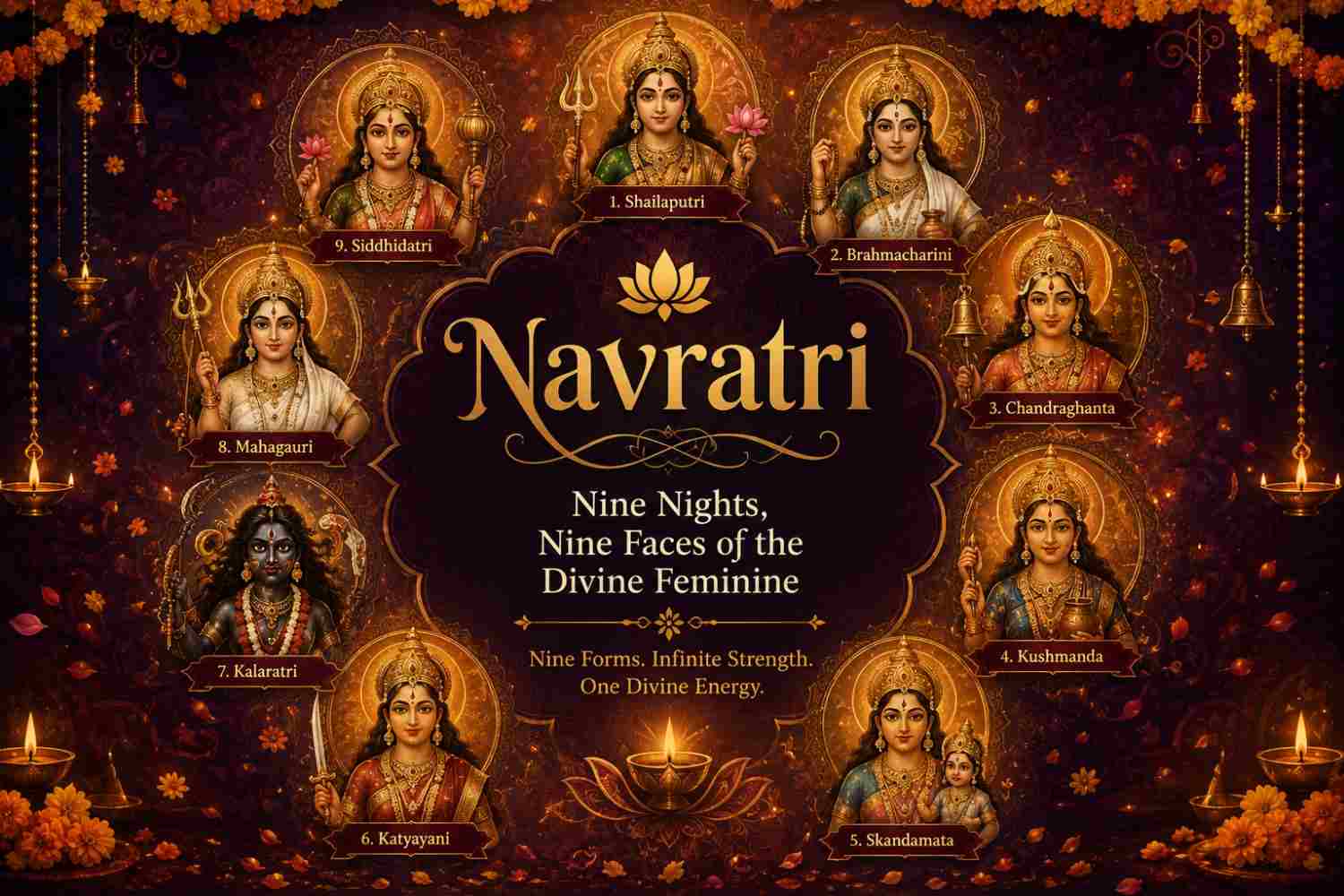
Navratri: Nine nights, nine faces of Shakti
The first indication of Navratri usually comes not from any temple. This could be a spontaneous display of a tiny kalash in the corner of your house, the planting of new barley seeds into the moist so