Deepavali oil bath & Narak Chaturdashi: the sacred morning before Diwali

RIYA SHARMA
HRDYAM - DISCOVER SACRED JOURNEYS, WISDOM & WELLNESS
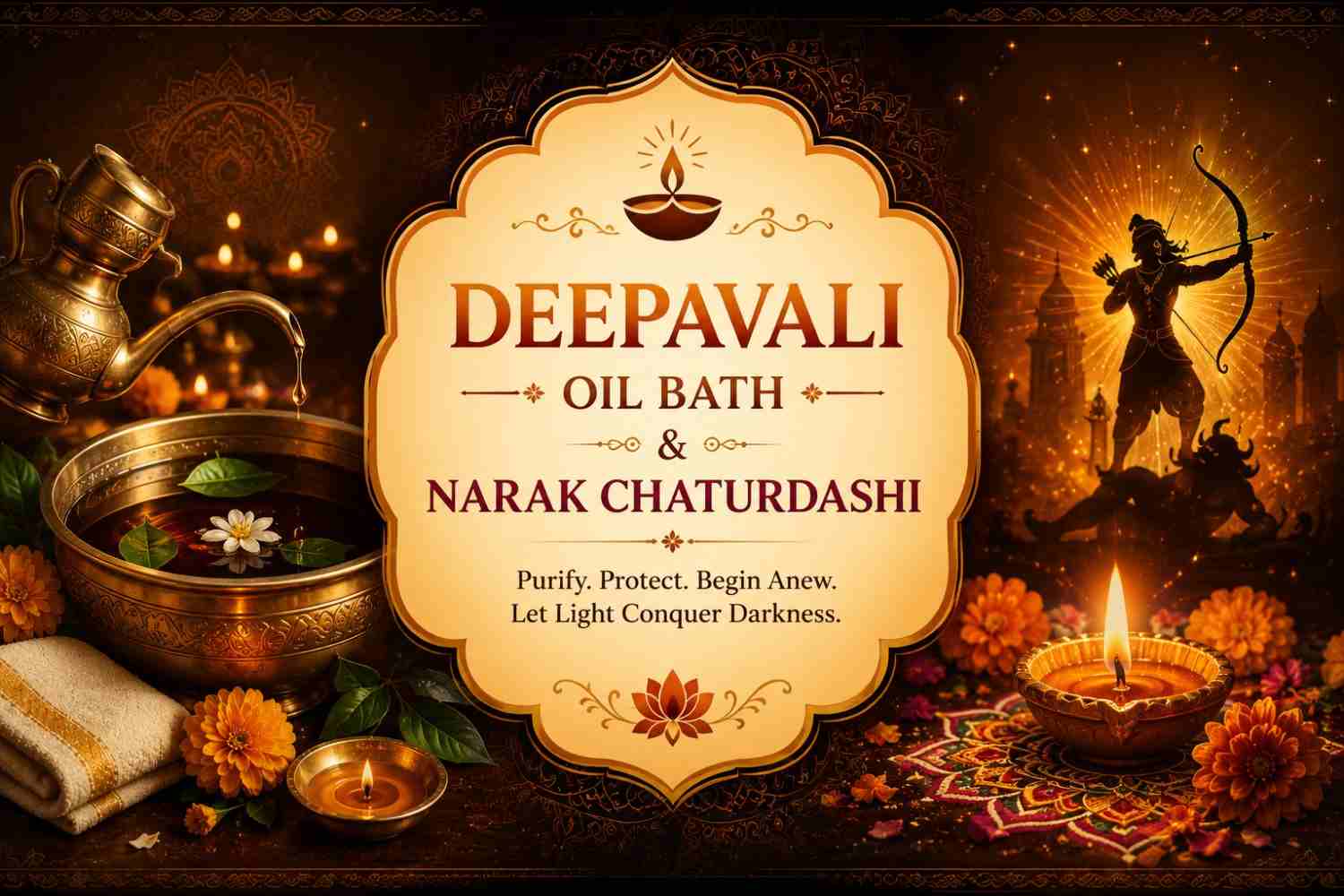
Not all families start off the celebrations of Diwali with crackers and lighting of lamps during the night hours. For several families in South India, the celebration starts much earlier-even before the break of dawn.
Oil is heated. Shikakai, herbal powder, or ubtan is prepared. New clothes are laid out. Sweets await preparation in the kitchen while family members get ready to perform the Deepavali oil bath ritual linked to the observance of Narak Chaturdashi.
This practice of oil bathing has several names in different regions of India. It goes by the name Abhyanga Snan in many places and holds a lot of importance, especially in states like Tamil Nadu, Karnataka, and Maharashtra. Current reports about the festival still describe the oil bathing ritual as one of the main rituals of Narak Chaturdashi.
Before the city breaks into celebrations of Diwali, the individual prepares himself.
What makes an oil bath sacred?
This is because the Deepavali oil bath goes beyond being just another regular bathing experience. In tradition, one is massaged with oil, mostly made of sesame oil, and then takes a bath with the help of natural products.
For most families in South India, this is followed up by putting on fresh clothes and beginning their celebrations.
Its beauty lies in its timing. This is done just before sunrise and hence right at the intersection between darkness and light. While cleansing your body, you are making yourself ready for a day of celebration.
Thus this practice merges physical cleansing with spiritual preparation. You do not simply get rid of the past, but prepare yourself for the arrival of something new.
And this may very well be the reason for generations preserving something so straightforward-while lighting your lamps outside, the first light begins inside.
How does Narakasura's story shape the morning?
Narak Chaturdashi tells the tale of Narakasura, the demon who was slain by Lord Krishna, with Satyabhama making an integral part of the story. Narakasura being slain is symbolic of good prevailing over evil, and lighting the lamps is symbolic of celebrating the triumph of light.
It is evident how the story is linked with the oil bath in the morning. Darkness that is associated with Narakasura is not only external to us but could also be symbolic of ignorance, arrogance, negativity, or destructive tendencies within us.
The oil bath, therefore, assumes significance as a ritual before the big celebration of lights.
First, cleanse yourself. Then, celebrate.
What does the oil bath symbolize?
The actual procedure may differ from region to region, but the basic concept is pretty much the same throughout.
| Ritual | Symbolic meaning |
|---|---|
| Oil application | Nourishment and preparation |
| Ubtan / herbal cleansing | Purification and renewal |
| Pre-dawn bath | Moving from darkness towards light |
| New clothes | Freshness and a new beginning |
| Lighting the diya | Inviting auspiciousness and dispelling darkness |
In the conventional setting, elderly people usually instruct the young ones about the tradition in relation not just to the actions that need to be performed, but also to the reasons behind them.
This is how an everyday ritual turns into a cultural memory.

When does a morning become a family memory?
It is somehow more personal to have the experience of a Deepavali morning at home.
The house is still sleepy as the ritual starts. The kids who hate getting out of bed early are coaxed to be awake. The elders describe the traditions. The application of oil, bathing, wearing new clothes-the entire family seems different now.
And then come the usual excitement of sweets, prayers, greetings, laughter, and lighting of the festival.
This particular order of things has become the most vivid memory of childhood for many families. It is the smell of sesame oil, the voice of the person who wakes up everyone, the very first bite of the festive sweets-not the mere visual image of the festival, but its very feeling.
It is not preserved through the tradition that is put into writing, but through the tradition that has been experienced by someone with their parents and repeated with their own children.
How many names can one ancient ritual carry?
Festivals in India usually have multiple ways in which they are celebrated. Narak Chaturdashi too transforms as one moves from region to region in India.
In Maharashtra, for instance, the morning is linked with Abhyanga Snan and cleaning and bathing rituals. In Karnataka, there are their own ways of celebrating the Deepavali bath ritual, but it is in Tamil Nadu that one comes across the famous tradition of taking the oil bath on Deepavali day. In Gujarat, the day is referred to as Kali Chaudas or Roop Chaudas.
| Region / tradition | Distinctive association |
|---|---|
| Tamil Nadu | Deepavali oil bath as an early-morning family ritual |
| Maharashtra | Abhyanga Snan with oil and cleansing preparations |
| Karnataka | Traditional early-morning Deepavali bath |
| Gujarat | Kali Chaudas traditions |
| Other regions | Narak Chaturdashi / Choti Diwali / Roop Chaudas |
Names change, recipes change, and even the tales told about the day itself may be different.
The process is still the same: letting go of something old and preparing for something new.
Can an ancient ritual find meaning in modern wellness?
Intriguingly, what was once seen only in terms of religious and cultural symbolism now gets analyzed in terms of self-care.
For example, contemporary descriptions of Roop Chaudas and Narak Chaturdashi are more and more concerned with traditional ubtans and natural ways of cleansing oneself. For example, a 2025 Times of India article presented Roop Chaudas as a traditional beauty and cleansing event and included information about the use of homemade remedies based on ingredients like besan, turmeric, neem, and sandalwood.
However, one should be careful not to limit the ritual's meaning to just being a beauty treatment.
Cultural and spiritual value lies much deeper than that. The reason why this physical cleansing becomes significant is that it means spiritual cleansing as well.
While the modern interpretation emphasizes taking care of one's skin, the traditional interpretation emphasizes purification. The ritual's significance lies somewhere in between.
What if celebration begins with cleansing?
Another rite that goes hand in hand with Narak Chaturdashi is cleansing the house. In a recent article on the cleaning ritual that precedes Diwali, The Times of India suggested that the practice was inextricably linked with the notion that an immaculate and luminous home was ready to welcome in the auspiciousness of Goddess Lakshmi. Further, the pre-Diwali cleaning ritual was seen as reflecting the spirit of Narak Chaturdashi.
It makes for a wonderful analogy. We clean the house. We cleanse our body. And finally we light the lamp.
Diwali seems more than ever before to be about a carefully orchestrated journey-from chaos to order, from darkness to light, and from last year to the next.
Can tradition teach us to celebrate responsibility?

Contemporary Diwali festivities have also raised discussions related to environmental pollution, waste management, and public health. As Narak Chaturdashi involves festivities and lighting, nowadays there are calls for people and authorities to make Diwali celebrations environmentally sustainable and healthier.
It is especially relevant at times when the problem of air and noise pollution continues to haunt Diwali celebrations in large cities. The growing trend of eco-friendly celebrations raises a key question: can the age-old festival of lights also become a celebration that respects the environment?
The solution might be found in going back to the roots of the holiday. Diya requires very few things. An eco-friendly celebration requires even fewer.
How does the morning prepare the heart for Diwali?
The sun will rise before the completion of the silent ritual.
Oil will have been cleansed from our skin, we will have put on new clothes, our kitchens will be bustling with activity, and celebrations will commence. The ritual that has started out in darkness has now reached lightness.
This is the quiet beauty of Narak Chaturdashi.
It does not require us to wait until evening to begin celebrating the light. Perhaps each morning of Diwali carries the same invitation: cleanse what needs to be cleansed, refresh what has become tired, and start a new day with lightness of heart.
Can a simple ritual become a sacred journey?
For HRDYAM, events such as the Deepavali oil bath provide a look at the intimate side of the spiritual culture of India.
A spiritual and cultural tour during Deepavali could mean more than just visiting the illuminated temples and vibrant markets; it could include the hidden rituals that occur within the household, including early morning baths, family prayers, traditional foods, and stories from their local communities.
Through well-chosen spiritual tours, HRDYAM can assist in making visitors experience these festivals not merely as events but also as a tradition influenced by place, family, and religion.
As on some days, the spirituality of India is not found beneath its grand temple dome but in the quietest hour of the morning, when a family arises before dawn to observe an ancient custom.
Conclusion
The oil bath has been completed. The lamps are awaiting to be lit. New dresses are prepared.
Outside, the world is slowly awakening, unaware of what is happening inside many houses where Diwali celebrations have already started.
Narak Chaturdashi teaches us that even before the victory of light is celebrated, it makes sense to prepare ourselves to accept it. The bath becomes the preparation ritual; the story of Narakasura becomes a lesson of overcoming the darkness; and the first diya becomes the promise of the new start.
The darkness starts to disappear by the time the sun rises.
Even though the celebration hasn't reached the point when it gets brighter, it has already started.
Spiritual travel researcher, Vedic cultural writer, and contributing editor at HRDYAM.
You Might Also Like
Tags
More Articles
View all
What is HRDYAM? The AI-Powered Spiritual Ecosystem
The spiritual essence of India has not merely consisted of temples alone. It is found in pilgrimage circuits, old rituals, Vedic astrology, Yoga, Ayurveda, sacred rivers, traditions of the region, art

How HRDYAM blends spirituality with sustainability
How would pilgrimage change if it were no longer viewed as a trip to a shrine but as an engagement with the entire sacred geography? The river next to the shrine, the communities that live by the shri
Navratri: Nine nights, nine faces of Shakti
The first indication of Navratri usually comes not from any temple. This could be a spontaneous display of a tiny kalash in the corner of your house, the planting of new barley seeds into the moist so