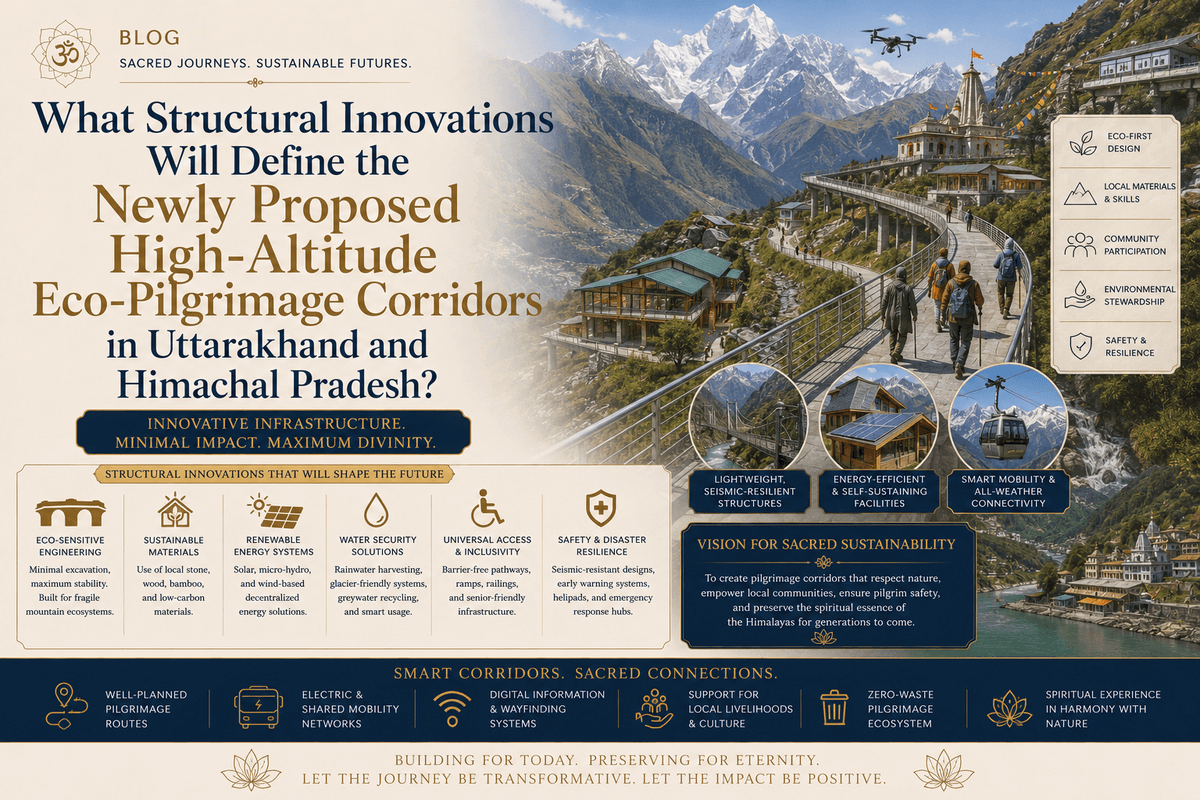
What Structural Innovations Will Define the Newly Proposed High-Altitude Eco-Pilgrimage Corridors in Uttarakhand and Himachal Pradesh?

Aaradhana aiyyar
HRDYAM — India's AI-powered spiritual platform for astrology, pilgrimage, puja, and wellness
- 1.The Ropeway Revolution: What's Being Built and Where
- 2.Kedarnath — The Anchor Project
- 3.Hemkund Sahib — Govindghat Ropeway
- 4.The Parvatmala Pariyojana Framework
- 5.The Ecological Counterforce: NGT, Carrying Capacity, and the Manimahesh Model
- 6.Why the Courts Are Now Setting Pilgrimage Policy
- 7.The Structural Innovation: Eco-Pilgrimage as a Defined Category
- 8.What This Means for Pilgrims Planning High-Altitude Yatras
- 9.The Planning Shift From Spontaneous to Pre-Registered
- 10.The Medical Dimension of High-Altitude Access
- 11.FAQs
The Himalayas are being rewired — ropeways, tunnels, NGT mandates, and eco-fees are remaking India's most sacred high-altitude routes. Here's exactly what's changing and what it means for pilgrims.
The old model of Himalayan pilgrimage was brutal by design. A 16-kilometre trek on uneven mountain paths to reach Kedarnath at 3,583 metres. A 14-kilometre climb to Hemkund Sahib at 4,329 metres. Manimahesh Lake at nearly 13,500 feet — approached entirely on foot through terrain that sees landslides, snowfall, and flash conditions from June to September. For centuries, the physical hardship was considered inseparable from the spiritual intention. You arrived at the deity having already proven something.
That model is being fundamentally redesigned — and the redesign is happening simultaneously from above (ropeway and tunnel engineering), from the judiciary (National Green Tribunal mandates), and from the bottom up (eco-fees, carrying capacity assessments, and mandatory pilgrim registration).
What emerges from these converging forces is something genuinely new in Indian sacred geography: a high-altitude pilgrimage infrastructure that is trying to be modern, accessible, and ecologically sustainable all at once — without losing the character of what makes these places worth reaching.
The Ropeway Revolution: What's Being Built and Where
Kedarnath — The Anchor Project
The most consequential single infrastructure project currently under development on India's high-altitude pilgrimage network is the Sonprayag–Kedarnath Ropeway — a 12.9-kilometre project developed by Adani Enterprises under the Government of India's Parvatmala Pariyojana, using advanced 3S (tricable) gondola technology capable of carrying up to 1,800 passengers per hour. Once completed, it will reduce the demanding 16-kilometre trek from Gaurikund — currently taking around 9 hours — to a comfortable 36-minute ride.
The project is being built under a Public–Private Partnership model at an estimated cost of ₹4,081 crore, with Adani Enterprises operating and maintaining the ropeway under a 29-year concession after construction. When completed, it will become India's longest ropeway and rank among the world's highest cable car systems, reaching elevations of around 11,500 feet.
For elderly pilgrims, families with mobility limitations, and anyone for whom the Kedarnath trek has been an insurmountable physical barrier, the ropeway represents a structural transformation — not a convenience upgrade. It converts a high-altitude Jyotirlinga from inaccessible to accessible for an entire category of devotees who have been excluded from this circuit for their entire lives.
Hemkund Sahib — Govindghat Ropeway
Work orders for the Govindghat to Hemkund Sahib ropeway route have already been issued, alongside the Sonprayag–Kedarnath project, as part of six major ropeway projects prioritised for immediate development by Uttarakhand under a Special Purpose Vehicle managed by National Highway Logistics Management Limited.
Hemkund Sahib — the Sikh shrine set beside a glacial lake at 4,329 metres — receives hundreds of thousands of pilgrims annually despite an approach that requires a 13-kilometre trek gaining over 1,400 metres of elevation from Ghangaria. The ropeway will transform this from a multi-day undertaking to a same-day visit accessible to senior citizens, families, and pilgrims without significant trekking fitness.
The Parvatmala Pariyojana Framework
The 2026-27 Union Budget has additionally proposed the development of ecologically sustainable mountain and nature trails in Himachal Pradesh, Uttarakhand, Jammu & Kashmir, Araku Valley in the Eastern Ghats, and Podhigai Malai in the Western Ghats — establishing a national policy framework for high-altitude corridor development that extends beyond the immediate Chardham circuit.
The tunnels currently under construction in Uttarakhand — including the Char Dham Highway's tunnels improving access to Gangotri and Yamunotri — add a second layer to this infrastructure transformation. These projects, including the 105-kilometre tunnel portion under development at an estimated cost of ₹14,000 crore+, improve access to Char Dham pilgrimage routes, boosting tourism and regional development.
The Ecological Counterforce: NGT, Carrying Capacity, and the Manimahesh Model
Why the Courts Are Now Setting Pilgrimage Policy
The ropeway and tunnel investments represent the access expansion side of the equation. The National Green Tribunal (NGT) is simultaneously imposing the constraint side — and the two forces are in active tension.
The Manimahesh Yatra 2026 — one of North India's most revered Himalayan pilgrimages, drawing lakhs of devotees to the sacred lake at nearly 13,500 feet beneath Manimahesh Kailash peak in the Bharmour region of Chamba district — will be conducted under strict NGT guidelines. The Bharmour administration is implementing tighter environmental safeguards, regulated commercial activity, and improved safety measures along the high-altitude pilgrimage route.
In a 2024 NGT order, the tribunal recommended implementing mandatory online registration for pilgrims, assessing the trekking route's carrying capacity, and regulating daily pilgrim movement to reduce ecological pressure on the area. The recommendations also called for strict monitoring of commercial activities along the yatra route, with no shops or langars allowed in the Manimahesh lake catchment area.
The practical implications of this framework for pilgrims planning the Manimahesh Yatra 2026:
Mandatory pre-registration via the designated online portal before arriving at Hadsar (the trek base)
Daily pilgrim caps — once carrying capacity limits are determined, entry will be regulated rather than open
Eco-fee and sanitation charges for both pilgrims and commercial establishments along the route
No unauthorised commercial stalls within the lake catchment area
Active restoration work on the trekking path from Hadsar to Manimahesh Dal, which suffered extensive damage during last year's heavy rains and landslides
The Structural Innovation: Eco-Pilgrimage as a Defined Category
What the Manimahesh NGT framework establishes — and what the Parvatmala Pariyojana ropeway projects are operationalising in parallel — is the emergence of eco-pilgrimage as a formally defined category of infrastructure development, distinct from both standard mass pilgrimage and adventure tourism.
The key parameters of an eco-pilgrimage corridor, as they are being defined in practice across Uttarakhand and Himachal Pradesh:
| Parameter | Standard Pilgrimage Model | Eco-Pilgrimage Corridor Model |
|---|---|---|
| Access regulation | Open, unregulated | Mandatory registration + daily caps |
| Commercial activity | Unregulated along route | NGT-licensed, sanitation-charge-paying |
| Waste management | Reactive, infrastructure-inadequate | Biodegradable facilities, 100% collection mandated |
| Physical access | Trek-only | Ropeway + trek hybrid, staged access |
| Environmental monitoring | Periodic | Real-time (where infrastructure supports) |
| Carrying capacity | Unknown / unenforced | Assessed, published, enforced |
| Revenue model | Ad hoc | Eco-fee + concession fee (PPP operators) |
What This Means for Pilgrims Planning High-Altitude Yatras
The Planning Shift From Spontaneous to Pre-Registered
The single most important practical implication of these structural innovations for individual pilgrims is that spontaneous, unplanned visits to major high-altitude sites are becoming increasingly difficult — and at some sites, impossible. Mandatory online registration at Manimahesh, advance slot booking for the Kedarnath ropeway when it becomes operational, and the existing Chardham Yatra registration system (biometric registration mandatory since 2024 for the Uttarakhand Chardham circuit) all move the planning decision-point weeks before the journey rather than on arrival.
For families planning a high-altitude pilgrimage for elderly parents or relatives, this shift has an important upside: pre-registration creates a documented framework within which assisted travel planning can be built. HRDYAM's Chardham Yatra packages manage the registration, slot booking, and itinerary sequencing as part of the pre-departure process — meaning the family doesn't have to navigate the separate portals of the Chardham Registration System, the temple trust booking systems, and the ropeway operators independently.
The Medical Dimension of High-Altitude Access
The expansion of ropeway access does not eliminate the altitude physiology challenge — it relocates it. A pilgrim arriving at Kedarnath via the ropeway still arrives at 3,583 metres, with the same oxygen saturation reduction (approximately 65% of sea-level ambient oxygen) that affects all visitors regardless of how they got there. The difference is that they arrive without the physical exhaustion of a 9-hour trek — which significantly changes the residual physical capacity available for the darshan experience.
For elderly pilgrims in particular, the ropeway model means they can consider the Kedarnath pilgrimage not as an extreme physical undertaking but as a high-altitude visit requiring medical preparation and acclimatisation, much like Badrinath. This is a meaningful change in who can realistically undertake this pilgrimage.
FAQs
What is the Parvatmala Pariyojana and how does it relate to pilgrimage infrastructure? Parvatmala Pariyojana is the Government of India's national ropeway development programme, aimed at improving connectivity in mountainous regions. Several projects under this programme specifically target pilgrimage routes, including the Sonprayag–Kedarnath ropeway (12.9 km, under development by Adani Enterprises under PPP) and the Govindghat–Hemkund Sahib route. The programme uses 3S (tricable) gondola technology designed for high-altitude operation.
When will the Kedarnath ropeway be operational? The Sonprayag–Kedarnath ropeway project was approved in late 2025 and is currently under development. Given the scale of the project (12.9 km, ₹4,081 crore, high-altitude terrain) and the typical construction timeline for comparable projects, a realistic operational window is 4 to 6 years from the commencement of construction. For current Chardham yatras, helicopter services via IRCTC HeliYatra-compliant operators remain the primary alternative to the trek.
What are the Manimahesh Yatra 2026 registration requirements? Mandatory online registration is being implemented for the 2026 Yatra (September 4–19, 2026). The Bharmour administration is operationalising daily pilgrim caps based on carrying capacity assessments. An eco-fee and sanitation charge will apply to both pilgrims and commercial establishments along the route. No shops or langars are permitted within the Manimahesh lake catchment area. The route from Hadsar to the lake is under active repair following last year's landslide damage.
What does the NGT's carrying capacity mandate mean for planning a high-altitude pilgrimage? It means that popular high-altitude pilgrimage sites will increasingly operate on a reservation-first model, with daily pilgrim limits enforced. Spontaneous or last-minute visits will become difficult or impossible during peak periods. Families planning high-altitude yatras — particularly for elderly or mobility-limited pilgrims — should book their registration and accommodation significantly in advance, ideally 4 to 8 weeks before the intended travel date.
How does the eco-pilgrimage model affect the spiritual character of these routes? This is a genuine tension, and worth acknowledging honestly. The mandatory registration, carrying capacity limits, and eco-fees change the character of spontaneous, faith-driven pilgrimage. At the same time, the NGT's intervention responds to a real ecological crisis — waste accumulation, trail degradation, and biodiversity damage at fragile high-altitude sites that have been severely strained by unregulated visitor growth. The Manimahesh lake catchment area, for instance, faces documented pollution from uncontrolled commercial activity and inadequate sanitation. Regulation, in this context, is environmental protection rather than spiritual restriction.
What PRASHAD scheme projects are currently sanctioned for Uttarakhand? The Ministry of Tourism's PRASHAD (Pilgrimage Rejuvenation and Spiritual Heritage Augmentation Drive) scheme has sanctioned projects for augmentation of pilgrimage infrastructure at Gangotri and Yamunotri Dham in Uttarakhand, with sanction amounts documented in the Rajya Sabha reply of December 2025. Additional projects across 15 archaeological and heritage sites — including Sarnath — were proposed in the 2026-27 Budget alongside the mountain trail development initiative.
You Might Also Like
More Articles
View all
Maa Shailputri: The goddess of strength, stability & new beginnings
With the onset of Navratri in 2026, Indian households will start their day a little earlier than usual. The courtyards get thoroughly cleaned, lamps will be lit before sunrise, there will be a strong

Hinglaj Mata: Where faith crosses every border
The journey to some temples starts with the sound of temple bells. However, when it comes to the pilgrimage to Hinglaj Mata Temple, the starting point of this journey is not sound but silence - the si

Tripura Sundari: Where beauty becomes divine
One of the few temples in India that has been named based on a profound philosophical thought, rather than a location, is called "Tripura Sundari," which means "The Beautiful One of the Three Worlds."
Ready to Start Your Journey?
Let us help you plan your perfect spiritual or wellness retreat across India's most sacred destinations.
- 1.The Ropeway Revolution: What's Being Built and Where
- 2.Kedarnath — The Anchor Project
- 3.Hemkund Sahib — Govindghat Ropeway
- 4.The Parvatmala Pariyojana Framework
- 5.The Ecological Counterforce: NGT, Carrying Capacity, and the Manimahesh Model
- 6.Why the Courts Are Now Setting Pilgrimage Policy
- 7.The Structural Innovation: Eco-Pilgrimage as a Defined Category
- 8.What This Means for Pilgrims Planning High-Altitude Yatras
- 9.The Planning Shift From Spontaneous to Pre-Registered
- 10.The Medical Dimension of High-Altitude Access
- 11.FAQs
Browse Series
Ready to Start Your Journey?
Let us help you plan your perfect spiritual or wellness retreat across India's most sacred destinations.