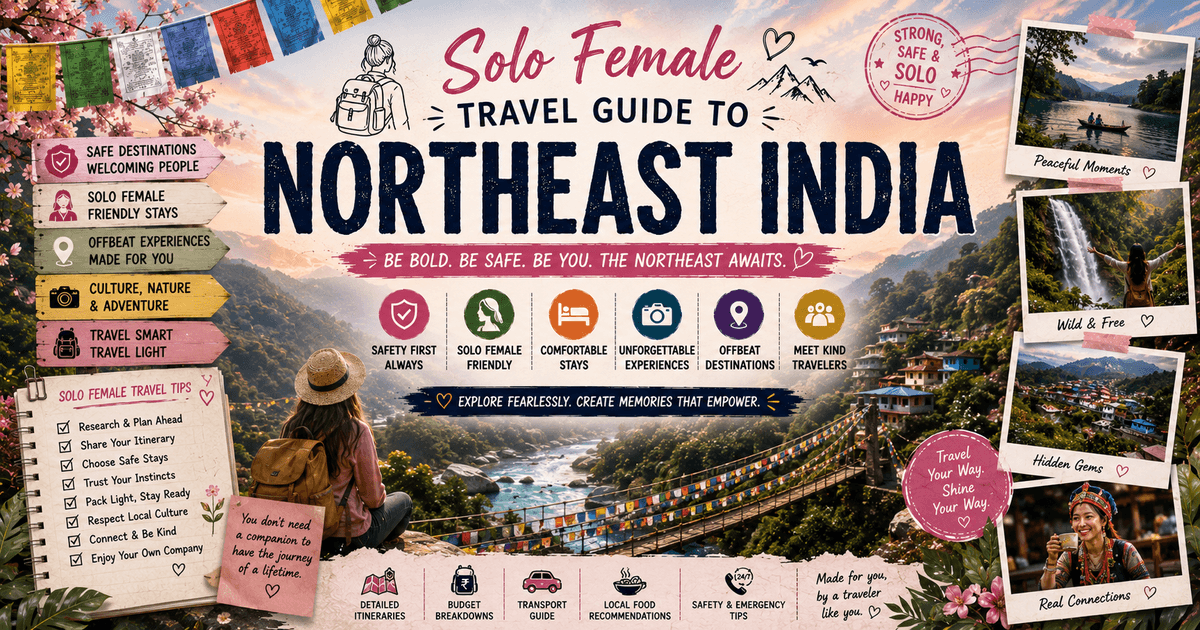
Solo Female Travel Guide to Northeast India

Aaradhana aiyyar
HRDYAM — India's AI-powered spiritual platform for astrology, pilgrimage, puja, and wellness
- 1.Why the Northeast Feels Different for Solo Women
- 2.The Matrilineal Factor
- 3.Community-Oriented Travel Infrastructure
- 4.Lower Population Density, Different Crowd Dynamics
- 5.The Honest Caveats
- 6.A Solo-Female-Optimised 10-Day Route
- 7.Practical Solo Female Travel Essentials for This Route
- 8.Where Some Coordination Genuinely Helps — Without Losing the "Solo" Character
A woman travelling alone through Meghalaya's Khasi hills is, statistically and culturally, entering one of the few genuinely matrilineal societies left in South Asia — where property, lineage, and household authority pass through women, not men. That single fact changes more about the texture of a solo trip here than almost anything else in this guide.
Solo female travel in India carries a specific, often exhausting mental overhead — constant vigilance, pre-emptive caution, the low hum of assessing every interaction for risk. The Northeast doesn't erase that overhead entirely. But something genuinely different happens here, and enough solo women travellers have reported the same thing independently that it's worth taking seriously as a pattern, not an anecdote.
Why the Northeast Feels Different for Solo Women
The Matrilineal Factor
Among the Khasi and Garo peoples of Meghalaya — two of the largest tribal communities in the state — inheritance passes through the youngest daughter, women retain their maiden names after marriage, and household decision-making authority sits with women in a way that has no real equivalent elsewhere in mainstream Indian culture. This isn't a tourist curiosity; it's the actual social fabric of the region, and it produces a day-to-day cultural environment where a woman travelling alone is not treated as an anomaly requiring explanation, but simply as a traveller.
Community-Oriented Travel Infrastructure
The homestay culture that defines budget and mid-range Meghalaya travel specifically benefits solo women. A solo female guest at a Mawlynnong or Cherrapunji homestay is folded into the household — sharing meals, conversation, and often direct introduction to the wider village — in a way that a hotel simply cannot replicate, and in a way that reduces the isolation many solo women feel in less community-oriented parts of India.
Lower Population Density, Different Crowd Dynamics
Much of the Northeast — particularly Meghalaya's countryside, Sikkim's monastery towns, and Assam's tea garden regions — simply has far fewer people per square kilometre than the urban and semi-urban India most solo female travel guides are written around. The specific kind of crowd-related harassment that dominates solo female travel anxiety in dense urban and pilgrimage-town settings is structurally less present here, simply because the environments themselves are quieter.
The Honest Caveats
None of this means the Northeast is risk-free, and treating it that way would be a disservice. Three specific things solo women travellers should genuinely plan around:
REAL CONSIDERATIONS FOR SOLO WOMEN IN THE NORTHEAST

REMOTENESS OVER CROWD RISK
  → The bigger practical concern isn't crowd
    harassment — it's genuine remoteness. Patchy
    network coverage, long stretches between towns,
    and limited emergency infrastructure in Arunachal
    and North Sikkim mean self-sufficiency planning
    matters more than most solo female travel
    guides for India typically emphasise

ARUNACHAL PRADESH SPECIFICALLY
  → The Tawang circuit's demanding roads and Inner
    Line Permit requirements make this the one leg
    most experienced solo women travellers recommend
    approaching with either a small group or
    dedicated local support, not because of safety
    concerns specifically, but because the
    logistics genuinely benefit from it

LOCAL DRESS AND CULTURAL AWARENESS
  → Nagaland's village communities and any active
    monastery in Arunachal or Sikkim carry specific
    modesty and behavioural expectations — research
    the specific community norms before arrival
    rather than assuming a blanket "be respectful"
    covers it adequately
A Solo-Female-Optimised 10-Day Route
DAYS 1-2: GUWAHATI
  Arrival, acclimatise
  Kamakhya Temple — a genuinely powerful solo
  experience for women specifically, given the
  temple's significance as one of the 51 Shakti
  Peeths and its deep association with the divine
  feminine (Shakti) in Hindu Tantric tradition

DAYS 3-6: SHILLONG, CHERRAPUNJI, MAWLYNNONG
  Homestay-based travel, shared Sumo transport
  between towns — genuinely easy and low-friction
  for a solo woman, and one of the best stretches
  of the entire Northeast for this specific trip type

DAYS 7-8: DAWKI & MAJULI
  Dawki's river experience, onward to Majuli via
  Guwahati — the ferry crossing and the island's
  satra (Vaishnavite monastery) culture offer a
  genuinely contemplative, safe solo stretch

DAYS 9-10: GANGTOK, SIKKIM
  Monastery visits (Rumtek, Enchey), well-developed
  local infrastructure, easy solo navigation
  Departure via Bagdogra
Practical Solo Female Travel Essentials for This Route
Inform someone of your general itinerary and expected check-in points — particularly important given patchy network coverage in several stretches
Download offline maps before losing signal, especially heading into Meghalaya's more remote villages and any Arunachal or North Sikkim leg
Carry cash in small denominations — many homestays and local transport options in remote areas don't take cards
Dress with awareness of local norms, particularly at active monasteries and in Nagaland's village communities
Choose homestays over isolated budget hotels where possible — the community integration genuinely adds a layer of informal safety alongside the cultural experience
Consider a coordinated darshan at Kamakhya rather than navigating an unfamiliar, potentially crowded queue alone — the temple's significance specifically for women seeking a meaningful Shakti-centred spiritual experience deserves an unhurried visit, not a rushed one
Where Some Coordination Genuinely Helps — Without Losing the "Solo" Character
A solo trip doesn't have to mean a fully unsupported one, and for specific parts of a Northeast itinerary, some coordination measurably improves the experience for a woman travelling alone, without compromising the independence that makes solo travel valuable in the first place.
HRDYAM's Kamakhya Temple darshan coordination allows a solo woman to experience one of India's most significant Shakti temples with a properly arranged window, priest introduction, and context for the temple's Tantric significance — rather than navigating an unfamiliar queue alone during a potentially crowded period. For the Arunachal Pradesh leg specifically, where genuine remoteness and permit requirements make solo logistics considerably harder, HRDYAM's Northeast India travel coordination can arrange a verified driver and permit processing, while leaving the rest of the itinerary — Meghalaya, Assam, Sikkim — genuinely independent. For women who want an additional safety layer, particularly for the more demanding stretches, a dedicated Care Companion can be arranged for specific legs of the journey without converting the entire trip into a guided tour.
Got Questions?
Frequently Asked Questions
Many solo female travellers report a notably different, more comfortable experience here, particularly in Meghalaya's matrilineal Khasi and Garo communities — though "different" and "lower crowd-related risk" is a more accurate framing than "risk-free." Standard solo travel precautions remain essential.
Genuine remoteness — patchy network coverage, long distances between towns, and limited emergency infrastructure in Arunachal and North Sikkim specifically. Planning around self-sufficiency (offline maps, informed check-in points, cash reserves) matters more here than the crowd-related vigilance that dominates solo female travel planning elsewhere in India.
Most experienced solo travellers recommend either joining a small group or arranging dedicated local support for this specific leg, given the demanding roads, permit requirements, and genuinely limited solo-traveller infrastructure — not due to a specific safety concern, but because the logistics benefit substantially from local coordination.
Both, generally. Beyond the cultural and culinary appeal, the community integration a homestay offers — being folded into a household's daily rhythm rather than existing in isolation — provides an informal layer of social safety that an isolated budget hotel room typically doesn't.
Yes, through advance darshan coordination, which arranges a specific timing window and bypasses the general queue — particularly valuable given the temple's specific significance as a Shakti Peeth and its deep association with feminine divine energy, which many solo women travellers describe as one of the most meaningful stops on a Northeast itinerary.
10 to 12 days, covering Guwahati, Meghalaya, and either Majuli or lower Sikkim — enough time to genuinely settle into the region without the added logistical complexity that Arunachal's more demanding solo travel infrastructure introduces on a first trip.
You Might Also Like
Tags
More Articles
View all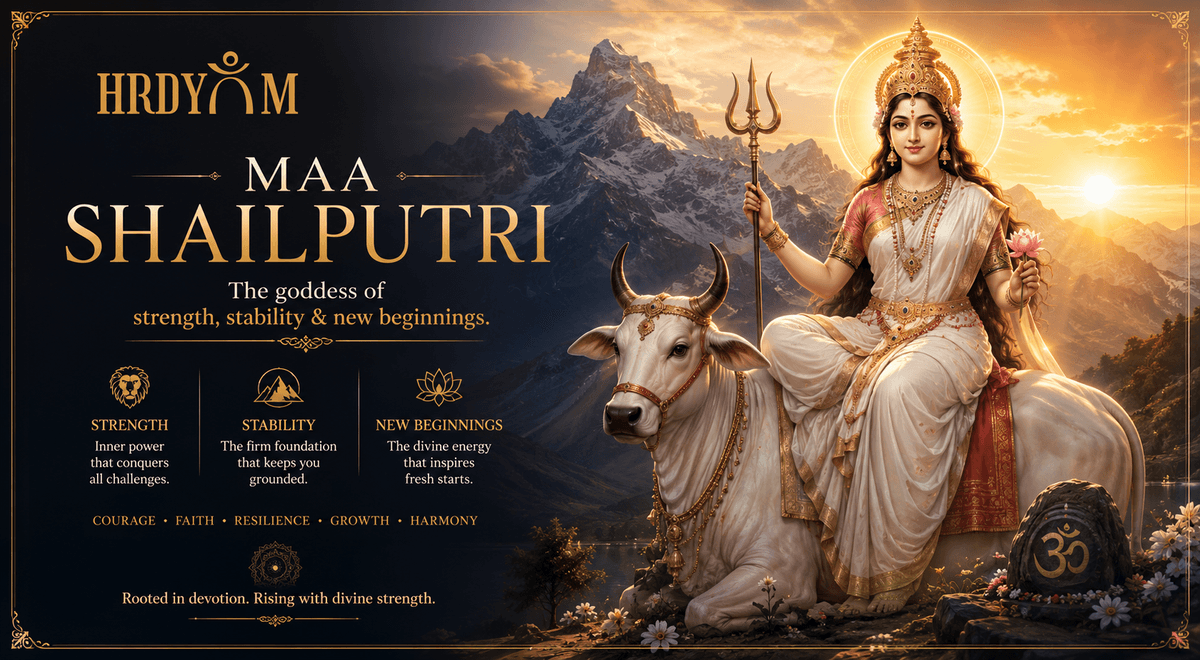
Maa Shailputri: The goddess of strength, stability & new beginnings
With the onset of Navratri in 2026, Indian households will start their day a little earlier than usual. The courtyards get thoroughly cleaned, lamps will be lit before sunrise, there will be a strong
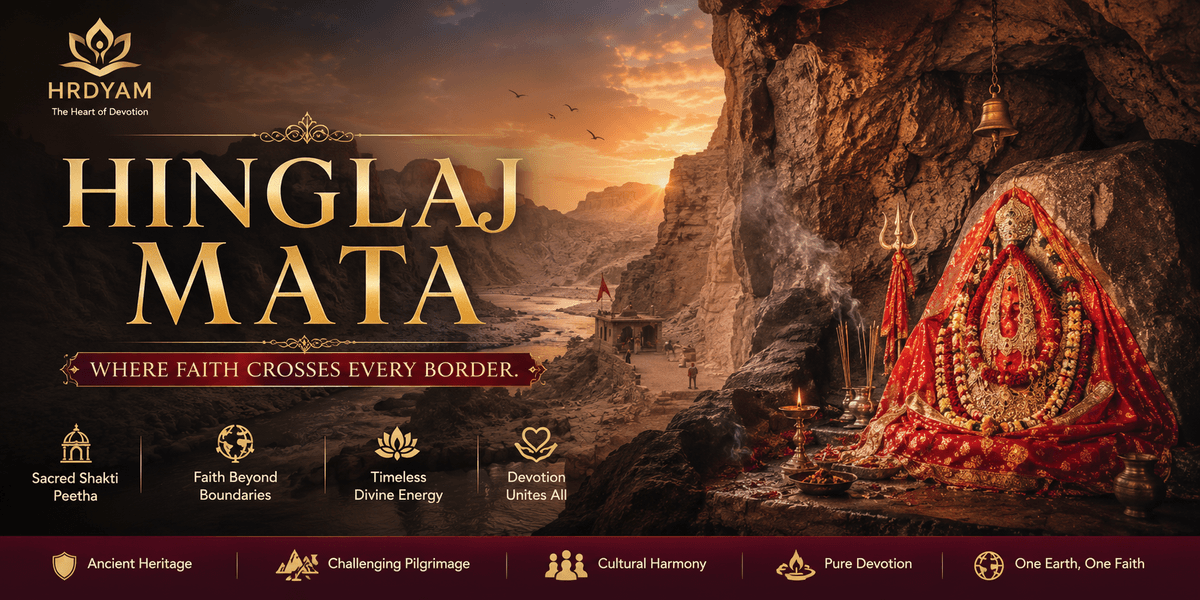
Hinglaj Mata: Where faith crosses every border
The journey to some temples starts with the sound of temple bells. However, when it comes to the pilgrimage to Hinglaj Mata Temple, the starting point of this journey is not sound but silence - the si
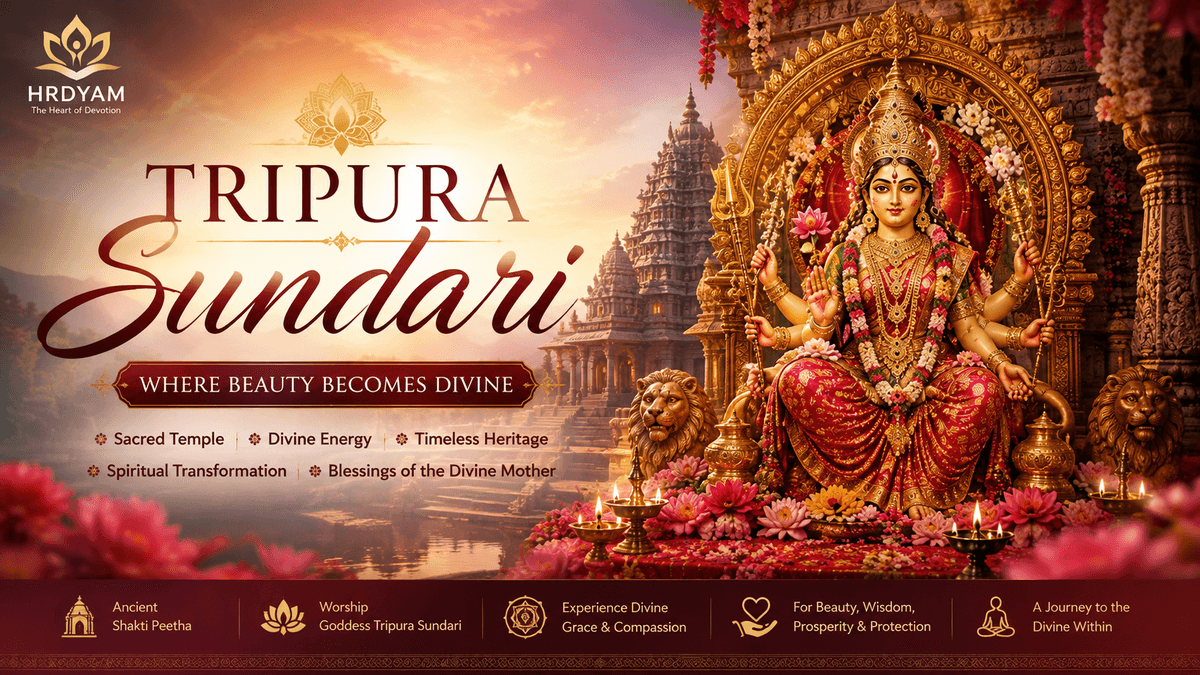
Tripura Sundari: Where beauty becomes divine
One of the few temples in India that has been named based on a profound philosophical thought, rather than a location, is called "Tripura Sundari," which means "The Beautiful One of the Three Worlds."
Ready to Start Your Journey?
Let us help you plan your perfect spiritual or wellness retreat across India's most sacred destinations.
- 1.Why the Northeast Feels Different for Solo Women
- 2.The Matrilineal Factor
- 3.Community-Oriented Travel Infrastructure
- 4.Lower Population Density, Different Crowd Dynamics
- 5.The Honest Caveats
- 6.A Solo-Female-Optimised 10-Day Route
- 7.Practical Solo Female Travel Essentials for This Route
- 8.Where Some Coordination Genuinely Helps — Without Losing the "Solo" Character
Browse Series
Ready to Start Your Journey?
Let us help you plan your perfect spiritual or wellness retreat across India's most sacred destinations.