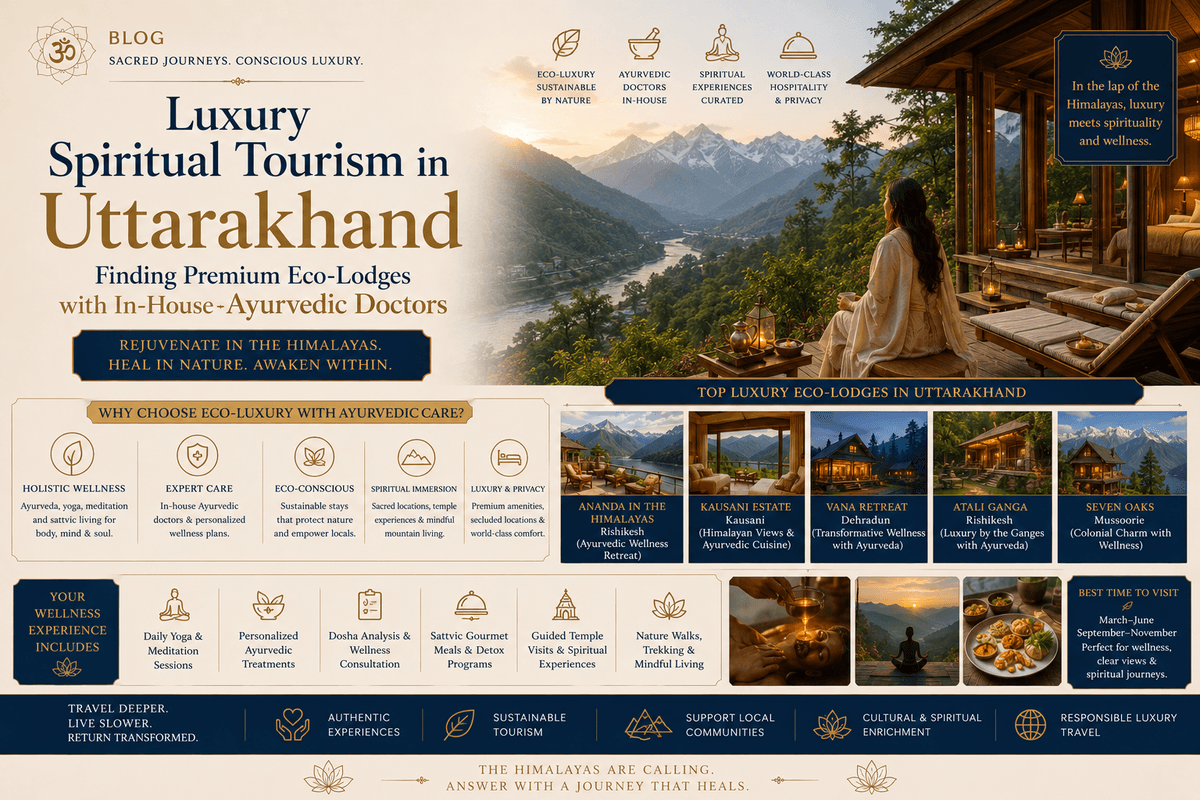
Luxury spiritual tourism in Uttarakhand: Finding premium eco-lodges with in-house Ayurvedic doctors.

Aaradhana aiyyar
HRDYAM — India's AI-powered spiritual platform for astrology, pilgrimage, puja, and wellness
- 1.Why Uttarakhand Specifically
- 2.The Properties That Actually Have In-House Physicians
- 3.Six Senses Vana — The Reference Point
- 4.Ananda in the Himalayas — Clinical Depth Above Rishikesh
- 5.Smaller Eco-Properties in the Kumaon Hills
- 6.What "Eco-Lodge" Should Actually Mean Here
- 7.Pairing a Retreat with a Pilgrimage: The Sequencing Question
What "eco-luxury" actually means in the Himalayas right now — and the specific question you should ask before booking anything.
There's a version of "eco-luxury lodge in Uttarakhand" that is mainly a tent with expensive linen and a peg of local spirits at sunset. Beautiful. Fine. Not what this guide is about.
What this is about: the rarer category of Himalayan property that has built an Ayurvedic clinical infrastructure into its core offering — not as a spa menu add-on but as the actual reason the property exists. A resident physician. A treatment facility designed around classical protocols, not around what guests will book in 50-minute sessions. A kitchen operating on sattvic and medically appropriate dietary principles, not on what's sustainable and Instagram-friendly. A location that earns the "eco" designation through actual ecological integration rather than as a marketing category.
These properties exist in Uttarakhand. There aren't many of them. Here's what's worth knowing.
Why Uttarakhand Specifically
The Himalayas aren't a setting that classical Ayurveda chose arbitrarily. Charak Samhita and Sushruta Samhita both specify the Himalayan foothills as the primary source territory for the medicinal plants on which classical formulations depend — ashwagandha, brahmi, haritaki, bibhitaki, amalaki, guduchi, shilajit. Some of these plants still grow wild in Uttarakhand at the elevations where their medicinal constituents are highest. A property at 1,500 to 2,500 metres in the Garhwal or Kumaon hills is potentially growing its own pharmacopoeia, which isn't a romantic claim — it's a meaningful difference in the quality of the raw materials an on-site apothecary is working with.
The altitude also matters for the therapeutic environment. Most of classical Ayurveda's core recommendations about Dinacharya (daily routine) and Ritucharya (seasonal routine) are calibrated to temperate climates with distinct seasons. Uttarakhand's mountain climate — cool mornings, mild days, cold nights, a clean monsoon — creates a natural environment that supports the kind of physiological regulation that Panchakarma is designed to produce. Doing a serious detoxification programme in a city or a hot-climate property is not the same as doing it in the Himalayan foothills.
The Properties That Actually Have In-House Physicians
Six Senses Vana — The Reference Point
Already described in the Rishikesh blog above, but worth noting the clinical specifics here: Vana's Ayurvedic doctors are full-time resident physicians, not visiting consultants. They conduct daily consultations, adjust treatments based on ongoing assessment, coordinate with the Tibetan medicine and TCM specialists operating in parallel, and supervise the kitchen's therapeutic dietary output. The 21-acre Sal forest setting means the property isn't technically "in" Uttarakhand's mountains — it's in the foothills outside Dehradun — but the ecological and climatic conditions are broadly the same, and the physician infrastructure is the best currently operating in the region.
The entry point for a meaningful programme at Vana is 5 to 7 nights, though the serious Ayurvedic programmes (Detox at 5 nights, Panchakarma at 21 nights) require longer. All stays are all-inclusive: meals, daily treatments, consultation, activities, airport transfers. The price reflects this comprehensiveness.
Ananda in the Himalayas — Clinical Depth Above Rishikesh
Ananda's Ayurvedic programme works from a consultation system where the resident physician takes a proper medical and constitutional history before designing your programme. The physician is available throughout the stay for reassessment and programme adjustment — not just for the initial intake. The property's relationship with its clinical team is long-standing, which matters: an Ayurvedic physician who has worked in the same property for several seasons understands the local seasonal influences on the treatments in a way a rotating roster of therapists doesn't.
Ananda also operates a naturopathy programme running in parallel with the Ayurvedic one — worth knowing for guests who may not be suited to certain classical protocols for medical reasons.
Smaller Eco-Properties in the Kumaon Hills
The Kumaon region of Uttarakhand — the hills east of Haridwar and Rishikesh, around Almora, Mukteshwar, and Ranikhet — has seen a cluster of boutique eco-property development over the past decade. Some of these properties are worth serious attention for guests seeking something smaller and more remote than Vana or Ananda, though the in-house physician offering is rarer here.
Soukya in the broader wellness network has affiliated practitioners in this region. Several Kumaon properties operate with visiting Ayurvedic physicians who spend 2 to 3 weeks per month on-site — not the same as a resident physician model, but more clinically serious than a spa menu.
The honest advice: if in-house physician access every day of your stay is non-negotiable, currently only Vana and Ananda can guarantee it with confidence. Everything else involves a degree of "visiting physician available on request" that you should understand before booking.
Here's an honest side-by-side of the three tiers:
| Property / Category | Location | In-House Physician | Medical System | Minimum Stay | Price Range (7 nights, per person) | Ganga Access | Best For |
|---|---|---|---|---|---|---|---|
| Six Senses Vana | Dehradun (Sal forest) | Yes — full-time, multi-discipline | Ayurveda + Tibetan Medicine (Sowa Rigpa) + TCM | 5–7 nights | ₹1.8–₹3 lakh | Day excursion, 45 min away | Integrative clinical depth, technology-free environment |
| Ananda in the Himalayas | Above Rishikesh, 1,000m | Yes — resident Ayurvedic physicians | Ayurveda + Naturopathy | 5 nights | ₹1.5–₹2.5 lakh | Arranged transport to Rishikesh | Heritage setting, classical Ayurvedic framework |
| Kumaon boutique eco-properties | Almora / Mukteshwar area | Visiting physician (2–3 weeks/month) | Ayurveda (visiting) | 3 nights typically | ₹40,000–₹80,000 | Not applicable | Smaller, more remote, lower cost — less clinical guarantee |
What "Eco-Lodge" Should Actually Mean Here
The term gets used loosely. In the context of Uttarakhand, properties that genuinely earn the designation:
Source a meaningful proportion of ingredients from their own kitchen gardens or from local Himalayan farms within 50 kilometres
Have waste management systems that don't simply relocate the problem to the nearest town
Are built with locally sourced materials — stone, wood, and traditional Garhwali or Kumaoni construction methods — rather than importing materials inappropriate to the climate and landscape
Are operating within the ecological carrying capacity of their site, not expanding room inventory beyond what the local water and energy systems can support sustainably
The 2026-27 Union Budget's proposal for ecologically sustainable mountain trails in Uttarakhand and Himachal Pradesh reflects a policy direction that will accelerate both legitimate eco-development and the green-washing that tends to follow policy attention. In the next two years, more properties will call themselves eco-lodges. The distinction between genuine ecological integration and aesthetic naturalism with good marketing will become more important, not less.
Ask any property you're considering these five questions. The answers — or the evasions — tell you everything:
| Question to Ask | Genuine Eco-Property Answer | Green-Washing Answer |
|---|---|---|
| What % of ingredients sourced within 50km? | Specific figure, named farms | "We use local and seasonal produce" |
| What's your waste management system? | Specific: biogas, composting, partner NGO | "We are committed to zero waste" |
| What construction materials were used? | Local stone, traditional Garhwali/Kumaoni wood | "Eco-friendly and sustainable materials" |
| How is water managed on the property? | Rainwater harvesting specs, greywater recycling | "We conserve water thoughtfully" |
| What ecological certification do you hold? | Names a specific certification body | "We follow eco-friendly practices" |
Pairing a Retreat with a Pilgrimage: The Sequencing Question
There is a specific decision worth thinking through for anyone planning a Chardham Yatra or a Kedarnath-Badrinath pilgrimage alongside an Uttarakhand wellness retreat: which comes first?
RETREAT + PILGRIMAGE SEQUENCING DECISION
                │
                ▼
    Is your pilgrimage time-sensitive?
    (Chardham temples: open late April–November)
          │                    │
         YES                   NO
          │                    │
          ▼                    ▼
    Chardham first          Retreat first
    (May window),           (7–14 days),
    then retreat            then pilgrimage
    (June onwards)
          │                    │
          ▼                    ▼
    Retreat provides        Retreat prepares
    recovery after          body and nervous
    high-altitude           system for altitude
    exertion                and exertion
          │                    │
          └──────────┬──────────┘
                     ▼
         Either way: coordinate both
         as a single itinerary, not
         two separate bookings
         [HRDYAM Chardham + Retreat Package]
The physiological logic points one way: the retreat first, the pilgrimage second. A properly conducted Ayurvedic programme — even a 7-day Detox — stabilises the digestive system, regulates sleep, and reduces the baseline inflammatory state that makes altitude and physical exertion more taxing. A pilgrim who has spent a week at Vana or Ananda before ascending to Kedarnath is in better physiological condition for that ascent than one who came directly from Delhi.
The practical logic sometimes points the other way: the pilgrimage is time-sensitive (the temples open in late April and close in October-November), while the retreat is available year-round. Some families sequence it as Chardham in May, retreat in June — which works from a planning standpoint but means the retreat follows rather than prepares for the exertion.
For the Chardham Yatra packages that HRDYAM coordinates, building a 5-to-7-day retreat either before or after the Chardham circuit is something the planning team can incorporate into the overall itinerary structure. The same vehicle, the same logistics framework, the same care continuity — and the retreat and the pilgrimage are designed as a single journey rather than two separate bookings that happen to be consecutive.
Got Questions?
Frequently Asked Questions
What are the best months for a wellness retreat combined with mountain ecology in Uttarakhand? October to February is optimal for most retreat activities — cool, clear, low humidity, and the Himalayan landscape at its most visually striking. The monsoon (July to September) is when the landscape is greenest and the plant pharmacopoeia most active, which has a traditional significance in Ayurvedic treatment timing — some classical texts recommend Panchakarma specifically during monsoon as Varsha Ritucharya (seasonal protocol). Properties like Vana that take their seasonal programming seriously will note this. A quick seasonal guide: Month Window Climate Retreat Suitability Pilgrimage Suitability Notes Oct–Feb Cool to cold, clear Excellent Chardham closed (Nov–Apr) Best retreat season; Rishikesh Aarti atmospheric Mar–Apr Warming, clear Good Chardham opening (late Apr) Retreat before Chardham window May–Jun Hot in plains, mild at altitude Good at Vana/Ananda Chardham peak season Sequence: retreat first, then Chardham Jul–Sep Monsoon, lush Good ( Varsha Ritucharya ) High-altitude risk Best for Panchakarma classically; Chardham weather unpredictable How do I verify that a property's "eco" designation is substantive rather than marketing? Ask: What percentage of ingredients are sourced within 50km? What are the waste management arrangements? What construction materials were used and where were they sourced? How is water managed on the property? What certification or assessment has the ecological programme received? Properties with substantive eco-practice will answer these specifically. Properties where "eco" means the aesthetic will give you general values language. Can a senior citizen with existing health conditions participate in a Panchakarma programme? Yes, but with medical coordination that must happen before booking. Classical Panchakarma is a clinical intervention that is contraindicated in certain conditions — active cardiovascular disease, recent surgery, severe osteoporosis, certain autoimmune conditions — and must be modified for others. The intake consultation at a serious programme (Vana, Ananda) includes health screening precisely to identify these parameters. Always share complete medical history, current medications, and your treating physician's notes with the retreat's medical team before confirmation.
How does a retreat connect to the broader HRDYAM pilgrimage experience? HRDYAM's yoga and wellness retreat programme and its pilgrimage itineraries are designed to work in combination — the retreat providing physiological and spiritual preparation, the pilgrimage providing the devotional expression of what the retreat opens. The Vedic astrology consultation layer can contextualise both within the individual's planetary cycle — identifying which therapeutic focus and which pilgrimage circuit are most aligned with the current Mahadasha period.
You Might Also Like
More Articles
View all
Maa Shailputri: The goddess of strength, stability & new beginnings
With the onset of Navratri in 2026, Indian households will start their day a little earlier than usual. The courtyards get thoroughly cleaned, lamps will be lit before sunrise, there will be a strong

Hinglaj Mata: Where faith crosses every border
The journey to some temples starts with the sound of temple bells. However, when it comes to the pilgrimage to Hinglaj Mata Temple, the starting point of this journey is not sound but silence - the si
Tripura Sundari: Where beauty becomes divine
One of the few temples in India that has been named based on a profound philosophical thought, rather than a location, is called "Tripura Sundari," which means "The Beautiful One of the Three Worlds."
Ready to Start Your Journey?
Let us help you plan your perfect spiritual or wellness retreat across India's most sacred destinations.
- 1.Why Uttarakhand Specifically
- 2.The Properties That Actually Have In-House Physicians
- 3.Six Senses Vana — The Reference Point
- 4.Ananda in the Himalayas — Clinical Depth Above Rishikesh
- 5.Smaller Eco-Properties in the Kumaon Hills
- 6.What "Eco-Lodge" Should Actually Mean Here
- 7.Pairing a Retreat with a Pilgrimage: The Sequencing Question
Browse Series
Ready to Start Your Journey?
Let us help you plan your perfect spiritual or wellness retreat across India's most sacred destinations.