Complete Meghalaya Travel Guide

Aaradhana aiyyar
HRDYAM — India's AI-powered spiritual platform for astrology, pilgrimage, puja, and wellness
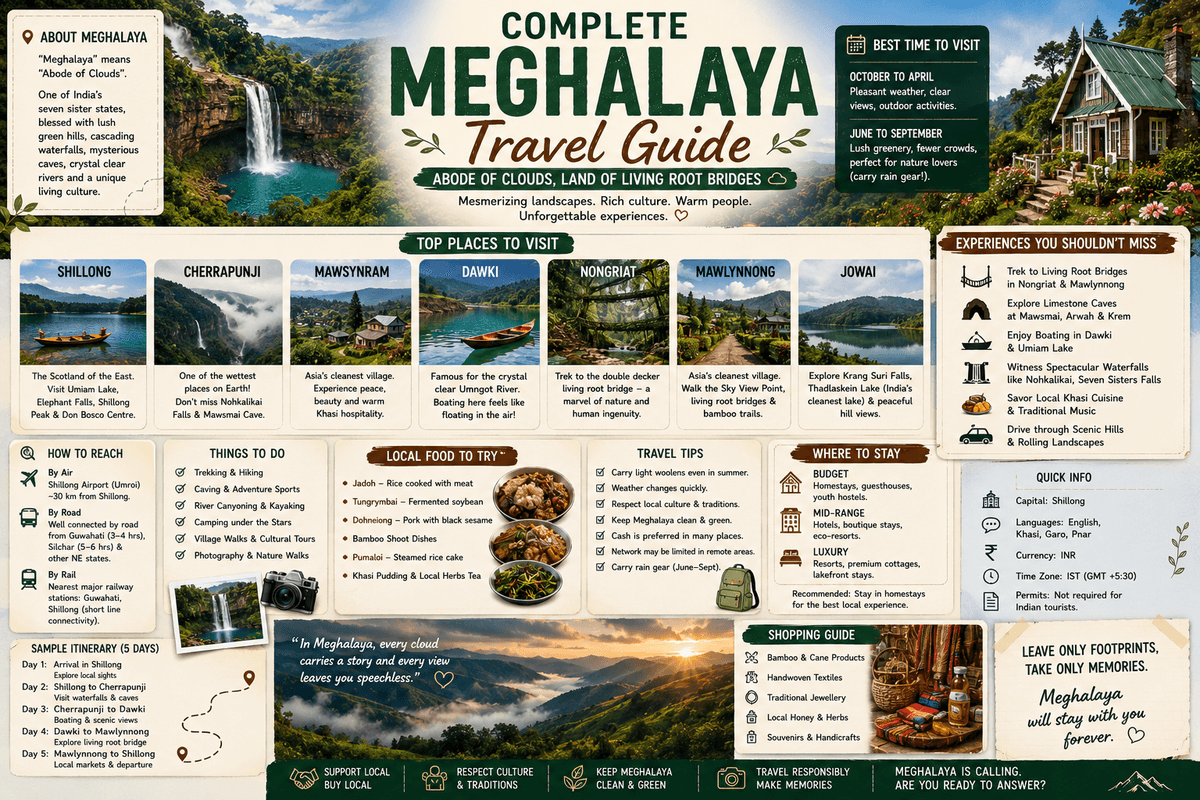
Meghalaya isn't one destination the way Goa or Manali is. It's a scattered constellation of waterfalls, villages, and rivers — and if you don't plan it right, you'll spend more time travelling between points than actually enjoying them.
Unlike Himachal or Goa, Meghalaya doesn't organise itself around a single town or a linear route. It's genuinely spread across three distinct regions — the Khasi Hills, the Jaintia Hills, and the Garo Hills — and understanding this structure is the single most important thing for planning a trip here properly.
The Core Places to Visit
| Destination | What It's Known For | Best For |
|---|---|---|
| Shillong | Cafés, lakes, the state's best base | First 2-3 nights of any Meghalaya trip |
| Cherrapunji (Sohra) | Waterfalls, caves, dramatic cliffs | Nature and landscape drama |
| Dawki / Shnongpdeng | Crystal-clear Umngot River | River experience, riverside camping |
| Mawlynnong | Asia's cleanest village, Sky Walk | Village culture, hidden canyon access |
| Laitlum Canyon | Scenic viewpoints | Sunset/sunrise photography |
| Mawphlang Sacred Forest | 78-hectare Khasi-protected forest | Guided nature walks, cultural depth |
How to Structure the Trip: Where to Actually Stay
This is where most people go wrong. Meghalaya rewards a multi-base approach rather than a single Shillong-centred trip with day excursions:
CHOOSING WHERE TO STAY BASED ON TRIP LENGTH

SHORT TRIP (2-3 days)
  → Stay in Shillong — city base, café culture,
    day trips to nearby attractions

MEDIUM TRIP (4-5 days)
  → Split between Shillong and Cherrapunji —
    nature + waterfalls, offbeat exploration

LONGER TRIP (6+ days)
  → Add Dawki/Shnongpdeng for the river
    experience, and Mawlynnong for the
    village and hidden canyon experience

KEY PRINCIPLE:
  → Staying only in Shillong means missing the
    real beauty of Meghalaya, which lies beyond
    the city — plan overnight stays in Cherrapunji
    and Shnongpdeng specifically for a
    considerably better experience
A Realistic 6-Day Itinerary
Day 1: Guwahati to Shillong (Umiam Lake, Laitlum Canyon). Day 2: Shillong sightseeing (Ward's Lake, Police Bazar, Elephant Falls). Day 3: Shillong to Dawki (Krangsuri Falls, Phe Phe Falls, Indo-Bangladesh border). Day 4: Dawki to Mawlynnong to Cherrapunji (Umngot River boat ride, cleanest village visit). Day 5: Cherrapunji waterfalls and caves (Nohkalikai Falls, Mawsmai Cave, Seven Sisters Falls). Day 6: Return to Guwahati.
For travellers with more time, a 7-day version adds a specific highlight most itineraries skip: the sacred forest of Mawphlang and the Whistling Village of Kongthong — a Khasi community where individuals are traditionally given unique whistled tunes as personal names, an extraordinary living cultural practice found nowhere else in India. Khasi tradition has protected the 78-hectare Mawphlang Sacred Forest for centuries; nothing leaves, not a leaf or a stone, and guided walks carry a genuinely rare stillness, part ecological wonder, part living cultural archive.
The Root Bridge Question: Which One and How Demanding
The Double Decker Living Root Bridge at Nongriat is Meghalaya's signature engineering marvel, created by the Khasi tribe by guiding rubber fig tree roots across the river over generations. Reaching it requires a genuine trek — several thousand stone steps down from Tyrna, and the same number back up, typically 3-4 hours round trip. For more adventurous travellers with extra time, the trek can be extended past the root bridge to Rainbow Falls, crossing several picturesque suspension bridges along the way.
For those wanting the root bridge experience without quite this level of exertion, guided packages exist that pace the trek more gradually, with rest stops built in — worth specifically requesting if travelling with less physically robust group members.
Beyond the Standard Circuit
A comprehensive Meghalaya guide should flag what most rushed itineraries skip entirely:
Mawryngkhang Bamboo Trek — crossing bamboo bridges to reach the formation locally called the "King of Stones," a genuinely thrilling and lesser-known adventure activity near Wahkhen.
Krem Liat Prah — in the Jaintia Hills, one of the longest natural cave systems in Asia. Unlike the well-lit, easily walkable Mawsmai Cave near Cherrapunji, this is genuinely suited only to serious spelunkers with proper equipment and guiding.
Rangsohkham Falls and Kshaid Thum Waterfall — in the Jaintia Hills, the kind of destinations that haven't yet made it onto crowded standard itineraries.
Ziplining at Mawkdok Valley — a solid adventure addition en route between Shillong and Cherrapunji.
Practical Realities Worth Knowing Before You Go
A few details that tend to get skipped in glossy Meghalaya itineraries but genuinely matter once you're actually travelling:
Road quality varies enormously. Meghalaya's roads swing from smooth national highways to narrow village tracks with potholes and broken edges. Build genuine buffer time into every day, especially after rain — a 60 kilometre drive can realistically take 3 hours.
Carry cash. ATMs exist in Shillong and Cherrapunji, but cards frequently don't work beyond these two towns — most homestays, local guides, and village shops operate cash-only.
Mobile connectivity is patchy beyond the main towns — download offline maps and inform someone of your general itinerary before heading into remoter stretches like Mawphlang or Mawlynnong.
Coordinating the Complete Meghalaya Experience
Meghalaya's scattered, multi-region geography is precisely why a well-sequenced itinerary matters more here than almost anywhere else in India — the difference between a trip that flows naturally through Shillong, Cherrapunji, Dawki, and Mawlynnong, versus one that spends its precious days backtracking across the same roads, comes down entirely to planning.
HRDYAM's Meghalaya and broader Northeast India circuits build itineraries around this exact multi-base logic — private vehicle transport that handles the region's genuinely unpredictable road conditions, accommodation booked at each stage rather than defaulting to a single Shillong base, and the lesser-known additions (Mawphlang's sacred forest, Kongthong's whistling village, Krem Liat Prah for serious cavers) woven in for travellers who want to go beyond the standard six-day loop.
Got Questions?
Frequently Asked Questions
5-6 days for the core circuit (Shillong, Cherrapunji, Dawki, Mawlynnong); 7-8 days allows for the addition of Mawphlang Sacred Forest and Kongthong's Whistling Village, which most standard itineraries skip but which offer genuinely distinct cultural depth.
Not entirely — the several-thousand-step descent and ascent at Nongriat genuinely demands reasonable fitness. Travellers with knee concerns or lower fitness levels should budget considerably more time, consider a walking stick, and set realistic expectations about the physical demands rather than treating it as a casual walk.
A multi-base approach — splitting time between Shillong, Cherrapunji, and Dawki/Shnongpdeng specifically — consistently produces a considerably better experience than a Shillong-only base with long day-trip excursions, since Meghalaya's real highlights are genuinely spread across the state rather than concentrated near the capital.
Kongthong is a Khasi community where individuals are traditionally given unique whistled tunes as personal names — a genuinely extraordinary living cultural practice found nowhere else in India, well worth the detour for travellers with 7+ days and a specific interest in Meghalaya's cultural rather than purely scenic depth.
Krem Liat Prah, one of the longest natural cave systems in Asia, is genuinely suited only to serious spelunkers with proper equipment and guiding — casual visitors should instead visit Mawsmai Cave near Cherrapunji, which is well-lit and easily walkable.
Underestimating road travel time and basing the entire trip in Shillong alone. A 60km drive that looks straightforward on a map can genuinely take 3 hours given the state's variable road conditions — building realistic buffer time and staying in multiple locations rather than commuting long distances daily makes a substantial difference to the overall trip quality.
You Might Also Like
Tags
More Articles
View all
Maa Shailputri: The goddess of strength, stability & new beginnings
With the onset of Navratri in 2026, Indian households will start their day a little earlier than usual. The courtyards get thoroughly cleaned, lamps will be lit before sunrise, there will be a strong
Hinglaj Mata: Where faith crosses every border
The journey to some temples starts with the sound of temple bells. However, when it comes to the pilgrimage to Hinglaj Mata Temple, the starting point of this journey is not sound but silence - the si

Tripura Sundari: Where beauty becomes divine
One of the few temples in India that has been named based on a profound philosophical thought, rather than a location, is called "Tripura Sundari," which means "The Beautiful One of the Three Worlds."
Ready to Start Your Journey?
Let us help you plan your perfect spiritual or wellness retreat across India's most sacred destinations.
Browse Series
Ready to Start Your Journey?
Let us help you plan your perfect spiritual or wellness retreat across India's most sacred destinations.