Jwalamukhi Temple: the eternal flame of Goddess Shakti

RIYA SHARMA
HRDYAM - DISCOVER SACRED JOURNEYS, WISDOM & WELLNESS
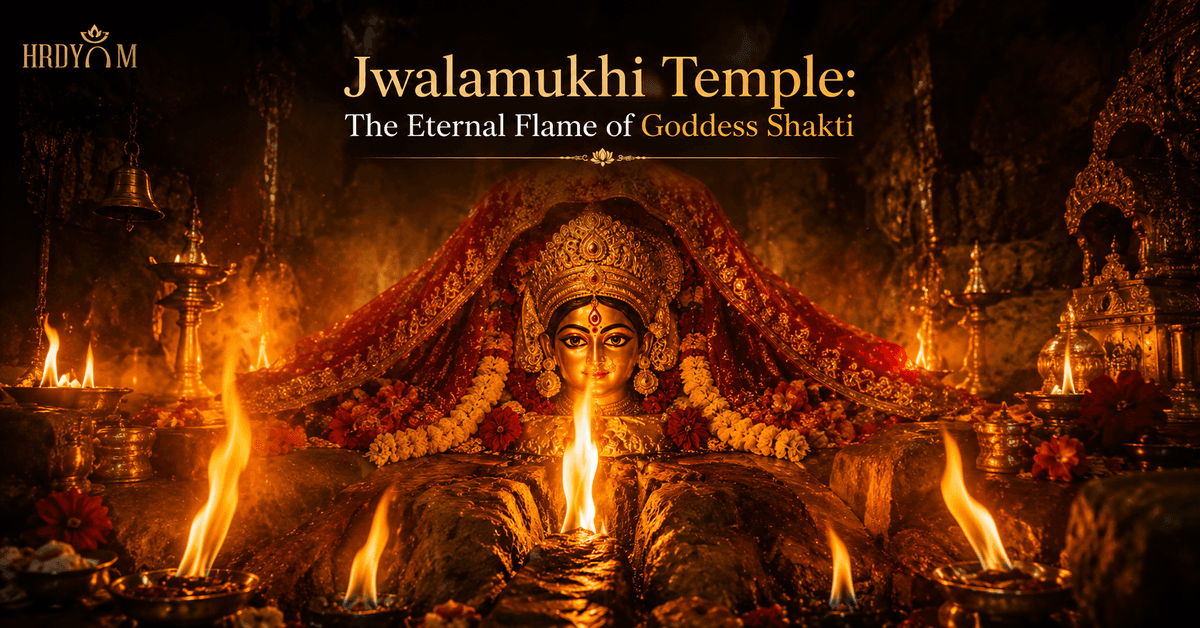
Then there are some temples whose architecture is so grand that they mesmerize people. There are some others whose centuries old history captures your attention. But then there is Jwalamukhi Temple, which stands out among all the other temples in India. The Jwalamukhi Temple is the place where there is no idol of stone. There is no sacred Shiva Lingam here and no grand deity awaiting you at the entrance of the sanctum. This temple is unique in its own way because the Goddess appears here through her eternal blue flames which have been burning for centuries.
At first when I had heard about the Jwalamukhi Temple, I had almost refused to believe in it. It was just another legend where the Goddess is worshipped not as a stone idol but as flames which emerge from the earth itself. But then after I started researching about its history and the stories associated with it in scriptures, I understood why it is considered one of the most potent Shakti Peeths in India.
It is a unique experience compared to visiting other temples because of the flame that never stops flickering, the ringing of bells, the sweet smell of incense and chanting of "Jai Mata Di." It is quite clear why pilgrims usually talk about how they felt the presence of the Goddess, rather than saw her.
As per Hindu mythology, the tongue of Goddess Sati is said to have fallen here when Lord Vishnu used Sudarshan Chakra to stop Lord Shiva's cosmic dance of grief. Since then, these flames are considered to be the living incarnation of Maa Jwala Devi, which depicts the perpetual energy of Shakti that cannot be created or destroyed.
From kings to saints to emperors and common devotees, many have come here to pay their homage in front of these flames. Some stories tell us about Mughal Emperor Akbar, who is believed to have witnessed the miracle of perpetual flames himself before finally bowing down to the Goddess. This temple also holds a significant place in Tantric mythology, where fire symbolizes purity and divine consciousness.
In present times, the Jwalamukhi Temple is amongst the most frequently visited pilgrim spots in northern India. Located amidst the picturesque hills of Kangra district, this temple provides its devotees spiritual satisfaction along with the beauty of the Himalayas, centuries-old traditions, and insight into one of the biggest enigmas of Hinduism.
If you are a devotee looking for the blessings of Maa Jwala Devi, a traveler exploring the sacred traditions of Himachal Pradesh, or just someone who wants to know more about the temple of fire worshiped as the Goddess, then come to the Jwalamukhi Temple.

| Attribute | Detail |
|---|---|
| Temple Name | Jwalamukhi Temple (Jwala Devi Temple) |
| Location | Jwalamukhi, Kangra District, Himachal Pradesh, India |
| Associated Body Part of Goddess Sati | Tongue (Jihva) |
| Presiding Goddess (Shakti) | Maa Jwala Devi (Manifested as Eternal Flames) |
| Associated Bhairava | Unmatta Bhairava |
| State | Himachal Pradesh |
| Elevation | Approximately 610 metres (2,000 ft) above sea level |
| Temple Type | Shakti Peetha; Goddess worshipped in the form of eternal natural flames |
| Believed Origin | Ancient temple mentioned in several Puranic traditions; patronized by numerous rulers including Raja Bhumi Chand and Maharaja Ranjit Singh |
| Best Time to Visit | October to March; Navratri festivals |
| Nearest Airport | Kangra Airport (Gaggal) – Approx. 50 km |
| Nearest Railway Station | Jwalamukhi Road Railway Station – Approx. 20 km |
| UNESCO Status | Not a UNESCO World Heritage Site |
| Temple Timings | Generally 5:00 AM – 10:00 PM (may vary during festivals) |
| VIP Darshan | Available during peak seasons through temple authorities |
| Photography Rules | Allowed in outer premises; prohibited inside the sanctum |
| Dress Code | Modest traditional attire recommended |
| Major Festivals | Chaitra Navratri, Sharad Navratri, Jwalamukhi Fair |
| Official Temple Management | Shri Jwalamukhi Temple Trust, Government of Himachal Pradesh |
Every eternal flame carries a timeless divine story
Every Shakti Peetha is rooted in the same ancient tale, the tale of love, devotion, and creation of sacred geography.
When King Daksha arranged the yajna ceremony and intentionally insulted Lord Shiva, Sati, unable to bear the disgrace of her beloved husband, offered herself in the holy flames of the sacrificial fire.
Devastated beyond redemption, Lord Shiva carried the dead body of Sati and roamed through the whole universe, performing his Tandava dance, which disturbed the balance of the entire universe.
To restore cosmic balance, Lord Vishnu intervened with his Sudarshan Chakra and separated the body of Sati into holy pieces. With the touch of every piece to the earth, a new Shakti Peetha was created.
In Jwalamukhi, it is believed that the tongue of Goddess Sati, called Jihva, fell.
However, unlike any other Peeth, here there is no stone idol.
The divine presence has revealed itself by means of eternal fires which emanate naturally from cracks in the rock.
They have been burning here uninterruptedly for centuries, defying any rational explanation and becoming the very incarnation of Maa Jwala Devi.
It is believed by devotees that these flames are not merely symbols – they are the goddess herself.
Several sacred fires are emerging from various fissures in the rock inside the shrine. Every fire is connected to a certain form of the Divine Mother, and together these fires symbolize the innumerable forms of Shakti supporting the Universe.
One of the most popular myths about the Jwala Ji Temple is connected to Mughal emperor Akbar.
Interested in the legend about miraculous flames, Akbar ordered several experiments aimed at extinguishing the fire. Water canals were led near the flames, iron plates were placed on top of them, and attempts were made to extinguish these flames.
According to the legend, it was all in vain.
Understanding the divine presence at the shrine, it is said that Akbar presented a Chhatra (gold umbrella) to the Goddess to show his reverence for her presence. According to temple legends, the Chhatra turned to an unknown metal, which was a divine sign showing that no worldly wealth could be compared with the divine power. To date, the Chhatra remains in the temple premises, attracting devotees.
The second local legend states that Raja Bhumi Chand of Kangra had a dream about the goddess telling him to revive the sacred fire that was buried under the forest and to rebuild the temple. Following the instructions of the local shepherds and villagers, the king rebuilt the temple around the eternal fire.
For centuries, the saints, kings and devotees continue to pay a visit to the Jwalamukhi temple not because of the statue but to bow down before the eternal fire which is nothing but the divine power of Adi Shakti herself.
Different from other temples where the idol is worshipped, Jwalamukhi tells us that sometimes the Divine cannot be contained into any form. Sometimes, the Goddess wants to make her presence felt most simply through the elements of nature.
Tracing centuries of faith, patronage, and preservation

While it is believed that the eternal flames of Jwalamukhi have been burning since the beginning of time, the temple itself has undergone several changes with the contributions of kings, saints, and devotees for thousands of years. Over time, the shrine has continued to be one of the most prominent Shakti centers in India.
| Period | Event |
|---|---|
| Mythological Era | According to Hindu tradition, the tongue of Goddess Sati fell here after Lord Vishnu's Sudarshan Chakra divided her body, making Jwalamukhi one of the 51 Shakti Peethas. |
| Ancient Period | The eternal flames are believed to have been worshipped long before a formal temple existed, attracting sages and local devotees. |
| Puranic References | The temple is mentioned in several Hindu scriptures, including the Kalika Purana, Devi Bhagavata Purana, and other Shakta texts that describe the sacred Shakti Peethas. |
| Early Kingdoms | Local tradition credits Raja Bhumi Chand of the Katoch dynasty with rediscovering the sacred flames after receiving divine instructions in a dream. He established the earliest shrine around the flames. |
| 16th Century | Mughal Emperor Akbar is believed to have visited Jwalamukhi after hearing about the miraculous flames. According to legend, he offered a golden umbrella to the Goddess after witnessing the flames' divine nature. |
| 18th Century | The temple continued to flourish under the patronage of the rulers of Kangra, becoming one of North India's most important pilgrimage centres. |
| Early 19th Century | Maharaja Ranjit Singh, founder of the Sikh Empire, visited the temple and donated a magnificent gold-plated dome, which still adorns the shrine today. |
| 19th Century | Raja Sansar Chand of Kangra, a great patron of art and religion, contributed to the maintenance and development of the temple complex. |
| British Era | British officials and geologists documented the temple's naturally occurring gas-fed flames, bringing international attention to the shrine's unique geological and religious significance. |
| Post-Independence | The Government of Himachal Pradesh established the Shri Jwalamukhi Temple Trust to oversee temple administration, pilgrim facilities, and preservation. |
| Present Day | Jwalamukhi Temple welcomes millions of devotees annually, especially during Chaitra and Sharad Navratri, remaining one of the most important Shakti Peethas in India. |
Where sacred simplicity reflects divine presence
Whereas most well-known temples in India have been constructed around idols, the Jwalamukhi Temple is one-of-a-kind in that it has been built around a geological marvel, a fire that constantly burns out of a crack in the rock. This fire emanating from the rock serves as a manifestation of Goddess Jwala Devi. This makes the Jwalamukhi Temple one of the unique pilgrimage places in the world.
The present-day temple has been designed by integrating North Indian architecture with elements incorporated by different rulers who ruled there. The whitish marble walls, the silver gates and the golden dome donated by Maharaja Ranjit Singh are among some of the features that make the temple look beautiful. Compared to other temples, the architecture here is quite simple.
In the Garbhagriha (sanctum sanctorum) itself, one does not find an idol carved out of stone but several blue flames emerge naturally from the crevices in the rocks and are worshipped as manifestations of the Divine Mother in different forms. They burn year-round continuously, without any human effort required and are thus self-manifested or Swayambhu.
This temple complex also houses several subsidiary shrines devoted to Lord Shiva (Unmatta Bhairava) and Lord Ganesha amongst others; depicting the perfect harmony between Shakta and Shaiva worship. There are large courtyards and marble floors that provide space to house thousands of pilgrims, particularly during the Navratri festival.
One of the main attractions of the temple is the gold-plated dome whose surface gleams under the bright Himalayan sun and can be spotted at a distance. In addition to the sacred flames, the surrounding hills and perpetual chanting of "Jai Mata Di" create a spiritual environment of peace and divine presence.
Whereas most ancient temples are revered for the architectural marvel of the buildings constructed by humans, Jwalamukhi Temple teaches us to understand that it's the eternal flame protected by the forces of nature that's the real miracle here.
Discover the deeper meaning behind the eternal flame
From among all the 51 Shakti Peethas, Jwalamukhi holds an exceptional position, since no idol form of the Goddess is worshiped here. Instead, devotees prostrate before the eternal flames which rise naturally from the ground - flames that are considered the live embodiment of Maa Jwala Devi herself. Thus, Jwalamukhi is one of the few temples in the world, where flame is the object of worship rather than a statue.
As per Shakta mythology, the tongue (Jihva) of the Goddess Sati was said to fall at this place. The tongue is a symbol of speech, sound, truth, knowledge, and creative power, thus making Jwalamukhi an auspicious spot for gaining wisdom, confidence, and spiritual awakening. It is believed that prayers at this spot can help in eliminating negativity, fears, obstacles, and inner doubts and boost one's determination and faith.
Temples also hold great significance in the Tantra school of thought, where fire signifies purity, transformation, and the eternal existence of Shakti. Many saints and followers of this religion have considered Jwalamukhi as the center of meditation and worship because the eternal flames are considered to signify the cosmic energy that nourishes all of life.
In contrast to other isolated temples situated on mountains that signify isolation, Jwalamukhi reminds everyone that divinity can manifest itself even in the most basic natural phenomenon. These eternally burning flames have been a source of devotion for many years and have attracted the attention of kings, saints, philosophers, and pilgrims from throughout India.
It is this faith, mystery, and devotion that make Jwalamukhi an exceptionally sacred place for pilgrimages in India. For many people, the greatest miracle is not only the everlasting burning of the flames but also the immense feeling of peace attained during their worship.
Celebrate the temple's most sacred and vibrant traditions
Like every major Shakti Peetha, Jwalamukhi Temple comes alive during the festivals dedicated to the Divine Mother. Throughout the year, thousands of devotees visit the temple, but during Navratri, the shrine transforms into one of Himachal Pradesh's largest spiritual gatherings.
Chaitra Navratri
Celebrated during March–April, Chaitra Navratri is among the temple's biggest festivals. Thousands of devotees undertake pilgrimages to seek the blessings of Maa Jwala Devi. Special aartis, continuous chanting of the Durga Saptashati, devotional music, and elaborate decorations fill the temple with spiritual energy.
Sharad Navratri
Observed in September–October, Sharad Navratri is equally significant. Pilgrims from across North India gather to offer coconuts, flowers, and prayers to the eternal flames. The temple remains beautifully illuminated, and the festive atmosphere continues throughout the nine sacred nights.
Jwalamukhi Temple Fair
This event is held in both Navratri festivals in a year and draws the attention of devotees, artisans, culture artists, and food vendors. It is known for its traditional Himachali music and devotional processions as well as cultural events.
Diwali
The eternal flames of the Goddess are decorated with thousands of lamps and flowers. It gives an extraordinary feeling when you see the burning flames amidst rows of diyas.
Makar Sankranti
Many devotees mark the beginning of a new crop season by praying at the Jwalamukhi Temple with wishes for health, prosperity, and protection.
Guru Purnima
Saints, spiritual aspirants, and devotees pay homage to their Gurus by praying to the Divine Mother.
Daily rituals
While the flames always remain burning all through the day, a series of rituals, which have not changed for hundreds of years, are conducted by temple priests. Every ritual is performed with utmost reverence since the flames themselves are the Goddess.
| Time | Ritual |
|---|---|
| 5:00 AM – 5:30 AM | Mangala Aarti – The temple opens with the first prayers and offerings to Maa Jwala Devi. |
| 6:00 AM – 11:00 AM | Nitya Puja & Archana – Daily worship, flower offerings, and chanting of sacred hymns. |
| 12:00 PM | Bhog Offering – Traditional food offerings are presented to the Goddess. |
| 1:00 PM – 4:00 PM | Continuous darshan, personal pujas, and devotional chanting by pilgrims. |
| 7:00 PM | Sandhya Aarti – Evening lamp ceremony accompanied by devotional music and temple bells. |
| 9:00 PM | Shayana Aarti – The final ritual of the day before the temple prepares for closing. |
Archana, coconut offering, flower offering, lighting of sacred lamps, and receiving blessings from the everlasting flame can be performed by devotees during the course of the day. At the time of Navratri and other festivals, special ceremonies are held along with aarti.
Plan your visit around the temple's daily schedule
The Jwalamukhi Temple is accessible on all days of the week, opening its doors to visitors throughout the year. The temple opens up well before dawn so that visitors can take part in the morning aarti, which takes place in the tranquil hours of the morning.
| Day | Morning | Evening |
|---|---|---|
| Monday – Sunday | 5:00 AM – 1:00 PM | 2:00 PM – 10:00 PM |
Darshan Options
General (Free) Darshan
General darshan is free for all devotees and doesn’t require any entry charges. On normal days, the waiting period would range between 20-60 minutes, and on weekends, Mondays, and Navratris, the queue would take 2-5 hours.
Special /VIP Darshan
During peak pilgrimage times, the temple administration offers the facility of Special Darshan. It helps devotees use an alternative queue and saves a lot of time. One can purchase the tickets from the authorities of the temple itself.
Senior Citizens
Senior citizens along with differently abled devotees can receive assistance from the temple management, especially during festivals where special arrangements are made for them.
Guided Darshan
Several pilgrims want to have a guided spiritual experience by getting to know about the history of the temple, significance of the eternal flame, adjacent shrines, and other rituals.

Arrange sacred rituals with ease and devotion
The followers may take part in many different types of pujas that are performed for Maa Jwala Devi, such as Archana, Havan, etc. Pujas may mostly be booked at the temple counter itself.
| Puja / Ritual | Purpose | Booking |
|---|---|---|
| Archana | Personal prayers using devotee's name and gotra | Temple Counter |
| Havan | Sacred fire ritual for blessings and prosperity | Advance booking recommended |
| Special Bhog | Food offering to Maa Jwala Devi | Available daily |
| Coconut & Flower Offering | Traditional offering during darshan | Available near temple entrance |
| Navratri Special Pujas | Conducted during Chaitra & Sharad Navratri | Limited slots |
Choose the ideal season for a peaceful pilgrimage
Visiting Jwalamukhi Temple is possible all year round; however, visiting will mean different things according to each season. October to March is considered to be the best time as the weather is cool, the sky is clear, and traveling in the Kangra Valley is really fun.
Pilgrims who want to see the temple during its busiest time can choose to visit it in the month of Chaitra Navratri (March to April) or Sharad Navratri (September to October). During these days, the temple is decorated, pious activities are performed all day long and there is devotional music playing everywhere.
To have a peaceful darshan, visiting on a weekday morning from November to February before 8 AM is recommended. In this way one can observe the never-ending flames without being surrounded by people.
| Month | Weather | Crowd Level | Notes |
|---|---|---|---|
| January | Cold (5–18°C) | Moderate | Excellent weather for pilgrimage. |
| February | Pleasant | Moderate | Ideal for sightseeing and temple visits. |
| March | Mild | High | Chaitra Navratri attracts large crowds. |
| April | Pleasant | Very High | Festival season continues with vibrant celebrations. |
| May | Warm | Moderate | Comfortable mornings; warmer afternoons. |
| June | Warm | Low | Good for peaceful visits before monsoon. |
| July | Monsoon | Low | Frequent rainfall; lush green surroundings. |
| August | Monsoon | Low–Moderate | Beautiful landscapes but occasional travel delays. |
| September | Pleasant | High | Sharad Navratri preparations begin. |
| October | Cool & Clear | Very High | One of the best months to visit. |
| November | Cool | High | Excellent weather with fewer rains. |
| December | Cold | Moderate | Peaceful atmosphere and clear Himalayan views. |
Travel comfortably by air, rail, or road
Located in the beautiful district of Kangra in Himachal Pradesh, Jwalamukhi Temple enjoys easy access through airways, railways, and road transport. From anywhere in India and even Delhi, it becomes quite easy to reach the temple and the last leg of your journey will give you stunning views of the Himalayan foothills.
From Delhi
There are direct flights from Delhi to Kangra (Gaggal Airport) in around 1.5 hours. However, another option could be an overnight train journey from Delhi to either Pathankot or Jwalamukhi Road Railway Station. The road journey from Delhi takes around 9-10 hours.
From Mumbai
Flying from Mumbai to Kangra through Delhi is the fastest way which will take approximately 4-6 hours. The train journey takes 26-30 hours, whereas the road route is not usually opted for because of the distance involved.
From Bengaluru
By flying, Delhi or Chandigarh is the best route from Bengaluru taking approximately 5-7 hours. By rail it takes over 40 hours.
From Hyderabad
You can fly from Hyderabad to Kangra via Delhi in around 4-6 hours. There are trains available to Pathankot but will require much more time to reach the destination.
From Chandigarh
Jwalamukhi Temple is approximately 200km away from Chandigarh and can be easily reached within 4.5-5 hours by road through the beautiful mountains of Himachal Pradesh.
| Mode of Transport | Details |
|---|---|
| By Air | Kangra Airport (Gaggal) is approximately 50 km from the temple. Taxis are easily available outside the airport. |
| By Rail | Jwalamukhi Road Railway Station is about 20 km away. Pathankot Junction (approximately 120 km) offers better rail connectivity from major cities. |
| By Road | Well-connected by Himachal Pradesh Road Transport Corporation (HRTC) buses and private taxis from Kangra, Dharamshala, Pathankot, Chandigarh, and Shimla. |
| By Taxi | Private taxis and app-based cab services are available from nearby towns, offering a comfortable journey through the hills. |
Quick transport guide
| Mode | From | Approx. Distance / Time |
|---|---|---|
| Air | Kangra Airport (Gaggal) | ~50 km / 1–1.5 hours |
| Rail | Jwalamukhi Road Railway Station | ~20 km / 30–40 minutes |
| Rail | Pathankot Junction | ~120 km / 3 hours |
| Road | Dharamshala | ~55 km / 1.5 hours |
| Road | Chandigarh | ~200 km / 4.5–5 hours |
Extend your journey through Himachal's sacred landscapes
Temple of Jwalamukhi is one of the most revered and scenic locations of Himachal Pradesh. The pilgrim tour to this temple also includes visiting other holy shrines that exist in the Kangra valley.
| Attraction | Approx. Distance from Jwalamukhi | Why Visit? |
|---|---|---|
| Kangra Devi (Brajeshwari) Temple | ~35 km | One of the 51 Shakti Peethas dedicated to Goddess Brajeshwari. |
| Chintpurni Temple | ~35 km | Revered Shakti Peetha where devotees pray for the fulfilment of wishes. |
| Chamunda Devi Temple | ~55 km | Famous temple dedicated to Maa Chamunda amidst scenic Himalayan surroundings. |
| Baglamukhi Temple, Bankhandi | ~30 km | Important Tantric temple dedicated to Goddess Baglamukhi. |
| Dharamshala | ~55 km | Home of the Dalai Lama and a gateway to Tibetan culture. |
| McLeod Ganj | ~60 km | Beautiful hill town known for monasteries, cafés, and mountain views. |
| Kangra Fort | ~40 km | One of India's oldest forts with panoramic views of the valley. |
| Masroor Rock-Cut Temples | ~45 km | Ancient monolithic rock temples often called the "Ellora of Himachal." |
| Pong Dam Lake | ~65 km | Popular destination for birdwatching and boating during winter. |
| Nagarkot (Kangra Town) | ~35 km | Historic town known for temples, markets, and traditional Himachali culture. |
Experience the authentic flavors of Himachali devotion
An unfulfilled experience of Jwalamukhi Temple would be that of not participating in the simple yet significant offering made to Maa Jwala Devi. Whereas most other Shakti temples have a more ritualistic atmosphere, this place maintains a focus on reverence and gratitude.
The traditional prasad offered at Jwalamukhi temple comprises coconut, mishri (rock sugar), dry fruits, and seasonal fruits. In addition, shops outside the temple provide decorated puja thalis that include flowers, red chunri, agarbatti (incense sticks), and offerings to the Goddess.
One can also relish the authentic Himachali food and North Indian delicacies in local restaurants and dhabas.
| Food / Specialty | Why Try It? |
|---|---|
| Temple Prasad | Coconut, mishri, dry fruits, and sacred offerings blessed by Maa Jwala Devi. |
| Himachali Dham | Traditional festive meal featuring rice, rajma, madra, and local delicacies. |
| Madra | A rich yogurt-based chickpea curry, one of Himachal's signature dishes. |
| Siddu | Steamed Himachali bread served with ghee or lentil curry. |
| Babru | Himachali-style stuffed kachori enjoyed as a snack. |
| Rajma Chawal | A comforting North Indian favourite widely available near the temple. |
| Kheer & Halwa | Traditional sweets often served during religious occasions. |
Find accommodations that suit every pilgrim's comfort
Regardless of whether you stay for a few hours or take a longer tour of the holy temples in Himachal Pradesh, Jwalamukhi can cater to your needs with a variety of accommodations depending on your budget. This ranges from dharamshalas for pilgrims to hotels and resorts in the surrounding hills.
| Category | Best For | What to Expect |
|---|---|---|
| Budget Dharamshalas & Guesthouses | Pilgrims & solo travellers | Affordable rooms, basic facilities, and walking distance from the temple. Many are managed by religious trusts. |
| Mid-Range Hotels | Families & regular travellers | Comfortable rooms with air conditioning, attached bathrooms, parking, and restaurants nearby. |
| Luxury Resorts | Premium travellers | High-end resorts in Kangra and Dharamshala offering mountain views, wellness facilities, and premium hospitality. |
| Senior-Friendly Hotels | Senior citizens & families | Hotels with lifts, easy vehicle access, and comfortable amenities for elderly pilgrims. |
| Pilgrim Guesthouses | Religious travellers | Clean, peaceful accommodations focused on spiritual visitors and temple pilgrims. |
Plan your pilgrimage with confidence and clarity
| Expense | Budget Traveller | Mid-Range Traveller | Luxury Traveller |
|---|---|---|---|
| Accommodation (Per Night) | ₹800 – ₹2,000 | ₹2,500 – ₹6,000 | ₹8,000 – ₹20,000+ |
| Local Transport (Per Day) | ₹200 – ₹500 (Bus/Shared Taxi) | ₹800 – ₹1,500 (Private Taxi) | ₹3,000+ (Private Vehicle with Driver) |
| Food (Per Day) | ₹300 – ₹700 | ₹800 – ₹2,000 | ₹3,000+ |
| Temple Offerings / Donations | ₹100 – ₹500 | ₹500 – ₹1,500 | As per personal devotion |
| Guided Darshan Assistance (Optional) | — | ₹1,500 – ₹3,500 | ₹3,500 – ₹7,000+ |
Experience Jwalamukhi at a relaxed and meaningful pace
If you are visiting Jwalamukhi temple alone or taking up a pilgrimage trip around Himachal Pradesh, the above travel itineraries will be useful to you in your trip.
1-Day Itinerary
| Time | Plan |
|---|---|
| 6:00 – 8:00 AM | Arrive early for a peaceful darshan and attend the morning aarti. |
| 8:00 – 10:00 AM | Explore the temple complex and nearby markets for prasad and souvenirs. |
| 10:30 AM – 1:00 PM | Visit Baglamukhi Temple or local viewpoints. |
| 2:00 – 5:00 PM | Enjoy traditional Himachali cuisine and explore the town. |
| 6:00 – 7:00 PM | Return for the beautiful Sandhya Aarti before departure. |
2-Day Itinerary
| Day | Suggested Plan |
|---|---|
| Day 1 | Jwalamukhi Temple → Local Market → Baglamukhi Temple → Evening Aarti |
| Day 2 | Kangra Devi Temple → Kangra Fort → Dharamshala → McLeod Ganj |
3-Day Itinerary
| Day | Suggested Plan |
|---|---|
| Day 1 | Jwalamukhi Temple and surrounding attractions |
| Day 2 | Chintpurni Temple → Kangra Devi Temple → Kangra Fort |
| Day 3 | Chamunda Devi Temple → Dharamshala → McLeod Ganj → Local Tibetan Market |
Simple guidance for a smooth and respectful pilgrimage
A little preparation can make your pilgrimage to Jwalamukhi temple smoother and more comfortable.
Maintain modesty while dressing up. Traditional Indian attire or modest clothes that cover the shoulders and knees are preferred.
Do not forget to remove your shoes before entering the temple premises. Facilities for shoe storage are arranged near the entrance gate.
Photography is usually permitted in the outer area but is strictly forbidden in the sanctum where the eternal flames are worshipped.
Carry a light woolen jacket if you plan to visit the place during winters, as mornings and evenings are very cold.
In Navratri, reach there early in the morning to skip long queues and overcrowded areas.
Flowers, coconuts, and other puja items are available at authorized shops near the temple.
Stay hydrated during your exploration of the temple and other sites, particularly during summers.
Visitors who are elderly will find some slopes and stairs tough to climb; wheelchairs are usually available in peak pilgrimage seasons.
Good mobile networks are available in the town, and keeping some money with you is preferable, as small shops do not accept online payment options.
In case you are planning to visit more temples of the Kangra valley, taking a local taxi is more convenient than using public transport.
Discover fascinating truths behind the eternal flame
The blue flames of the temple have been burning ceaselessly since time immemorial and are considered to be one of the most intriguing religious marvels in India.
As per legends, it was the tongue of Goddess Sati that fell at this place thereby earning the temple its place among the 51 Shakti Peethas.
It is said that Mughal Emperor Akbar visited the shrine and made an offering of a golden umbrella after seeing the wondrous phenomenon of flames.
The beautiful gold-coated dome of the temple was gifted to the temple by Maharaja Ranjit Singh.
While scientists say that the burning of the flame is due to natural gas emanation, the devotees consider it the perpetual form of Maa Jwala Devi.
Several divine flames are burning inside the sanctum, each one being the form of the Divine Mother.
The temple forms one of the important sites on the Himachal Shakti Peetha circuit along with Kangra Devi, Chintpurni, and Chamunda Devi.
The temple comes under the administration of the Shri Jwalamukhi Temple Trust.
Each year lakhs of devotees visit the temple during the months of Chaitra and Sharad Navratri.
Explore trusted books that deepen your understanding
In case you feel fascinated about your trip to Jwalamukhi Temple and would like to learn more about the history of Shakti Peethas, Tantrism, and worship of the Divine Mother, then these readings are for you.
| Book | Why Read It? |
|---|---|
| Shakti and Shakta – Sir John Woodroffe (Arthur Avalon) | One of the most respected works on Shakta philosophy, Tantra, and the worship of the Divine Mother. |
| Kali: The Feminine Force – Ajit Mookerjee | Explores the symbolism, iconography, and spiritual significance of Goddess Kali and Shakti traditions. |
| The Serpent Power – Arthur Avalon | A classic introduction to Kundalini, Tantra, and the spiritual symbolism of divine energy. |
| Tantric Visions of the Divine Feminine – David Kinsley | Examines the many forms of the Goddess, including their theological and Tantric significance. |
| Devi Bhagavata Purana | One of the principal scriptures devoted to the Divine Mother, containing stories and teachings related to Shakti worship and the sacred Peethas. |
Personalized spiritual journeys crafted with care and devotion
A tour to Jwalamukhi Temple is not merely about traveling to a spiritual destination; it is about experiencing one of the most magnificent forms of the Divine Mother in India. At HRDYAM, we will help you make your pilgrimage an easy and highly spiritual journey.
Whatever help you need, be it related to organizing Darshan, accommodation, transportation services, visiting temples, or taking a full round of Himachal Shakti Peethas, we will manage everything for you. We can also organize pilgrimages to the nearby spiritual temples such as Kangra Devi, Chintpurni, Chamunda Devi, and Baglamukhi Temple.
If one needs any more spiritual assistance, then with the help of the Vedic astrology services from HRDYAM under the leadership of Dr. Aaditya Pandey, one can find a good date for his or her pilgrimage according to one’s own birth chart. One can also purchase puja essential products from the very selective collection of HRDYAM, which will allow one to take the blessings of Maa Jwala Devi home.
Starting from the initial prayers till one comes back home safe and sound, HRDYAM promises a peaceful and comfortable journey.
Where every journey finds light

There are numerous temples from which devotees can connect with the Divine. In Jwalamukhi, there is no divine presence created in the form of idols made of stone; rather, the Divine is seen as an eternal flame. Through the ages, the flames in the temple have been a source of inspiration and devotion, reminding millions of pilgrims that there are some things about the Divine that need to be experienced but cannot be explained.
No matter if you choose to pray to Maa Jwala Devi for her blessings, visit one of the most sacred Shakti Peethas of India, or marvel at the unique natural flames burning continuously for many years, a visit to Jwalamukhi will remain with you forever. The serene hills of Kangra Valley, the sounds of ringing bells inside the temples, and the eternal glow of the sacred fire combine to create an unforgettable experience that is deeply spiritual.
Visit with faith, patience, and an open heart. Stand before the eternal flames for some silent moments, pray to Maa Jwala Devi, and be reminded that even in your deepest hour of darkness, the light of hope, strength, and Divine grace never extinguishes.
Spiritual travel researcher, Vedic cultural writer, and contributing editor at HRDYAM.
You Might Also Like
Tags
More Articles
View all
Hinglaj Mata: Where faith crosses every border
The journey to some temples starts with the sound of temple bells. However, when it comes to the pilgrimage to Hinglaj Mata Temple, the starting point of this journey is not sound but silence - the si
Tripura Sundari: Where beauty becomes divine
One of the few temples in India that has been named based on a profound philosophical thought, rather than a location, is called "Tripura Sundari," which means "The Beautiful One of the Three Worlds."

5-Day Meghalaya Itinerary
There's a version of this itinerary floating around every travel blog that promises you can do Shillong, Cherrapunji, Dawki, and Mawlynnong in five days without breaking a sweat. Technically true. Pra