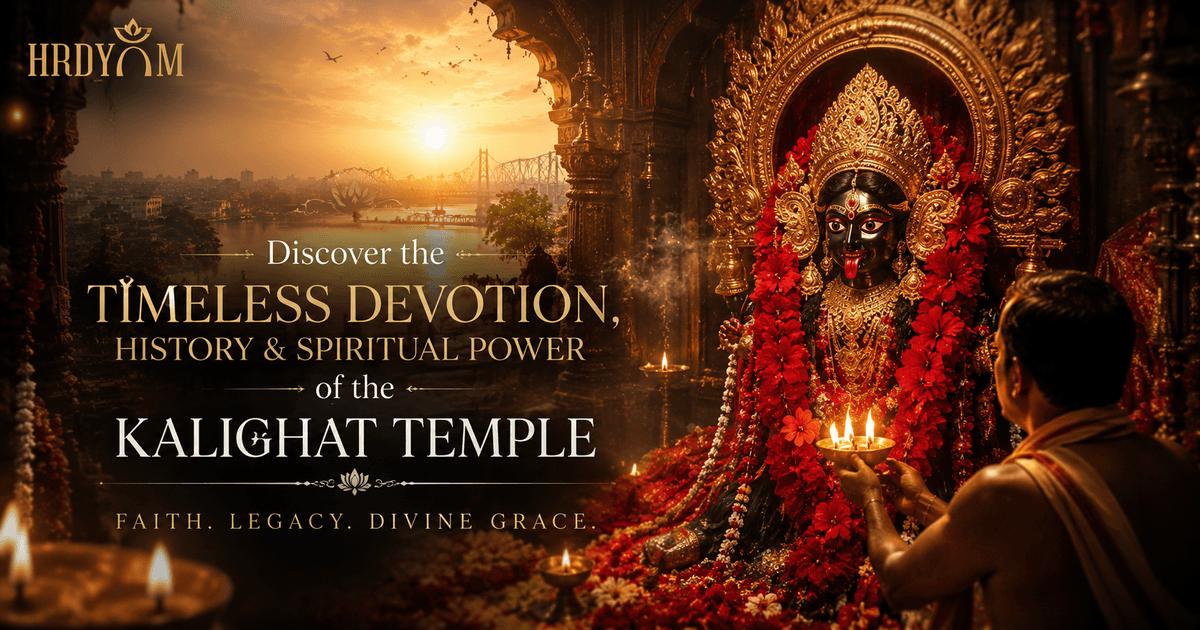
Discover the timeless devotion, history, and spiritual power of the Kalighat temple.

RIYA SHARMA
HRDYAM - DISCOVER SACRED JOURNEYS, WISDOM & WELLNESS
I will never forget how I first heard the name of the Kalighat Temple.
It was not from a historian detailing its architecture or a tourist guide talking about attractions of Kolkata. It was from a Bengali old lady sitting silently next to me on a train ride. In between all the talk of food, family, and festivities, she asked me one very basic question.
"Have you ever been to the Kalighat?"
When I answered her with a negative, she smiled.
"Yes, you must go at least once in your lifetime. Maa Kali doesn't necessarily fulfill your desires the way you wish, but she surely gives you what you deserve."
And that sentence left me thinking.
Out of curiosity, I started researching the temple and talking to its devotees, along with listening to centuries-old stories about the place. Each individual had a different tale to tell, but there was one emotion that prevailed, the emotion of gratitude.
Some had found their strength in hard times.
Others were sure that Maa Kali had given them their long-desired child.
They came in advance before setting up their business, writing exams, marriage, or just out of gratitude towards the goddess for all the blessings of life.
The more I was listening, the more I came to understand that Kalighat is not any other famous temple in Kolkata.
It is one such place where mythology does not appear like something that happened ages ago in some ancient scriptures. Rather, it appears like something very close.
Today, standing near the entrance of the temple, you will come across one amazing mixture of devotion and routine. While sellers prepare baskets filled with fresh and red flowers (hibiscus), which are considered to be the most preferred flower by Maa Kali, priests keep chanting mantras in ancient Sanskrit. Meanwhile, devotees line up for long hours waiting to pay their respects with sweets, coconuts, and red sarees. Bells ring endlessly, the smell of incense spreads in the air, and in the crowd, someone folds his/her hands, shedding tears.
For the first-time visitor, it can seem overwhelming.
For regular devotees, it feels like being back at home.
Unlike many temples that attract people with their majestic architecture, the greatness of Kalighat lies in its atmosphere.
Kalighat is situated in the city of Kolkata and is considered one of the 51 holy Shakti Peeths, where the tradition goes that the toes of the right foot of Goddess Sati landed when Lord Vishnu ended the cosmic agony of Lord Shiva with the help of the Sudarshana Chakra.
But for the followers of Maa Kali, it is not just an ancient belief.
This is precisely the reason why millions keep coming back each year.
Kings, monks, revolutionaries, poets, painters, intellectuals, and common people have all prayed to the same Goddess for bravery, wisdom, safety, and serenity.
Perhaps that is the reason why Kalighat never seems to be a relic from the past.
It is full of life.
In this guide, we will take you through the amazing mythological legends, history, rituals, travel tips, temple hours, VIP darshan, places near the temple, Bengali food, and everything else you need to know about visiting one of the most important temples of India dedicated to the Divine Mother.
| Attribute | Detail |
|---|---|
| Temple Name | Kalighat Kali Temple |
| Location | Kalighat, South Kolkata, West Bengal, India |
| Associated Body Part of Goddess Sati | Right Toe (some traditions mention the Right Foot) |
| Presiding Goddess (Shakti) | Maa Dakshina Kali (Kalika) |
| Associated Bhairava | Nakuleshwar Mahadev (Nakuleshwar Bhairava) |
| State | West Bengal |
| Elevation | Approximately 6 metres (17 ft) above sea level, situated in Kolkata's Gangetic delta plain |
| Temple Type | Traditional Bengal Aat-Chala (Eight-Roofed) architecture; one of the 51 Shakti Peethas |
| Construction & Patronage | Construction initiated in 1798 by Santosh Roy Chowdhury of the Sabarna Roy Choudhury family and completed in 1809. Major conservation and restoration works were undertaken during 2023–2025 by the Reliance Foundation in collaboration with the Kolkata Municipal Corporation. |
| Best Time to Visit | October to February (pleasant weather); Kali Puja and Durga Puja are the most vibrant festival periods. |
| Nearest Airport | Netaji Subhas Chandra Bose International Airport (CCU), approximately 17–18 km away |
| Nearest Railway Stations | Sealdah Junction (Approx. 7 km) and Howrah Junction (Approx. 14.5 km) |
| Nearest Metro Station | Kalighat Metro Station (Blue Line), approximately 500–700 metres from the temple |
| UNESCO Status | Not a UNESCO World Heritage Site |
| Temple Timings | 5:00 AM – 2:00 PM and 5:00 PM – 10:30 PM (until 11:30 PM on Saturdays, Sundays & select festivals). The temple remains closed between 2:00 PM and 5:00 PM for Bhog and afternoon rituals. |
| VIP / Special Darshan | Available through the official temple committee counter, subject to temple regulations and crowd conditions. Visitors should avoid unauthorized agents or touts offering "VIP darshan." |
| Photography Rules | Photography and videography are strictly prohibited inside the Garbhagriha (sanctum sanctorum). Photography is generally permitted in the outer courtyard and the temple skywalk unless restricted during festivals. |
| Dress Code | Visitors are advised to wear modest and respectful attire. Clothing covering the shoulders and knees is recommended. Shorts, sleeveless tops, and leather items should be avoided. Footwear must be removed before entering the temple premises. |
| Major Festivals | Kali Puja, Diwali, Durga Puja, Snan Yatra, Poila Boishakh (Bengali New Year) |
Every sacred shrine begins with a timeless legend
All the Shakti Peethas present in the country have their roots entangled deeply into one of the most significant and emotional legends in the history of Hinduism, which not only is an account of divine love, but also about loss, sacrifice, and creation of sacred geography.
King Daksha was the father of Goddess Sati. Even though he did not like the ascetic god, who was the husband of Sati, there was nothing he could do because Sati had already married Lord Shiva. In order to humiliate the god, Daksha planned to perform a yajna and invite everyone to the ceremony, except for Shiva.
Sati, unable to tolerate the disrespect towards her husband, ignored Shiva’s warning and went to the yajna. What happened next can be easily guessed – her father, full of pride, and other people started insulting Shiva in front of her, and Sati decided to end her life through immolation in order to be able to separate from the family members who had insulted her husband.
Grieving from within, he placed the lifeless body of Sati on his shoulders and performed the Tandava, the violent cosmic dance that destroyed the world.
In order to restore the balance in nature, Lord Vishnu cut Sati's body into fifty-one pieces using his Sudarshana Chakra. All these sacred spots in India were henceforth blessed by these divine pieces, and each spot became a place of worship for the Divine Mother.
One such holy site is Kalighat, where it is believed that the right big toe of Goddess Sati had touched the Earth.
Where divine presence transformed an ordinary land into eternal sacredness

As opposed to other temples that grace the peaks of mountains and banks of large rivers, the site where the toe of Sati is said to have fallen used to be very humble. It is located next to Adi Ganga, the ancient river that became the Hooghly River and runs across Kolkata, which is the city that grew from that place.
Today, millions of devotees honor the Goddess at this site as Maa Dakshina Kali, one of the kindest and the most powerful incarnations of Mother Divine. Here, alongside the Goddess, lives Nakuleshwar Mahadev, who is sometimes called Nakuleshwar Bhairava, the guardian deity of this holy Peetha. The temple that houses the svayambhu Shiva Lingam of Lord Bhairava is believed to be indispensable for pilgrims to complete the Kalighat pilgrimage.
Together, the Goddess and Bhairava symbolize the eternal unity of Shakti (the divine energy) and Shiva (the pure consciousness).
How Kalighat became the spiritual heart of Kolkata
The link between Kalighat and Kolkata is much more than geographical.
It is believed by many historians that the very name of "Kolkata" is derived from the term "Kalikshetra," which means the holy ground of Goddess Kali. According to this version of events, the city came into existence because of Goddess Kali and hence she became not only its guardian but also its mother goddess.
An alternate and somewhat practical interpretation of the term is that it comes from the Bengali words "khal" (meaning canal/creek) and "kata" (meaning dug).
Whatever the explanation, they all come to the same point that the history of Kolkata cannot be separated from the story of Mother Kali.
Up till today, it has continued to shape the city's festivals, literature, songs, arts, and even day-to-day life.
Faith existed here long before stone walls were built
Even though the current temple structure at Kalighat was erected during the nineteenth century, the spiritual significance of the place goes back much further into the past.
The religious literature written in ancient Bengali supports the idea that pilgrims have been visiting the holy Kalikshetra even several centuries before the temple was constructed.
Such literary works as the Manasa Mangal Kavya (fifteenth century) and Kavikankan Chandi (seventeenth century) include references to Kalighat as one of the sacred shrines, which proves that devotees have already realized the spiritual significance of this place even before the temple has been constructed.
Therefore, the walls of the temple may be several hundred years old; but, the faith that preserves the spiritual significance of Kalighat has been going on for centuries already.
This could be the very reason why Kalighat is so special.
Kalighat is not just an ancient monument protected by history. Kalighat is a living shrine, where mythology, devotion and the pulsations of Kolkata unite each and every day.
Tracing centuries of devotion through history
The Kalighat legend does not exist only in myths but has also been associated throughout time periods with history, literature, architecture, and devotion. Over the years, the Kalighat temple has grown from its origins recorded in early Bengali texts to its present status as one of India's most important Shakti Peethas.
| Period / Year | Historical Event |
|---|---|
| Century | Kalikshetra is mentioned in renowned Bengali devotional texts such as the Manasa Mangal Kavya and Kavikankan Chandi, indicating that it was already an established centre of Goddess worship centuries before the present temple was built. |
| Circa 1570 | According to tradition, Padmabati Devi, mother of Lakshmikanta Roy Choudhury, receives a divine vision leading to the rediscovery of Goddess Sati's sacred toe relic in Kalikunda, reinforcing Kalighat's identity as one of the 51 Shakti Peethas. |
| Mughal Era | A modest shrine, believed to be a simple thatched structure, continues to attract local devotees along the banks of the ancient Adi Ganga, gradually growing into an important pilgrimage site. |
| 1798–1809 | Santosh Roy Chowdhury of the Sabarna Roy Choudhury family begins constructing the present-day temple. After nearly 11 years, the stone temple is completed under the family's patronage and becomes the principal shrine seen today. |
| 1835 | Kashinath Roy constructs the Nat Mandir (Prayer & Congregation Hall), providing devotees with a larger space for worship and religious gatherings. |
| 1843 | Uday Narayan Mondal of the Bawali Zamindar family establishes the Shyam Rai (Radha–Krishna) Temple within the Kalighat temple complex, reflecting the coexistence of Shakta and Vaishnava traditions. |
| 1858 | Madan Gopal Kole builds the Dal Mancha for the Shyam Rai Temple, expanding the religious infrastructure within the complex. |
| Colonial Period | Kalighat becomes deeply intertwined with Kolkata's cultural identity. During this period, local Patua artists develop the famous Kalighat Pat painting style, depicting mythology, social life, and folklore. These artworks become popular souvenirs among pilgrims and are now celebrated worldwide as a distinctive school of Indian folk art. |
| 20th Century | The temple continues to be managed by the Sabarna Roy Choudhury family and hereditary priestly lineages, while civic authorities gradually become involved in preserving and managing the growing pilgrimage site. |
| November 2023 | The Reliance Foundation, in collaboration with the Government of West Bengal, announces a comprehensive restoration project for the nearly 200-year-old temple complex, focusing on heritage conservation and improved pilgrim facilities. |
| 2024 | Kalighat undergoes its first major modern restoration since its construction. The project, with an estimated budget of ₹200 crore, includes heritage preservation, improved infrastructure, better drainage, lighting, and enhanced visitor amenities. |
| 14 April 2025 | The Kalighat Skywalk, an elevated 440-metre-long pedestrian corridor, is inaugurated by Chief Minister Mamata Banerjee. Built at a cost of approximately ₹100 crore, the skywalk significantly improves crowd management and provides safer, smoother access for millions of pilgrims visiting the temple each year. |
Every structure reflects centuries of sacred tradition
The most surprising thing for first-time visitors about the Kalighat Temple is how modest it is. The temple does not impress with majestic gateways or huge stone corridors; on the contrary, it has a simple appearance that represents the beauty of it. It has been constructed according to the traditional architecture style of Bengal "chala," which means the design of rural Bengali huts, reminding that the Goddess belongs both to ordinary houses and temples.
Main temple building is made according to "Aat-Chala" style. "Aat-Chala" is a square base and two tiers of gently curved roof, which altogether give a building an appearance of eight faces. In contrast to temples of South India with its grand architecture, the Kalighat Temple represents the local architecture, so it connects the Goddess with the culture of the region.
The silver roofs have colorful borders of red, yellow, green and blue colors near the cornice, and three decorative spires rise up above the building; the topmost of them has a small triangular flag fluttering there, visible even from several streets away. Ornate terracotta panels decorating the façade represent images of different gods and floral motifs. This unique decoration has been carefully restored during 2023-2025 renovation.
Kalighat temple like other old age temples has not been constructed in one go. It has developed gradually over the ages, generation by generation by devotees and patrons. The Garbhagriha (inner chamber) of the temple offers darshan to the Goddess Maa Kali. There is an ample-sized Nat Mandir which was established in 1835 for aartis and congregation of people. Also, there is the temple of Nakuleshwar Bhairava near the temple of Kalikka. The Shyam Rai temple dedicated to Radha and Krishna shows the amalgamation of Shakta and Vaishnava traditions. There is the Kundupukur tank and also the shrine beneath the old Shoshti-tola tree in the Kalikka temple.
The uniqueness of Kalighat temple can be attributed to the idol of Maa Kali. While during kali puja a full-fledged and beautifully designed statue of the Goddess is worshiped, the idol of the Goddess Maa Kali here has an eternal and simple look. As per the belief, the goddess is self-manifested. It is a black stone idol having three big eyes, golden tongue, and four hands ornamented in silver. Every day the hereditary priests adorn the Goddess with red silk clothes and flowers and gold ornaments before offering darshan to devotees.
The recent efforts at restoration from 2023 to 2025, and the building of the Kalighat Skywalk, have been successful in striking a balance between preserving the cultural heritage of the temple and providing modern pilgrim amenities to its visitors.
Understanding why millions seek the blessings of Maa Kali

There are some temples that can take your breath away owing to their lofty architecture. There are some other temples that will stun you owing to their centuries-old sculptures or scenic beauty. But there is one temple that will touch you deep inside with the unyielding spirit of its devotees every single day.
Kalighat Temple differs from Kamakhya known for its rich Tantric legacy and from Vaishno Devi with its sacred pilgrimage to a mountain shrine. Unlike these two temples, Kalighat gained its reputation with the never-ceasing devotion of its devotees numbering millions. Located right in the center of the bustling Kolkata, it is one of the few temples that have managed to combine spirituality and urbanity into one whole.
The Goddess in Kalighat is worshipped as Maa Dakshina Kali, a form of the Divine Mother being gentle and merciful. Even if her fierce look means the destruction of the evil powers, devotees do not come there with any fear and trepidation but with the confidence and complete trust of a child coming to its kind mother.
People visit Maa Kali at their hardest times in life such as when they experience fear, economic difficulties, ill health, legal problems, or uncertainties regarding their future. According to the belief, sincere prayers to the Goddess at Kalighat lead to her immediate blessings.
Another unique feature of Kalighat is its inclusiveness. The same temple complex houses Maa Kali, Nakuleshwar Mahadev (Bhairava), and Shyam Rai (Radha-Krishna). This peaceful co-existence of the Shakta, Shaiva, and Vaishnava cults is truly symbolic of the diverse spiritual heritage of Bengal, wherein various streams of devotion exist side by side.
Apart from daily worship, Kalighat is also important to those who have come to offer prayers in honor of their ancestors. It is believed that prayers and offerings made at Kalighat bring peace to their ancestors and blessings to future generations.
Could this be the reason why, amidst all the hustle and bustle of one of India’s most bustling cities, walking into Kalighat seems like entering an area where religion has been the same over centuries? In this place, with all the ringing bells, burning of incense sticks, and the unending flow of pilgrims, Maa Kali keeps reminding everybody that, amidst the chaos of their lives, Goddess is never far away.
Celebrate the temple's most vibrant and sacred occasions
The Kalighat Temple is a place filled with spirituality year-round, but at its festivals, its energy takes on a new meaning altogether. With the sound of conches, prayers chanted rhythmically, fragrance of incense filling the air and a multitude of people gathered to pray, the temple is brought alive with faith. To witness the temple at its best, it may be ideal to visit it during any of its sacred festivals.
| Festival | When | Why It's Special |
|---|---|---|
| Kali Puja (Shyama Puja) | Amavasya of Kartik (October–November) | The most important festival at Kalighat. Celebrated alongside Diwali, devotees gather in huge numbers to worship Maa Kali. The temple remains open late into the night for the sacred Nishitha Puja, when elaborate rituals, devotional chanting, and traditional ceremonies are performed. It is the busiest day of the year. |
| Durga Puja | September–October | Although Kalighat is dedicated to Maa Kali, the temple witnesses a massive influx of devotees during Kolkata's world-famous Durga Puja. Many pilgrims combine visits to the city's iconic Durga pandals with darshan at Kalighat. |
| Navratri | Nine days before Durga Puja | The temple celebrates the Divine Mother in her many forms through special prayers, devotional recitations, and extended worship throughout the nine sacred nights. |
| Snan Yatra | Annual Ritual (Date varies) | One of Kalighat's unique traditions, where ceremonial bathing rituals are performed at the sacred Kundupukur tank. Parts of the rituals are conducted privately by temple priests, adding to the ceremony's spiritual significance. |
| Pohela Boishakh (Bengali New Year) | Mid-April | Thousands of devotees visit the temple to seek Maa Kali's blessings for prosperity, happiness, and new beginnings as Bengal welcomes the new year. |
| Bhoot Chaturdashi | One day before Kali Puja | A unique Bengali tradition where families light 14 lamps to honour ancestors and ward off negativity. Many devotees visit Kalighat on this evening before celebrating Kali Puja the following day. |
When is the best time for you to come for a visit during a festival?
When your aim is to see Kalighat at its best, you must choose Kali Puja for experiencing the spiritual glory of Kalighat Temple. Thousands of lamps light up the temple, religious songs keep singing all night long, and everything becomes devoted to Goddess Kali.
But if you wish to have some quiet moments during your darshan and enjoy the festive mood of Kolkata, Pohela Boishakh or Navratri would be a good choice for you. For those who come for Durga Puja, both the greatest festivals of Bengal will become available in one journey.
Experience the rhythm of daily worship and devotion
Visiting the Kalighat Temple involves much more than seeking out Darshan; it involves watching centuries-old rituals which are still followed to date, with utmost dedication on a daily basis. Starting from the calm Mangal Aarti in the morning, to the Shayana Aarti in the evening, each one of the rituals indicates a different stage in the daily prayers of the goddess.
| Time | Ritual | Significance |
|---|---|---|
| 4:00 AM – 4:30 AM | Mangal Aarti | The Goddess is ceremonially awakened with prayers, bells, and devotional hymns. |
| 5:30 AM – 7:00 AM | Nitya Puja | The daily worship rituals are performed, including offerings, chanting, and Vedic prayers. |
| 12:00 PM – 12:30 PM | Bhog Aarti | Sacred food (Bhog) is offered to Maa Kali before being distributed as prasad. |
| 2:00 PM – 5:00 PM | Temple Closed | The sanctum remains closed for Bhog preparations, rituals, and the Goddess's ceremonial rest. |
| 6:30 PM – 7:00 PM | Sandhya Aarti | The evening worship with lamps, conch shells, devotional songs, and prayers creates one of the day's most spiritual experiences. |
| 10:00 PM – 10:15 PM | Shayana Aarti | The final ritual of the day, symbolically putting the Goddess to rest before the temple closes. |
Other daily rituals
Besides the planned aartis, worshiping at Kalighat does not stop during the course of the day. The devotees may seek Archana, which involves personal prayers offered by priests on behalf of the devotee, or take part in Pushpanjali, a flower offering ritual dedicated to Maa Kali.
An interesting tradition practiced in Kalighat is the offering of goat meat as Bhog in a ritual which goes back to the long-standing practices of Shaktism. The offering is done in accordance with the temple rules in a specific section of the premises.
No matter whether you visit Kalighat in the peaceful morning hours or in the evening time of the aarti, seeing the daily rituals will help you understand more about this living spiritual tradition of the Kalighat Temple.
Plan your visit with confidence and convenience
The Kalighat Temple opens its doors to pilgrims all throughout the week, making it convenient for any devotee planning to visit this religious place anytime while they are in Kolkata. There are two visiting sessions in the temple; however, there is a certain period during the middle of the day when the temple closes down, allowing the Brahmins to offer Bhog and the goddess to rest.
| Day | Morning | Evening |
|---|---|---|
| Monday – Friday | 5:00 AM – 2:00 PM | 5:00 PM – 10:30 PM |
| Saturday | 5:00 AM – 2:00 PM | 5:00 PM – 11:30 PM |
| Sunday | 5:00 AM – 2:00 PM | 5:00 PM – 11:30 PM |
Darshan facilities at Kalighat temple
Irrespective of whether you are new to Kalighat or an old devotee, the temple provides you with various types of darshans to choose from. General darshan is available free of cost for all devotees; however, if you wish to have your darshan quickly, then the official paid darshan queue facility can be used. The important point here is that you should trust only official temple facilities and not any "VIP darshan" offered by outsiders.
| Darshan Type | Details | Typical Waiting Time |
|---|---|---|
| General (Free) Darshan | Open to all devotees without any entry fee. | 1–2 hours on regular days; 3–5 hours during weekends, Tuesdays, Saturdays, Ashtami, Kali Puja, and other festivals. |
| Special / Paid Darshan | Available through the official temple committee counter. This dedicated queue helps reduce waiting time but does not provide direct access to the sanctum. | Approximately 15–30 minutes, depending on the crowd. |
| Guided Darshan | Several authorized local guides and priests offer guided darshan, explaining the temple's history, rituals, and significance while assisting visitors through the complex. A good option for first-time pilgrims, senior citizens, families, and international visitors. | Varies depending on the service provider and crowd conditions. |
Beware of unauthorized "VIP Darshan" offers
While approaching Kalighat Temple, there are chances that you come across people who ask you for payment in order to provide you with a VIP darshan service. Such services are not officially sanctioned by the temple authority.
In order to have an authentic darshan experience:
Buy Special Darshan tickets from the authorized temple committee office alone. Refrain from buying from unauthorized sources or agents. Make any donations in the authorized temple counters. For more clarification, do consult the temple information desk. Is Online Darshan Facility Available at Kalighat Temple?
Unlike many other temples of India, Kalighat Temple has no online darshan facility at present. It is better to check with the authorized temple authorities regarding the timings and availability of special darshan or for making arrangements during any festival time.
If you are going to Kolkata for the very first time, particularly around Kali Puja or Durga Puja, then it is advised to plan an organized spiritual tour. Not only will you get assistance in scheduling the darshan, but you will also learn some interesting facts about the mythology of Kalighat.
Arrange sacred rituals with proper guidance
At Kalighat Temple, there are different types of pujas and rituals that can be done by devotees to invoke the blessings of Maa Kali. Most of the rituals can be conducted with the help of the authorized priests of the temple. It is recommended to buy flowers, sweets, and bhog from the authorized stores located close to the temple gates.
| Puja / Ritual | Purpose | Booking |
|---|---|---|
| Archana | Personalized prayers using the devotee's name and gotra | At the temple |
| Pushpanjali | Offering flowers to Maa Kali | At the temple |
| Bhog Offering | Offering sweets, fruits, and traditional bhog | Licensed temple shops |
| Pitru Rituals | Prayers for departed ancestors | Through temple priests |
| Special Pujas | Conducted for specific spiritual intentions | On request |
Choose the ideal season for a peaceful pilgrimage
| Month | Weather | Crowd Level | What to Expect |
|---|---|---|---|
| January | Cool & pleasant (12–25°C) | Moderate | Ideal weather for temple visits and sightseeing across Kolkata. |
| February | Mild & comfortable | Moderate | Pleasant climate with fewer crowds; perfect for peaceful morning darshan. |
| March | Warm, humidity begins to rise | Low–Moderate | Visit early in the morning to avoid the afternoon heat. |
| April | Hot | High | Pohela Boishakh (Bengali New Year) attracts a large number of devotees. |
| May | Very hot & humid | Low | Early morning or evening visits are recommended. |
| June | Hot with the onset of monsoon | Low | Occasional pre-monsoon showers begin. |
| July | Monsoon, heavy rainfall | Low | Rain may cause waterlogging in some surrounding areas. |
| August | Monsoon continues | Low–Moderate | Moderate pilgrim footfall with occasional regional celebrations. |
| September | Retreating monsoon | Moderate | Weather gradually improves as the festive season approaches. |
| October | Pleasant, post-monsoon | Very High | Durga Puja transforms Kolkata, making this one of the busiest and most vibrant months. |
| November | Cool & dry | Very High | Kali Puja is the most important festival at Kalighat, drawing massive crowds. |
| December | Cool & pleasant | High | Excellent weather for pilgrimage and city exploration, with holiday-season visitors. |
Visiting Kalighat Temple during the period from October to February would be ideal, owing to the fact that it marks a period of pleasant weather in the city of Kolkata, along with numerous festive celebrations in the city. For a quieter darshan experience, it is advisable to make a visit to the temple during mornings on weekdays in the months of January or February before 8:00 AM.
Travel easily by air, rail, metro, or road
Accessing Kalighat Temple is easy due to Kolkata’s good connectivity options for air, train, metro, and road transport. You may visit this temple easily whether traveling from some other city or already sightseeing in Kolkata.
Access to Kolkata
From Delhi
Regular direct flights are available that take about 2 hours from Delhi to Kolkata. Alternatively, travelers can opt for trains like the Poorva Express and Rajdhani Express, reaching Howrah Junction within 17–24 hours.
From Mumbai
Direct flights to Kolkata take only 2.5 hours and are the fastest mode. Travelers preferring trains can avail themselves of Howrah Duronto Express and other long-distance trains with a total journey time of 30–32 hours.
From Bengaluru
The most efficient way would be to take direct flights, which take 2.5–3 hours to reach Kolkata. Although rail connection is available but rail journey might take nearly 36 hours, therefore, air travel is the preferred option.
From Hyderabad
Direct flights will take about 2 hours to reach Kolkata, whereas rail trains like Falaknuma Express take about 24–26 hours.
From Chennai
Travelers can take direct flights that take about 2.5 hours to reach Kolkata. The Coromandel Express train takes travelers from Chennai to Howrah Junction in 27 hours.
Getting to Kalighat temple from within Kolkata
| Mode of Transport | Details |
|---|---|
| By Air | Netaji Subhas Chandra Bose International Airport is approximately 17–18 km from the temple. The drive usually takes 45–60 minutes, depending on traffic. |
| By Rail | Sealdah Railway Station is about 7 km away, while Howrah Junction is approximately 14.5 km from the temple. Taxis, buses, and metro services are easily available from both stations. |
| By Metro | The fastest and most convenient option. Kalighat Metro Station (Blue Line) is just a 5–10 minute walk from the temple. Jatin Das Park Metro Station also provides easy access from the southern side. |
| By Taxi / Car | App-based cabs and local taxis are readily available throughout Kolkata. Roads leading to the temple include Pratapaditya Road and Sadananda Road. Parking is limited, especially during festivals. |
| By Bus | Several city buses stop on S.P. Mukherjee Road, around 400 metres from the temple entrance, making it an economical option for local travel. |
Explore Kolkata's spiritual and cultural treasures
| Attraction | Approx. Distance from Kalighat | Why Visit? |
|---|---|---|
| Nirmal Hriday (Missionaries of Charity) | Adjacent to the temple | Mother Teresa's home for the destitute and dying, offering a deeply moving humanitarian experience. |
| Birla Mandir (Ballygunge) | ~2–4 km | A beautiful white marble temple dedicated to Radha-Krishna, known for its peaceful atmosphere. |
| Rabindra Sarobar (Dhakuria Lake) | ~4–5 km | A serene lake and park, perfect for morning walks, boating, and relaxation. |
| Victoria Memorial | ~5–6 km | Kolkata's iconic marble monument and museum showcasing the city's colonial history. |
| Park Street & St. Paul's Cathedral | ~6–7 km | Explore Kolkata's famous food street alongside one of India's finest Gothic churches. |
| Indian Museum | ~7 km | India's oldest and largest museum, home to remarkable archaeological, artistic, and historical collections. |
| Dakshineswar Kali Temple | ~15–18 km | A revered temple established by Rani Rashmoni and closely associated with Sri Ramakrishna Paramahamsa. |
| Belur Math | ~18–20 km | Headquarters of the Ramakrishna Mission, renowned for its peaceful riverside setting and unique architecture. |
| Howrah Bridge | ~14–15 km | One of Kolkata's most iconic landmarks, best experienced during an evening walk or ferry ride. |
| Kumartuli | ~16–18 km | The historic artisan district where skilled craftsmen create magnificent clay idols for festivals across India. |

Savor the authentic flavors of Kolkata's sacred traditions
A trip to Kalighat Temple not only entails spirituality but also involves culture. According to traditional Shakta rituals, apart from prasad like sweets, fruits, and rice, non-vegetarian bhog, which includes goat meat cooked without onion and garlic, is also an offering made to Goddess Kali. It is a custom that has been followed for centuries and tends to shock first time visitors to the temple who have only heard about vegetarian offerings at temples.
However, outside the temple premises, the bustling lanes of Kalighat boast numerous flower vendors, sweets shops, and food vendors serving native cuisine.
| Food / Specialty | Why Try It? |
|---|---|
| Temple Prasad | Traditional offerings of sweets, fruits, and rice blessed by Maa Kali. |
| Traditional Bhog | A unique non-vegetarian bhog offered as part of the temple's ancient Shakta traditions. |
| Jhal Muri | Kolkata's iconic puffed rice snack mixed with mustard oil, spices, and fresh vegetables. |
| Telebhaja | Crispy Bengali-style fritters, perfect as an evening snack. |
| Rosogolla | Bengal's world-famous soft and juicy cottage cheese dessert. |
| Sandesh | A classic Bengali sweet prepared from fresh chhena (cottage cheese). |
| Bengali Thali | A wholesome meal featuring rice, dal, vegetables, and traditional Bengali dishes. |
Find stays that suit every pilgrim's comfort
No matter if you travel with your family or alone and regardless of whether you have some money to spend on hotels or not, there is always a place for you to stay in Kalighat. Although there are budget hotels situated in close proximity to the temple, most people prefer to stay in South Kolkata.
| Category | Best For | What to Expect |
|---|---|---|
| Budget Dharamshalas & Guesthouses | Pilgrims & solo travellers | Affordable rooms, basic facilities, and close proximity to the temple. Many are managed by religious trusts and Vaishnava maths. |
| Mid-Range Hotels | Families & regular travellers | Air-conditioned rooms, attached bathrooms, Wi-Fi, and convenient access from Kalighat, Rashbehari, and Gariahat. |
| Luxury Hotels | Premium travellers | Five-star hotels in the Park Street, Camac Street, Ballygunge, and Alipore areas offering premium hospitality, fine dining, and luxury amenities. |
| Senior-Friendly Hotels | Senior citizens & families | Hotels near Rashbehari Avenue with lifts, easier accessibility, and smoother approach roads compared to the crowded temple lanes. |
| Pilgrim Guesthouses | Religious travellers | Simple, peaceful accommodations operated by Vaishnava and spiritual organizations, designed specifically for pilgrims. |
Plan your pilgrimage with
clarity and confidence
| Expense | Budget Traveller | Mid-Range Traveller | Luxury Traveller |
|---|---|---|---|
| Accommodation (Per Night) | ₹800 – ₹1,800 | ₹2,500 – ₹6,000 | ₹8,000 – ₹25,000+ |
| Local Transport (Per Day) | ₹100 – ₹250 (Metro/Bus) | ₹500 – ₹1,000 (App-based Cabs) | ₹2,000+ (Private Car with Driver) |
| Food (Per Day) | ₹300 – ₹600 | ₹800 – ₹2,000 | ₹3,000+ |
| Temple Offerings / Donations | ₹100 – ₹300 | ₹300 – ₹1,000 | As per personal devotion |
| Guided Darshan Assistance (Optional) | — | ₹1,500 – ₹3,000 | ₹3,000 – ₹6,000+ |
A thoughtfully planned journey through Kalighat and beyond
Whether you're visiting Kolkata for a day or planning a longer spiritual journey, here's a suggested itinerary to help you make the most of your trip.
1-day itinerary
| Time | Plan |
|---|---|
| 6:00 – 8:00 AM | Arrive early for a peaceful darshan at Kalighat Temple before the crowds build up. |
| 8:00 – 10:00 AM | Visit Nirmal Hriday (Missionaries of Charity) and explore the vibrant lanes around Kalighat. |
| 10:00 AM – 12:00 PM | Enjoy authentic Bengali snacks and sweets at nearby local eateries. |
| 1:00 – 4:00 PM | Explore the Victoria Memorial and the surrounding Maidan area. |
| 5:00 – 7:00 PM | Attend the Sandhya Aarti at Kalighat Temple or unwind with an evening walk at Rabindra Sarobar. |
2-day itinerary
| Day | Suggested Plan |
|---|---|
| Day 1 | Kalighat Temple → Nirmal Hriday → Birla Mandir → Victoria Memorial → Park Street |
| Day 2 | Dakshineswar Kali Temple → Belur Math → Howrah Bridge → Hooghly River Ferry Ride → Kumartuli |
3-day itinerary
| Day | Suggested Plan |
|---|---|
| Day 1 | Kalighat Temple → Nirmal Hriday → Birla Mandir → Rabindra Sarobar |
| Day 2 | Dakshineswar Kali Temple → Belur Math → Howrah Bridge → Kumartuli |
| Day 3 | Visit Kankalitala Shakti Peetha (or begin a Birbhum Shakti Peetha circuit), or explore the Indian Museum, St. Paul's Cathedral, and New Market before departure. |
Simple guidelines that many pilgrims never hear

Just a little bit of planning goes a long way in making your visit to the Kalighat Temple a pleasant one. Here are some handy tips to keep in mind before you undertake your pilgrimage to Kalighat Temple:
Make sure you dress appropriately. You might choose to don your kurta pajama or dhoti as a man, while ladies may want to wear their saree or salwar suits.
Make sure you remove your shoes before going into the temple. The good thing is that there are some shops close to the entrance that
keep the footwear of visitors in exchange for money.
Don’t carry any leathers like belts or wallets in the temple premises.
Photography is strictly not allowed in Garbhagriha. You may photograph outside the temple area, as you are permitted to.
It is better to keep your mobile phone on silent mode.
Watch out for the "pandas" providing quick VIP darshan or pricey puja services and do your darshan, donations, and rituals through the official counters and authorized priests.
To have a tranquil experience, choose to come on days other than Tuesday, Saturday, Ashtami, and festival days as they will be the busiest days for the temple.
Female visitors are generally safe and can visit the temple at all times. As in any other big city, take general precautions for safety when traveling.
For senior citizens, the congested paths and uneven paths may cause some problems. Getting guidance will ease things for them.
Tourists traveling in family groups can visit the temple during the early mornings because the temple gets overcrowded and the sanctum gets hot and smoky during peak hours.
Tourists who cannot get accustomed to the tradition of animals as offerings by the temple can simply not visit the northern region of the temple that is designated for this purpose.
Keep some money for donations, prasad, flowers, and local purchases as many small vendors selling around the temple premises may not take digital payments.
Uncover stories that many pilgrims never hear
The name of Kolkata itself is said to derive from Kalikshetra (Kali Kshetra), which means "the land of Goddess Kali," indicating the intimate spiritual association between the city and the temple.
The famed Chowringhee district of Kolkata is said to derive its name from Chowranga Giri, who was a hermit at the time of the discovery of the holy place.
Among the many important Hindu temples, the unique distinction of offering meat as bhog in ancient Shakta practices is enjoyed by Kalighat; this includes goat meat without onion or garlic.
Immediately adjacent to the temple premises lies Nirmal Hriday, Mother Teresa’s Home for the Dying, managed by Missionaries of Charity.
In 2023-2025, for the first time in two centuries, a renovation project of Kalighat Temple was taken up by Kolkata Municipal Corporation and Reliance Foundation.
The Kalighat Skywalk, built in April 2025, measures about 440 meters in length, making it one of the longest skywalks in Kolkata and helping pilgrims to have easy access to it.
Kalighat has been the source of inspiration behind the renowned "Kalighat Pat" paintings, a unique folk art from Bengal dating back to the 19th century which used to be made as souvenirs for pilgrims.
The idol of Ma Kali is said to be Swayambhu (self-manifested). Instead of showing the complete carving of the idol, it is decorated daily with red silk cloth, flowers, and ornaments.
Kalighat finds mention in the devotional Bengali literature like Manasa Mangal Kavya and Kavikankan Chandi, thus establishing that the place has been respected even before the current temple was established.
Snan Yatra ceremony is carried out at the sacred Kundupukur tank which is part of the complex. K
alighat is often mistaken for Dakshineswar Kali Temple and vice versa. Both of them are completely different temples with their own distinct histories and traditions.
The temple opens on all days of the year without any weekly closure period.
Shyam Rai (Radha-Krishna) Temple within the premises shows how the Shakta and Vaishnava religions existed in harmony within the state of Bengal.
Kalighat is one of the holy 51 Shakti Peethas, which makes it an essential place in the pilgrimage circuit dedicated to goddess Shakti in the Indian subcontinent.
Even though this temple is situated right in the heart of one of the busiest metropolitan cities in India, it has been able to retain its age-old traditions and rituals, thus turning into one of the liveliest temples in India.
Deepen your understanding through trusted literature
Should your visit to Kalighat inspire you to know more about its myths, history, paintings, and spirituality, these books can serve as good starting points.
| Book | Why Read It? |
|---|---|
| The Cult of the Goddess Kali in Bengal | Explores the history of Kali worship, Shakta traditions, and the religious significance of Kalighat. |
| Kali: The Feminine Force – Ajit Mookerjee | A classic work on the symbolism, iconography, and Tantric philosophy associated with Goddess Kali. |
| Sacred Geography of Goddess in South Asia (Edited Volume) | Examines the network of the 51 Shakti Peethas, including Kalighat's place in the sacred geography of South Asia. |
| Calcutta: The Living City (Edited by Sukanta Chaudhuri) | Provides fascinating insights into Kolkata's history, culture, Kalighat Temple, and the famous Kalighat Pat painting tradition. |
| Manasa Mangal Kavya & Kavikankan Chandi | Medieval Bengali devotional texts that contain some of the earliest literary references to Kalikshetra, the ancient pilgrimage site associated with Kalighat. |
Some pilgrimages end at the temple; the blessings travel home with you
While some temples take you with awe through their sheer scale, there are others who captivate you with emotions they evoke in you. Kalighat falls into the latter category. Amid the hustle and bustle of Calcutta’s streets, the honking of traffic and busy everyday routine, Kalighat Shakti Peetha serves as a reminder that spirituality can exist not only in remote mountainous places but right in the midst of a lively metropolis.
Whether you visit Kalighat looking for the blessings of Goddess Dakshina Kali, explore one of the oldest and most prestigious Shakti Peethas in India, or simply wish to immerse yourself in the spiritual atmosphere of Calcutta, Kalighat will offer you much more than just another spiritual experience. Come prepared to observe the temple's customs with respect and let yourself be carried away by centuries of devotion practiced here.
When you feel ready to start your pilgrimage, HRDYAM is happy to help you organize your spiritual trip with reliable guidance, comfortable accommodation, local transportation, and visits to holy shrines.
Personalized spiritual journeys designed with care and devotion

Kalighat Temple visit becomes much more spiritual when all the details of your trip are carefully planned. With the assistance from HRDYAM, you will be able to take your pilgrim experience to the next level and create unique spiritual journey that would be adjusted specifically to your beliefs, preferences, and convenience.
With HRDYAM's help you will receive comprehensive assistance with your darshan, find suitable accommodation and transport solutions, receive guided tours of the temple or organize your own Bengal Shakti Peetha pilgrimage tour. There are also other sacred sites near Kalighat Temple which include Dakshineswar, Tarapith, and Bakreshwar temples.
HRDYAM's Vedic Astrology consultations offered by Dr. Aaditya Pandey will provide you with information about your personal astrological profile, based on which you can select an auspicious day for your pilgrim journey. In case you wish to continue worshipping and being devoted to the Gods after your return, you will be able to purchase the best puja accessories available at HRDYAM's online shop.
Your trip starts and ends with HRDYAM's help!
Spiritual travel researcher, Vedic cultural writer, and contributing editor at HRDYAM.
You Might Also Like
Tags
More Articles
View all
Hinglaj Mata: Where faith crosses every border
The journey to some temples starts with the sound of temple bells. However, when it comes to the pilgrimage to Hinglaj Mata Temple, the starting point of this journey is not sound but silence - the si

Tripura Sundari: Where beauty becomes divine
One of the few temples in India that has been named based on a profound philosophical thought, rather than a location, is called "Tripura Sundari," which means "The Beautiful One of the Three Worlds."

5-Day Meghalaya Itinerary
There's a version of this itinerary floating around every travel blog that promises you can do Shillong, Cherrapunji, Dawki, and Mawlynnong in five days without breaking a sweat. Technically true. Pra